
Best Online Bookkeeping Services UK: Compare Costs, Features & Top Cloud Software Providers
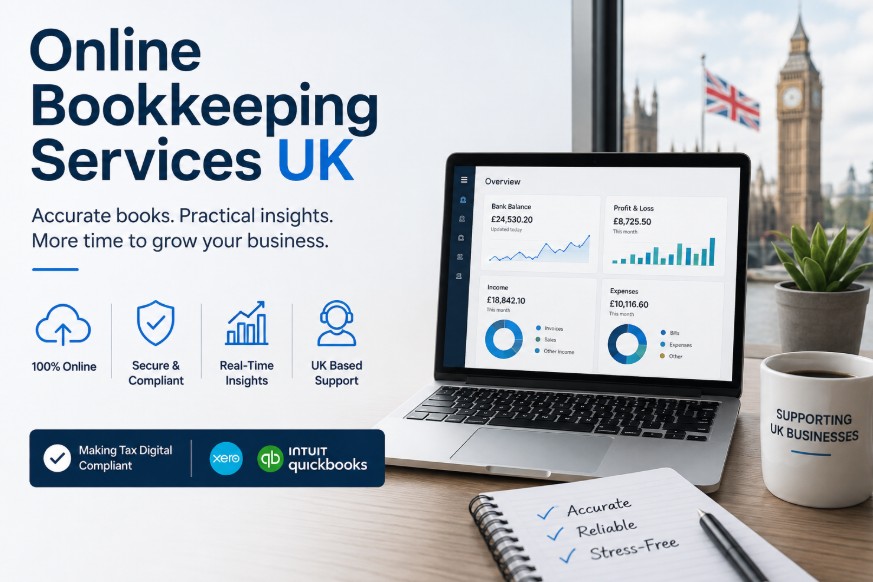
Online bookkeeping services in the UK provide small business owners with cloud-based daily financial record-keeping, bank reconciliations, VAT reporting, and payroll management through automated software paired with certified human bookkeepers.
These digital solutions streamline real-time cash flow monitoring, ensure statutory compliance with HM Revenue & Customs, and eliminate manual paper processes.
Key Takeaways
-
Professional online bookkeeping services across the UK typically cost between £100 and £950 per month depending on transaction volumes.
-
Certified online bookkeepers oversee day-to-day transaction entry, bank reconciliations, and routine Making Tax Digital submissions to HMRC.
-
Modern cloud platforms integrate directly with mobile receipt-scanning software to maintain audit-ready digital accounting records.
-
Digital bookkeeping solutions ensure continuous compliance with HM Revenue & Customs regulations for UK limited companies and sole traders.
What Is Online Bookkeeping?
Online bookkeeping refers to the practice of managing, recording, and reconciling a business’s financial transactions using secure cloud-based software, managed remotely by certified professionals.
Rather than relying on physical ledgers or desktop spreadsheets stored on a single office computer, online bookkeeping centralises financial data in the cloud.
This allows business owners and qualified bookkeepers to access real-time ledgers, collaborate instantly, and automate routine tasks like bank statement parsing and receipt archiving from any location.
How Does It Work?
The online bookkeeping workflow relies on a continuous digital cycle that connects business operations directly to the financial ledger:
-
Automated Data Feeds: Business bank accounts, credit cards, and payment gateways (such as Stripe or PayPal) are securely linked via open banking APIs to cloud platforms like Xero or QuickBooks, pulling transaction feeds daily.
-
Digital Document Capture: Paper receipts, bills, and invoices are snapped via mobile applications or emailed directly into receipt-processing tools (like Dext or Hubdoc), which use Optical Character Recognition (OCR) to extract dates, supplier names, totals, and VAT breakdowns automatically.
-
Ledger Matching & Categorisation: Software algorithms attempt to match incoming receipts with bank transactions. A certified human bookkeeper then reviews these suggestions, assigns correct nominal codes, handles supplier payments, and resolves anomalies.
-
Compliance & Reporting: Once the ledger is reconciled, structured reports (Profit and Loss, Balance Sheet) update instantly, and Making Tax Digital (MTD) compliant returns or VAT payments are compiled for HMRC submission.
Best Online Bookkeeping Services Providers
The top online bookkeeping providers in the UK include Sleek, Crunch, Mazuma, The Accountancy Partnership, QuickBooks Live, MyIVA, CoxHinkins, E2E Accounting, QX Accounting, and Makesworth Accountants, offering tiered packages ranging from £100 to over £950 per month.
| Provider | Best For | Key Feature | Pricing Model & Starting Cost |
| Sleek | Growing Startups & SMEs | Unified digital platform combining bookkeeping, corporate secretarial, and tax filing. | Fixed monthly retainers (from £60/mo billed annually) |
| Crunch | Freelancers & Contractors | Proprietary software paired with unlimited real-time advice from in-house accountants. | Free tier; Software from £10+VAT/mo; Bundled accountant plans from £21.60+VAT/mo |
| Mazuma | Micro-Businesses | Traditional purple envelope postal receipt service combined with a fully digital cloud backend. | Low-cost flat monthly fee (from £38+VAT/mo) |
| The Accountancy Partnership | Small Businesses | Dedicated online accounting portal supported by fixed-fee bookkeeping and year-end statutory accounts. | Transparent fixed pricing (from £24.50/mo for sole traders, £39.50/mo for limited companies) |
| QuickBooks Live | Quick Backlog Cleanups | Direct matching with dedicated, certified virtual bookkeepers inside the native QuickBooks ecosystem. | Add-on monthly subscription |
| MyIVA | Modern Entrepreneurs | Paperless, cloud-based solution bridging low-cost software with human support. | Fixed monthly pricing |
| CoxHinkins | Growth-Minded SMEs | Forward-looking management reporting and strategic KPI tracking. | Tailored fixed retainers |
| E2E Accounting | Seamless Compliance | Smooth transition from day-to-day ledger tasks to year-end statutory corporation tax filing. | Package-based tiers |
| QX Accounting | High-Volume Scaling | Enterprise-grade processing power capable of managing massive transaction spikes without lag. | Volume-based pricing |
| Makesworth Accountants | Full-Service Outsourcing | UK-chartered practice offering an end-to-end outsourced finance function with high flexibility. | Flexible modular pricing |
1. Sleek
Sleek provides an all-in-one digital corporate administration and cloud bookkeeping infrastructure tailored for modern businesses operating in the UK. It integrates real-time transaction tracking with company secretarial maintenance to streamline compliance and day-to-day ledger management.
- Pros:
- Permanent free bookkeeping software tier available for very early-stage independents.
- Built-in dividend planners, salary vs. dividend optimization calculators, and unlimited human advisor access on premium tiers.
- Cons & Considerations:
- The free plan displays advertisements and lacks support for Making Tax Digital (MTD) quarterly submissions or open-banking bank feeds.
- Mandatory core add-ons for VAT processing and PAYE payroll can quickly escalate monthly outlays.
2. Crunch
Built specifically around the workflows of sole traders, freelancers, and limited company contractors, Crunch pairs intuitive expense-tracking and invoicing software with access to real, qualified human advisors.
- Pros:
- Permanent free bookkeeping software tier available for very early-stage independents.
- Built-in dividend planners, salary vs. dividend optimization calculators, and unlimited human advisor access on premium tiers.
- Cons & Considerations:
- The free plan displays advertisements and lacks support for Making Tax Digital (MTD) quarterly submissions or open-banking bank feeds.
-
Mandatory core add-ons for VAT processing and PAYE payroll can quickly escalate monthly outlays.
3. Mazuma
Mazuma offers a streamlined, low-friction digital bookkeeping service designed primarily for micro-businesses and small enterprises seeking predictable overheads. It blends modern cloud dashboards with a hybrid purple envelope system.
- Pros:
- Unique physical hybrid approach allows less digitally inclined owners to mail paper receipts directly using purple envelopes for offsite scanning and processing.
- All-inclusive flat-fee structure covers monthly bookkeeping, statutory year-end accounts, and one Self Assessment tax return.
- Cons & Considerations:
- Less customizable or scalable for complex e-commerce merchants handling heavy multi-currency transactions.
- Traditional physical mail-in workflows introduce processing latency compared to automated, real-time open banking API feeds.
4. The Accountancy Partnership
This provider focuses on delivering comprehensive small-business packages that bundle daily bookkeeping, VAT submissions, and statutory year-end compliance while eliminating billable-hour anxiety.
- Pros:
- Clients receive complimentary access to Pandle, their proprietary, user-friendly cloud bookkeeping software designed specifically for small businesses.
- Highly transparent, predictable fixed-fee pricing model backed by a designated single point of contact.
- Cons & Considerations:
- Specialized operational requirements, such as standalone payroll management or quarterly MTD updates, incur separate, non-bundled charges.
5. QuickBooks Live
QuickBooks Live embeds certified virtual bookkeepers directly into the user’s native QuickBooks software interface, acting as a powerful tool for businesses trying to straighten out messy historical records.
- Pros:
- Direct, real-time collaboration with certified virtual experts embedded directly inside the native QuickBooks software user interface.
- Exceptionally efficient service tier for clearing months of unreconciled bank feeds and messy historical backlogs.
- Cons & Considerations:
- Deeply locked into the proprietary QuickBooks ecosystem; migrating accounting infrastructure away later introduces major friction.
- Ongoing subscription fees scale upward automatically as business transaction volumes and inventory thresholds expand.
6. MyIVA
MyIVA fills the gap between expensive manpower and standalone software by offering a paperless, cloud-driven bookkeeping model tailored for modern entrepreneurs.
- Pros:
- Completely paperless onboarding and management framework that heavily reduces administrative overhead without sacrificing data accuracy.
- Seamless integration with major open-banking APIs ensures daily transaction flows update automatically in real time.
- Cons & Considerations:
- Completely digital infrastructure lacks the physical mail-in document handling options provided by competitors like Mazuma for cash-heavy or paper-reliant small businesses.
7. CoxHinkins
CoxHinkins shifts the focus of bookkeeping from past data recording to a springboard for future corporate growth, specializing in strategic management accounting and KPI tracking for expanding SMEs.
- Pros:
- Advanced financial analytics and management reporting give leadership teams deep operational visibility to drive strategic growth.
- Ideal advisory depth for expanding scale-up businesses that require commercial insight far beyond standard regulatory compliance.
- Cons & Considerations:
- Premium cost structure and bespoke scope make it entirely unsuitable for micro-startups, sole traders, or lifestyle freelancers with low transaction volumes.
8. E2E Accounting
E2E Accounting is built around a comprehensive end-to-end service framework bridging everyday bookkeeping with final corporate tax submissions.
- Pros:
- Structured framework ensures a seamless, error-free data handover when shifting from day-to-day ledger maintenance to annual statutory corporation tax filing.
- Consistently praised in client reviews for rapid support responsiveness and clear milestone tracking.
- Cons:
- Package-based structure offers less granular modular flexibility compared to competitors that let users pick individual à la carte services.
9. QX Accounting
QX Accounting is engineered for fast-growing small-to-medium businesses handling heavy, high-volume transaction loads daily.
- Pros:
- High-performance data processing architecture specifically engineered to prevent system lags or processing bottlenecks during peak commercial traffic spikes.
- Enterprise-grade multi-sector capabilities capable of scaling alongside rapid operational expansion.
- Cons:
- Massively over-resourced and financially prohibitive for sole traders, freelancers, or low-volume service businesses.
10. Makesworth Accountants
Makesworth combines the credibility of a UK-chartered practice with the flexibility of an outsourced finance function.
- Pros:
- Combines the professional rigor and legal security of a UK-chartered accountancy practice with the flexibility of an outsourced finance department.
- Comprehensive advisory scope spans routine payroll management all the way to complex multi-tier corporate tax planning.
- Cons:
- Heavy corporate advisory focus and institutional structure can feel overly formal or intimidating for early-stage lifestyle freelancers.
Is Online Bookkeeping Legit and Safe for UK Businesses?
Yes, online bookkeeping is fully legitimate and safe in the UK when providers maintain Anti-Money Laundering (AML) supervision, UK GDPR compliance via ICO registration, and professional body certifications such as ICB or AAT.
| Compliance Layer | Core Requirement | Verification Standard |
| Data Protection | UK GDPR / Data Protection Act 2018 | ICO Registration |
| Financial Supervision | Money Laundering Regulations (MLR) | HMRC or Body Supervision |
| Professional Qualifications | Recognized Professional Standards | ICB / AAT Membership |
| Ledger Security | 256-bit SSL Encryption & MFA Access | SOC 2 / ISO 27001 |
Essential Regulatory Standards to Verify
-
Anti-Money Laundering (AML) Supervision: Under UK law, any entity providing bookkeeping services must be supervised for AML compliance by an approved professional body or directly by HM Revenue & Customs (HMRC).
-
Data Security (UK GDPR): Digital platforms must enforce end-to-end encryption, multi-factor authentication, and comply with the UK Data Protection Act 2018, backed by active Information Commissioner’s Office (ICO) registration.
-
Professional Credentials: Trustworthy firms hold practising certificates from established bodies such as the Institute of Certified Bookkeepers (ICB) or the Association of Accounting Technicians (AAT).
In practice, a growing UK e-commerce retailer transitioning from a local spreadsheet to an AML-regulated online bookkeeping firm eliminated annual reconciliation discrepancies by establishing automated bank feeds and enforcing strict digital audit trails across multi-currency channels.
What Is the Difference between Bookkeeper and Accountant?
Bookkeepers systematically record day-to-day financial transactions, reconcile bank statements, and manage invoices, whereas chartered accountants use those balanced books to perform tax planning, corporate structuring, and statutory year-end submissions.
| Feature | Online Bookkeeper | Chartered Accountant |
| Primary Focus | Daily recording & operational data | Tax strategy & year-end compliance |
| Key Deliverables | Bank reconciliations, VAT, invoices | Statutory accounts, CT600 tax |
| Standard Service Rates | £20 – £50 per hour | £100 – £250+ per hour |
| Software Utilization | Continuous daily input & processing | Periodic review & tax filing |
| Primary Value Proposition | Accurately maintained financial logs | Tax minimization & advice |
Cost Advantages of a Dual Approach
Hiring an accountant at £150 or more per hour to handle basic receipt sorting and bank matching wastes valuable capital.
Delegating daily entry to an online bookkeeping service operating at lower rates ensures that your ledger remains balanced year-round.
When tax season arrives, your accountant receives clean, error-free books, reducing overall billable hours for annual return submissions.
How Much Do Online Bookkeeping Services Cost in the UK?
Online bookkeeping services in the UK typically range from £100 to £200 per month for sole traders, £200 to £450 per month for growing small businesses, and £450 to £950+ per month for complex e-commerce SMEs.
| Tier / Service Level | Typical Business Profile | Hourly Rate | Monthly Retainer |
| Sole Trader / Freelance | Low volume (< 50 transactions/mo) | £18 – £30 / hour | £100 – £200 / mo |
| Growing Small Business | Standard (50–150 transactions/mo) | £30 – £45 / hour | £200 – £450 / mo |
| Complex SME / E-Commerce | High volume (> 150 transactions) | £45 – £75+ / hour | £450 – £950+/ mo |
Variables Driving Monthly Service Fees
-
Transaction Volume: High invoice counts or frequent micro-transactions increase data verification workload.
-
VAT Registration Status: Managing standard scheme VAT, Flat Rate Scheme, or partial exemption calculations adds technical steps.
-
Payroll Processing: Running monthly PAYE calculations, pension auto-enrolment, and issuing payslips adds predictable fixed fees.
-
Catch-Up Requirements: Cleaning up months of backlog data before establishing regular maintenance incurs one-off onboarding fees.
How to Shift Your Business Operations to Cloud Bookkeeping?
Transitioning to cloud bookkeeping involves auditing existing financial files, selecting HMRC-compliant software like Xero or QuickBooks, setting up open-banking live feeds, and onboarding an AML-supervised bookkeeping partner.
-
Audit Existing Financial Files: Gather historical bank statements, open sales invoices, unpaid supplier bills, and previous tax filings.
-
Select an HMRC-Compatible Cloud Software: Choose a cloud platform such as Xero, QuickBooks Online, or FreeAgent that fits your operational needs.
-
Establish Live Digital Bank Feeds: Securely link your UK business bank accounts to feed daily transaction records into the cloud platform automatically.
-
Deploy Document Processing Tools: Install mobile capture tools like Dext or Hubdoc across team mobile devices to scan receipts instantly.
-
Appoint an AML-Supervised Online Service: Onboard a qualified bookkeeping partner to configure your chart of accounts, verify data matches, and run monthly reconciliations.
-
Establish Monthly Review Routines: Schedule regular reviews of key financial reports, including profit and loss statements, balance sheets, and aged debtor reports.
How to Choose the Right Online Bookkeeping Service for Your UK Business?
Selecting an online bookkeeping service requires verifying professional credentials (ICB/AAT), checking Anti-Money Laundering (AML) registration, and confirming software stack compatibility with platforms like Xero or QuickBooks.
| Verification Stage | Key Question / Requirement | Status / Confirmation |
| Professional Credential | Are key staff certified by ICB or AAT? | [ ] Verified |
| Regulatory Oversight | Is the provider registered for AML? | [ ] Verified |
| Platform Accreditation | Are they certified in Xero/QuickBooks? | [ ] Verified |
| Data Protection | Is the firm registered with the ICO? | [ ] Verified |
| Pricing Scope | Are VAT, payroll, and catch-up included? | [ ] Clarified |
Core Selection Criteria
-
Software Specialisation: Ensure your service provider holds formal partner certifications in your chosen software.
-
Transparent Service Scope: Confirm what is included in the monthly retainer fee, checking specifically for VAT return preparation, Construction Industry Scheme (CIS) filings, or catch-up work.
-
Communication Standards: Check whether the package provides dedicated account managers, email turnaround windows, or scheduled telephone consultations.
For instance, a fast-growing UK consulting firm selected an AAT-certified online service that integrated directly with Xero. This setup automated their recurring monthly client billing and gave their remote team clear, up-to-date visibility into open accounts.
Conclusion
Outsourcing day-to-day accounts to an online bookkeeping service gives UK small businesses accurate real-time ledgers, stress-free statutory tax compliance, and clear cash flow visibility.
By combining cloud software with human oversight, small business owners can streamline their financial routines and focus on scaling their business.
Next Steps to Streamline Your Finances
-
Calculate Transaction Volume: Estimate your monthly volume of sales invoices, bills, and bank line items.
-
Review Current Software: Confirm whether your accounting software is HMRC-recognised for MTD reporting.
-
Compare Qualified Providers: Request proposals from AML-supervised, ICB- or AAT-accredited online bookkeeping services to establish a clear fixed-fee retainer.
Disclaimer: This guide is for informational purposes only and does not constitute formal financial, legal, or tax advice.
FAQ
Do I need an online bookkeeping service if I already use Xero or QuickBooks?
Yes. Software records data, but a certified bookkeeper ensures entries are accurately classified, reconciles bank accounts, manages exceptions, and keeps your records compliant with HMRC rules.
How much do online bookkeeping services cost in the UK?
Packages for small businesses typically range from £100 to £450 per month, depending on overall transaction volumes, VAT obligations, and additional services like payroll management.
Is online bookkeeping safe and secure for UK small businesses?
Yes. Reputable providers use bank-grade 256-bit encryption, strictly follow UK GDPR rules, register with the ICO, and maintain anti-money laundering supervision.
Can an online bookkeeper file my VAT returns directly with HMRC?
Yes. Authorised online bookkeepers can act as your registered agent, filing Making Tax Digital (MTD) compliant VAT returns directly to HMRC on your behalf.
How do I send my physical receipts to an online bookkeeper?
You capture physical receipts instantly using mobile apps like Dext or Hubdoc. These apps extract receipt details automatically and link the digital image to your cloud software ledger.
What qualifications should I look for in a UK online bookkeeper?
Look for practicing members of recognized professional organizations such as the Institute of Certified Bookkeepers (ICB) or the Association of Accounting Technicians (AAT), alongside active AML supervision.






2 Comments