What Is a Private Limited Company: Complete Guide to Incorporation, Tax, Liability for UK Business Owners
A private limited company is a highly popular legal structure used to incorporate a business in the United Kingdom. Choosing to establish this structure creates a completely distinct legal entity that exists independently from the individuals who own or manage it.
Key Takeaways
-
Incorporating a limited company establishes a distinct legal identity that entirely separates business debts from the personal assets of the owners.
-
Business owners must register the company directly with Companies House and pay a standard online setup fee of one hundred pounds in the UK.
-
Incorporated businesses are required to pay UK Corporation Tax on all taxable profits up to a maximum main rate of twenty-five percent as of 2026.
-
Registered company directors must pass mandatory identity verification checks under updated transparency legislation enforced by Companies House.
What is a private limited company?
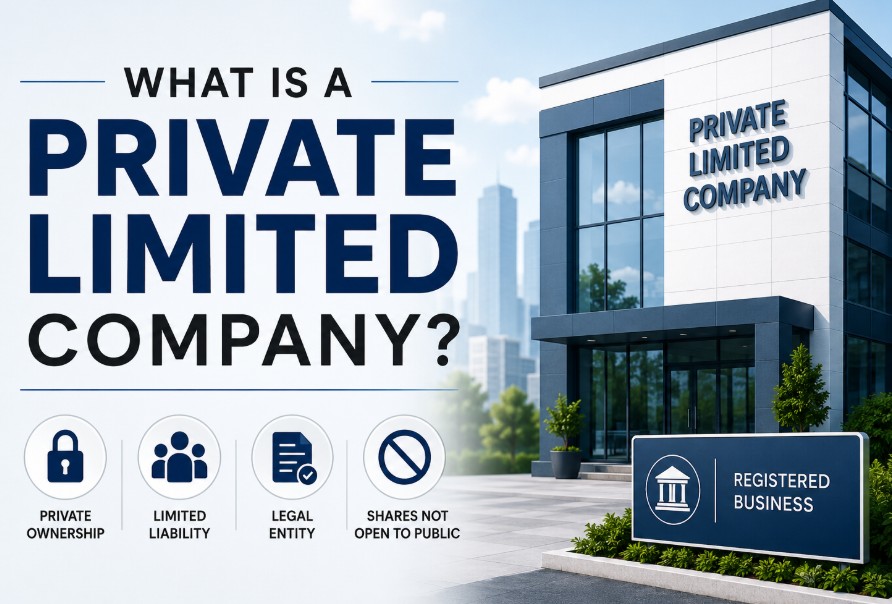
A private limited company is an independent legal entity registered at Companies House that limits the financial liability of its shareholders to the value of their invested shares. This legal framework ensures that the personal wealth, property, and assets of the business owners remain legally protected if the company faces insolvency or litigation.

How does a private limited company work?
A private limited company works by creating a corporate veil that separates the business from its owners.
The company manages its own affairs, such as hiring staff and signing contracts, while the owners (shareholders) and managers (directors) operate within the framework of the Companies Act.
If the company incurs debt, creditors generally pursue the company’s assets, not the owners’ personal property.
The Corporate Veil and Legal Independence
Once incorporated, a private limited company exists as a separate legal person. It holds the autonomy to own assets, enter into binding contracts, employ staff, and face litigation in its own name, independent of the individuals who manage or own it.
Limited Liability Protection
The limited status serves as a financial firewall. Shareholder liability is capped at the value of their shareholdings. In the event of insolvency, your personal assets like homes and savings are shielded from creditors.
Management vs. Ownership
While shareholders possess ownership through equity and voting rights, directors oversee day-to-day operations and governance. In small businesses, one person often serves as both sole director and sole shareholder, maintaining total control within the formal corporate framework.
Regulatory Compliance and Transparency
Companies must maintain transparency by filing financial accounts and confirmation statements. Under 2026 mandates, directors and Persons with Significant Control must undergo rigorous identity verification. This ensures the public register remains accurate and secure against fraud.
What are the two types of private limited companies in the UK?
The two primary categories of private limited companies in the UK are companies limited by shares, which are used for commercial, profit-driven ventures, and companies limited by guarantee, which are typically used for non-profits and community groups.
Company limited by shares
The vast majority of commercial, profit-driven small businesses in the UK choose this arrangement. Shareholders own a portion of the business relative to the nominal value of the shares they hold and are entitled to receive a portion of the profits via dividends.
Company limited by guarantee
This structure does not possess share capital or traditional shareholders. It is formed by members who act as guarantors, promising to contribute a specific, nominal sum, usually £1, toward company debts if it undergoes liquidation. This is typically used for non-profits, charities, and community groups.
What are the advantages of a private limited company?
The advantages of a private limited company include ring-fenced personal assets, tax planning flexibility through dividends, enhanced commercial credibility, perpetual succession, and the ability to attract external capital more easily than a sole trader.
-
Ring-fenced Personal Assets: Your personal property is legally insulated from business debts. Creditors generally cannot pursue your home or private savings, limiting your risk to the value of your shares.
-
Tax Planning Flexibility: Companies are subject to Corporation Tax rather than personal income tax on all earnings. This allows you to retain profit for reinvestment or extract it efficiently via a combination of dividends and salary.
-
Enhanced Commercial Credibility: The Ltd suffix projects a professional image, which is often a prerequisite for securing contracts with large corporations, government agencies, and institutional suppliers.
-
Perpetual Succession: The company survives independently of its directors and shareholders. Ownership can be transferred, or shares inherited, without disrupting the continuity of business operations.
-
Access to Capital: The structure makes it easier to bring on new investors or shareholders, facilitating long-term business growth and scaling that is more difficult for sole traders.

What are the disadvantages of a private limited company?
The primary disadvantages include the requirement for public disclosure of financial information, increased administrative burdens, strict adherence to Companies Act governance rules, the cost of professional accounting services, and the mandatory identity verification processes required for all directors.
-
Public Disclosure: Your business information, including annual accounts, registered office address, and director details, is published on the public record. This removes the anonymity enjoyed by sole traders.
-
Complex Administrative Requirements: You must meet strict deadlines for filing financial accounts and confirmation statements. Failure to comply results in financial penalties and potential strike-off.
-
Mandatory Identity Verification: All directors and Persons with Significant Control must complete a rigorous identity verification process with Companies House. This is a non-negotiable step to comply with 2026 transparency laws.
-
Higher Professional Costs: Due to the regulatory nature of the structure, you will likely require the services of a qualified accountant or professional advisor to manage filings, payroll, and tax returns correctly.
-
Strict Governance Rules: Directors are bound by specific legal duties under the Companies Act. You must act in the company’s best interest and adhere to formal procedures for making major business decisions.
What is the difference between a private limited company and a public limited company?
A private limited company (Ltd) is a business structure that restricts share ownership to pre-approved individuals and cannot offer shares to the general public, whereas a public limited company (PLC) is a larger entity specifically structured to offer its shares openly on public stock exchanges.
While both provide limited liability protection, they differ significantly in their capital requirements, governance, and transparency mandates.
| Feature | Private Limited Company (Ltd) | Public Limited Company (PLC) |
| Share Offering | Privately held; cannot offer to the public | Shares traded openly on public stock exchanges |
| Minimum Directors | Minimum of one director required | Minimum of two directors required |
| Minimum Capital | No statutory minimum required | Minimum nominal share value of £50,000 |
| Company Secretary | Not legally required | Legally required |
| Financial Disclosure | Standard annual accounts filed | Intensive, audited financial disclosure |
| Primary Suffix | Designated by Ltd or Limited | Designated by PLC |
| Trading Ability | Cannot trade shares on the stock market | Eligible to list on stock exchanges |
What tax does a private limited company pay in the UK?
A private limited company pays UK Corporation Tax on all taxable profits. Rates currently start at 19% for profits under £50,000, with a tapered marginal relief rate for profits up to £250,000. Profits exceeding this threshold are taxed at the 25% main rate.
| Profit Threshold | Applicable Corporation Tax Rate | Strategic Impact |
| Profits under £50,000 | Small Profits Rate of 19% | Favourable for micro-businesses and start-ups |
| Profits between £50,000 and £250,000 | Marginal Relief Tapered Rate | Marginal rate adjusts dynamically as profit climbs |
| Profits exceeding £250,000 | Main Rate of 25% | Applies to high-earning entities and mid-sized firms |
To extract money efficiently, business owners often employ a balanced remuneration strategy. Directors typically pay themselves a small salary via the Pay As You Earn system that remains below the National Insurance threshold, minimizing payroll tax.
The remaining business distributions are drawn as dividends, which carry lower tax rates than standard income bands and remain entirely free from National Insurance contributions.
Additionally, if the total value of commissionable sales crosses the mandatory £90,000 threshold within a twelve-month rolling period, the company must register for Value Added Tax.

Who is the owner of a private limited company?
The legal owners of a private limited company are its shareholders, who hold equity in the form of shares that grant them voting rights and entitlements to dividends.
While these shareholders own the company, directors are the individuals appointed to manage the business, and anyone holding more than 25% of the shares or voting rights is officially registered as a Person with Significant Control (PSC).
How do you set up a private limited company?
To set up a private limited company, you must register your company with Companies House via the official Gov.uk digital portal, appoint directors and shareholders, provide a registered office address, and pay a standard £100 incorporation fee.
- Select an available business name: Check the Companies House register to ensure the chosen name is unique and does not contain sensitive terms or infringe on existing trademarks.
- Appoint your corporate officers: Identify the initial directors and shareholders, ensuring every individual completes the mandatory identity verification required under 2026 guidelines.
- Establish a registered office address: Provide a physical UK address where official government correspondence and legal notices can be delivered and displayed on the public record.
- Prepare the constitutional documents: Adopt the Memorandum of Association and the Articles of Association to outline the internal operational rules and share structures of the business.
- Submit the application to Companies House: File the formal application online through the official Gov.uk incorporation service and pay the statutory registration fee.
- Register for business taxes: Set up the corporate tax profiles with HM Revenue and Customs for Corporation Tax, Pay As You Earn payroll, and Value Added Tax within three months of trading.
Conclusion
Selecting the optimal framework for a business is a balance between mitigating risk and managing administrative responsibilities. Incorporating a limited company delivers unparalleled peace of mind through limited liability protections and unlocks powerful tax planning advantages as profits rise.
However, these clear benefits require a commitment to transparency, regular compliance filings, and strict financial tracking.
Business owners should review their annual financial forecasts and assess their operational risk threshold before finalizing their transition to an incorporated structure.
Disclaimer: This content is for informational purposes only and does not constitute formal legal or tax advice; please consult a qualified professional.
FAQ
Is a private limited company good for a brand new freelancer?
It depends entirely on your projected earnings and risk profile. Freelancers handling high-liability work or earning over fifty thousand pounds annually benefit from asset protection and tax efficiencies, while lower earners may prefer sole trader simplicity.
How much does it cost to set up a private limited company UK online?
Incorporating a business directly online through the official Gov.uk digital portal incurs a standard statutory registration fee of one hundred pounds. This fee covers the administrative processing costs required by Companies House.
Does registering with Companies House completely protect my business name?
Registration prevents another business from incorporating under that identical name. However, it does not offer absolute trademark protection, meaning external businesses can still trade under a similar name unless a formal trademark is registered.
Do I legally need a separate business bank account for an Ltd company?
Yes, you must maintain a separate corporate bank account. Because a limited company is a distinct legal entity, its corporate finances must never mix with the personal funds of the directors or shareholders.
What are the 4 types of business ownership in the UK?
The four primary commercial business models comprise Sole Traders, Partnerships, Limited Liability Partnerships, and Private Limited Companies. Each structure carries unique legal liabilities, filing duties, and tax systems for owners.
Can a private limited company have only one director?
Yes, a private company can legally operate with a single director who also serves as the sole shareholder, making it an ideal choice for independent contractors and solo business owners.
What happens to a private limited company if the owner passes away?
Because the company exists as a separate legal entity, it possesses perpetual succession. The business does not automatically dissolve; instead, the shares pass to the beneficiaries outlined in the deceased owner’s will.