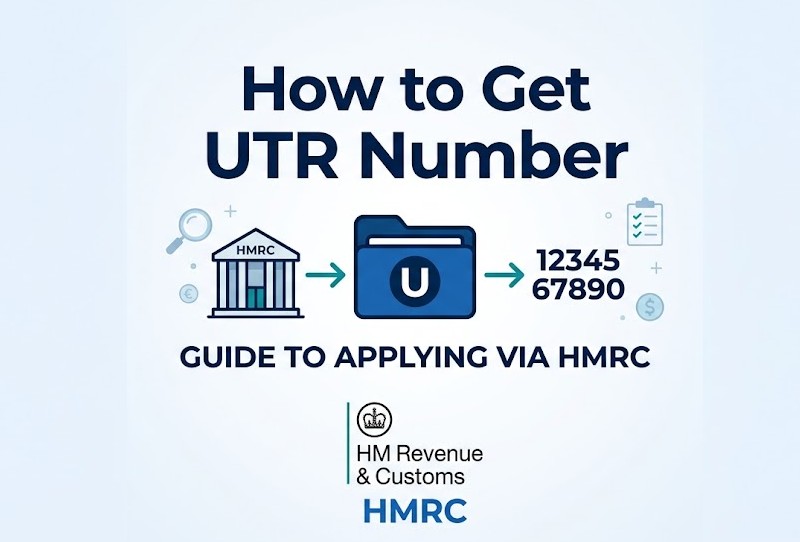
How to Get UTR Number? The HMRC Guide
Last Updated on
To register for Self Assessment and manage independent earnings, you must know how to get UTR number from the UK from HM Revenue and Customs (HMRC). This 10-digit identifier uniquely tracks your tax obligations.
The application process is completely free, and the fastest route is completed online through the official Government Gateway portal.
What is a UTR Number?
A Unique Taxpayer Reference (UTR) is a permanent 10-digit code issued by HM Revenue and Customs (HMRC) to individuals, partnerships, and limited companies in the UK.
It serves as a dedicated identifier to ensure that all your tax filings, payments, and correspondence map accurately to your specific account. Think of it as your official account number within the UK tax system.
How It Differs From Other UK Tax Identifiers?
It is entirely different from other common identifiers:
-
National Insurance (NI) Number: Tracks your state pension contributions and benefits, staying the same whether you are employed or running a business.
-
Tax Code: A shifting combination of letters and numbers used by employers to calculate Pay As You Earn (PAYE) deductions from a standard payslip.
How to Get UTR Number?
Applying for your tax identifier is entirely free of charge when handled directly through official public channels. While third-party agencies often charge between £30.00 and £100.00 to submit these applications, you can easily avoid this expense by applying yourself online.
| Verification Channel | Cost | Purpose | Accessibility |
| Official GOV.UK Portal | £0.00 (Free) | Direct registration and secure record creation | Available 24/7 online |
| Third-Party Agencies | £30.00 to £100.00 | Document checking and submission forwarding | Varied business hours |
Step-by-Step Online Application Process
-
Go to the official GOV.UK website and search for the Self Assessment registration portal.
-
Create a secure Government Gateway user ID using your email address. (Note: Creating a Gateway ID is just the identity phase; you must complete the next steps to actually trigger your UTR).
-
Confirm your identity by answering security questions based on your passport, credit file, or P60.
-
Select the correct registration path based on your specific operational structure (e.g., Sole Trader vs. Form SA1 for non-self-employed).
-
Input your personal contact details, National Insurance number, and details regarding your trade (including your official business startup date).
-
Review your information and submit the digital forms directly to HMRC. Save your submission confirmation reference number.
How to get UTR number for self-assessment as a sole trader?
To get a UTR number as a sole trader, you must register for Self Assessment as self-employed using form CWF1 on the GOV.UK portal. This registers your personal entity for both Income Tax and Class 2/4 National Insurance contributions simultaneously.
When you complete the self-employed track, HMRC links your new 10-digit code to your individual identity. Ensure this is completed by the mandatory deadline to prevent operational disruption.
How to get a company UTR number for limited companies?
A company UTR number is generated automatically by HMRC within 14 days of your business incorporating via Companies House. The corporate tax reference is physical documentation posted directly to the company’s registered office address.
When a business incorporates via Companies House, a separate legal entity is established. Companies House automatically shares this incorporation data with HMRC.
Consequently, a distinct Corporation Tax UTR is generated for the company itself. This corporate number is completely separate from any personal tax reference held by the directors.
Processing Times
Standard delivery timelines generally run between 10 and 15 working days for domestic UK addresses. The physical documentation containing your 10-digit number will be sent to your home or registered office address via Royal Mail.
During peak tax season (November to the final January filing deadline), processing queues lengthen. For international applicants living abroad, postal delivery can take 21 working days or longer.
What is Needed to Get a UTR Number?
To successfully execute your application online free of charge, gather the following verification and business details before you begin:
-
Personal Information: Your full legal name, current address history, and date of birth.
-
National Insurance Number: A valid UK National Insurance number.
-
Contact Details: An active personal email address and phone number to anchor your digital credentials.
-
Business Details: The exact date your independent business activities commenced.
-
Nature of Trade: Your specific business classification or type of work (e.g., plumbing, graphic design, consulting).
Who Needs a UTR Number?
You need a UTR number if you have any obligation to report untaxed income exceeding £1,000 to HMRC, if you incorporate a UK limited company, or if you earn high non-salary income from property, investments, or capital gains.
The structure of your business or income dictates how you register:
-
Sole Traders: If you are self-employed and earning untaxed income that exceeds the standard £1,000 tax-free trading allowance, you must get a UTR.
-
Limited Companies: When a business incorporates via Companies House, a distinct Corporation Tax UTR is automatically generated for the company itself. This corporate number is completely separate from any personal UTR held by the directors.
-
Individuals (Not Self-Employed): You may still need a UTR to report untaxed earnings via Self Assessment if you meet specific criteria detailed below.

Registering for Self Assessment
Individuals who are not self-employed must register for Self Assessment using Form SA1 if they receive untaxed income exceeding specific statutory thresholds set by HMRC. This includes landlords, high earners, and investors who do not run a formal trading business.
Common scenarios requiring individual registration include:
-
Property Income: Receiving gross income from rental properties exceeding £2,500 annually.
-
Investment Dividends: Earning significant annual dividend distributions from personal investments.
-
High Income Child Benefit Charge: Having an individual income over £60,000 while claiming Child Benefit.
-
Capital Gains: Needing to pay Capital Gains Tax on asset sales.
For these situations, individuals submit Form SA1 online to register for the tax return framework without marking themselves down as self-employed traders.
Why Getting a UTR Number is Important?
Operating without a UTR prevents you from completing essential regulatory duties, exposing you to immediate operational blocks and financial penalties.
-
Avoid Fines: Without a UTR, you cannot file an annual tax return or pay liabilities, leading to automatic late-filing fines starting at £100.
-
CIS Deductions: Contractors working within the construction sector will find that main contractors must deduct a higher 30% emergency tax rate from their payments, rather than the standard 20%, if a valid UTR cannot be verified through the Construction Industry Scheme (CIS) system.
-
Hiring an Accountant: You cannot formally appoint a professional to manage your accounts until this number exists. According to national independent accounting fee surveys, UK accountants (who charge anywhere from £150 to £450 for a basic return) require your UTR upfront to secure formal agent authorisation with HMRC.
- Operational Infrastructure: Once you have registered for your tax reference and built out your formal framework, you can begin unlocking proper financial tools for your venture. For instance, learning how to get a business credit card for a new business is a key step to help separate personal finances from corporate expenses while building your corporate credit rating.
-
Expense Compliance: Having your UTR organised simplifies complex tax assessments, such as applying the 24-month rule, which governs whether travel expenses to a temporary workplace remain tax-deductible.
What is the difference between an HMRC UTR and a 12-digit banking UTR?
Great confusion arises because the acronym UTR is shared across two entirely distinct financial systems. The table below highlights the key differences so you don’t mistake one for the other.
| Feature | HMRC UTR (Tax Reference) | Banking UTR (Transaction Reference) |
| Format | 10 digits (often displayed as two blocks of five, e.g., 12345 67890) | 12 characters/digits (alphanumeric depending on the financial institution) |
| Issuer | HM Revenue and Customs (HMRC) | Retail banks and financial institutions (e.g., State Bank of India) |
| Primary Purpose | To track personal Self Assessment or corporate tax obligations in the UK. | To trace, identify, and resolve issues with specific bank wire transfers. |
| Lifespan | Permanent. It stays tied to your identity for life, even if you stop trading. | Single-use. A unique code is generated per individual transaction. |
How can I check my UTR number online if I have lost it?
If you have lost your UTR number, you can check it online instantly by logging into your official personal HMRC online tax account or the HMRC App. It can also be found displayed clearly on any past tax returns, coding notices, or official correspondence from HMRC.
What should I do if I have lost my UTR number?
Check your digital portals immediately. Your 10-digit reference is permanently stamped across:
-
Your personal Government Gateway dashboard.
-
Your official Notice to File a Tax Return letter.
-
Any physical documentation received under the Construction Industry Scheme (CIS).
How do I find a company UTR number UK online?
A corporate tax reference cannot be looked up via public directories like the standard Companies House search tool.
To find it digitally, a director must log into the company’s dedicated Business Tax Account. Alternatively, check the physical Notice to file a Corporation Tax Return (Form CT603) originally posted to your registered business office.
How to get my UTR number by phone?
You can request your lost UTR number by calling the HMRC Self Assessment Helpline on 0300 200 3310 or by contacting HMRC VAT Customer Services for alternative support channels.
For data security reasons, helpline advisers will not read the 10-digit code aloud; instead, they will trigger an automated request to post a copy to your address.
When digital access fails, security protocols dictate that your identity must be verified over the phone first.
Once verified, the physical confirmation letter is dispatched via Royal Mail to the registered address held on your account.

What happens if I don’t have a UTR number?
Operating without a UTR number stops you from filing your mandatory annual tax return, exposes your business to immediate late-filing fines starting at £100, and subjects construction workers to higher 30% emergency tax deductions under CIS rules.
How do the 24-month rule and accountant costs impact your business?
Furthermore, you cannot formally appoint a professional to manage your accounts until this number exists.
When reviewing decisions, small businesses find that average UK accountant costs for preparing a basic self-employed tax return range from £150 to £450 according to trade association data; however, professionals require your tax reference upfront to secure formal agent authorisation with HMRC.
Having your paperwork organised also simplifies complex tax assessments, such as applying the 24-month rule, which governs whether travel expenses to a temporary workplace remain tax-deductible.
Summary of Next Steps for Your Business
The immediate next step for your business is to secure your 10-digit tax reference through GOV.UK, store it securely in your permanent company records, and use it to activate your online filing account before the annual October registration deadlines.
| Business Entity | Identifier Format | Primary Practical Purpose | Critical Registration Deadline |
| Sole Trader / Individual | 10 Numbers (e.g., 12345 67890) | Filing personal Self Assessment returns | 5 October following the end of the tax year |
| Limited Company | 10 Numbers (often in 5-digit blocks) | Filing annual Corporation Tax returns | Within 3 months of active trading |
Once your application is approved and your letter arrives, keep this document stored safely in your company records.
You will need it annually to file your tax returns, log into your tax portal, or collaborate with a professional accountant.
If you are approaching the autumn registration deadline, start your application online today to avoid processing queues and stay fully aligned with HMRC timelines.
FAQ about how to get UTR number?
Can I get my UTR number on the phone instantly?
No. HMRC cannot read your 10-digit reference aloud over the telephone due to strict privacy and security laws. Staff can only arrange for a physical copy to be sent to your registered address.
Do you have to pay to get a UTR number?
No, the registration process is entirely free of charge when completed directly through the official GOV.UK portal. Avoid any third-party websites that demand a fee for processing this application.
What does an HMRC UTR look like?
It is a unique 10-digit string of digits. It is sometimes displayed on official documentation divided cleanly into two blocks of five numbers, such as 98765 43210.
Does a UTR code expire if I stop trading?
The number remains permanently tied to your personal identity. If you close your business, HMRC will change your account status to inactive so returns are no longer expected, but the code reacts if you start trading again later.
Can my accountant apply for a UTR on my behalf?
Yes, an accountant can manage your registration if you formally appoint them as your tax agent. However, many business owners prefer to complete the quick online form themselves to avoid paying extra setup fees.
Where is the UTR number located on a tax return?
It appears in the top-right corner of physical Self Assessment forms, on official tax calculation statements, and within the notification letters sent to you by HMRC.
Is my UTR the same as my VAT registration number?
No, they are completely separate. Your tax reference manages your income tax or corporate profits, whereas a VAT number is a 9-digit code issued only if your turnover crosses the mandatory £90,000 threshold set by HMRC.