
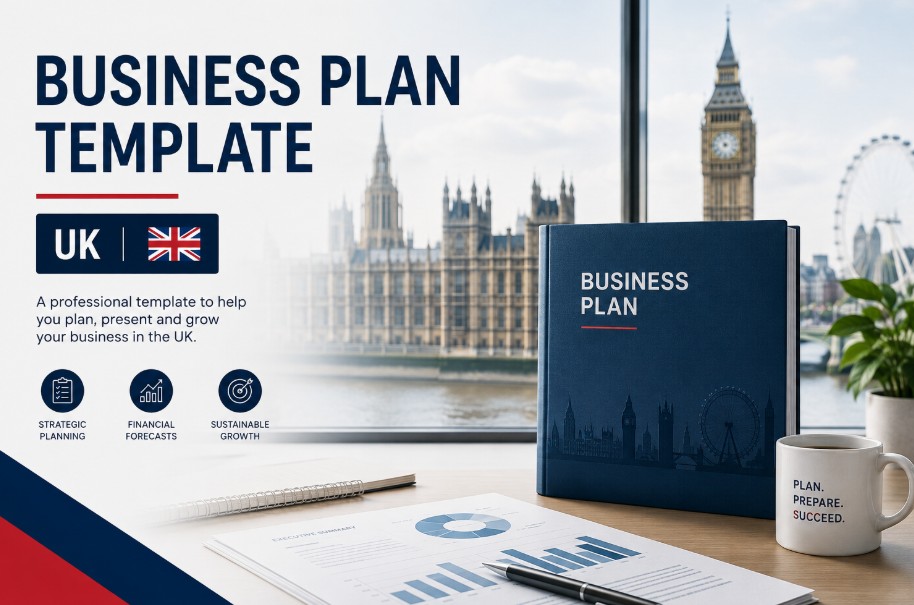
Business Plan Template UK: How to Draft a Bank-Ready Plan for Funding & HMRC
Securing a business plan template UK provides the structural foundation required to transform an entrepreneurial concept into a fundable, legally compliant commercial enterprise within the British market.
Launching a venture across England, Scotland, Wales, or Northern Ireland demands rigorous alignment with national regulatory bodies such as Companies House and HM Revenue and Customs.
This comprehensive resource delivers practical frameworks, precise financial forecasting methods, and actionable formatting options to streamline the enterprise development lifecycle.
Key Takeaways
-
Securing venture funding from British lending institutions requires a structured business plan that outlines clear financial forecasts and cash flow viability.
-
Operating a commercial venture demands strict adherence to HM Revenue and Customs guidelines regarding Unique Taxpayer Reference registration and tax reporting.
-
Choosing between a sole trader structure and a limited company through Companies House fundamentally impacts personal liability and tax efficiency.
-
Developing realistic cash flow projections over a three-to-five-year timeline mitigates operational risks and demonstrates market understanding to investors.
What is a Business Plan?
A business plan is a formal written document outlining a company’s commercial goals, operational strategies, target market, and financial projections.
In the UK, it serves as both an internal operational roadmap and an external pitch document required by high-street banks, angel investors, and regulatory bodies.
Crucially, structuring these growth plans early also establishes clear operational foundations if founders later decide on how to sell a business at maximum valuation.
A business plan details your business model, operational strategy, market analysis, financial forecasts, and organizational structure. Within the British commercial ecosystem, it bridges the gap between a raw business idea and an institution-ready proposal.

Why is a Business Plan Important for UK Startups?
A business plan is critical in the UK to secure capital from banks and government schemes, establish operational directions, mitigate market risks, and ensure full compliance with UK statutory obligations like VAT and UK GDPR.
A well-crafted business plan is critical for several key reasons:
-
Securing Funding & Investment: High street banks, angel investors, and government schemes like the Start Up Loans company mandate a comprehensive business plan before approving capital or loan applications.
-
Operational Direction: It provides clear direction for day-to-day operations, target milestones, and resource allocation.
-
Risk Mitigation: Forcing founders to research competitors, local regulations, and financial modeling uncovers blind spots before capital is deployed.
-
Compliance & Taxation Alignment: Ensures the business is structured to meet specific UK statutory obligations, such as VAT registration thresholds, workplace pensions, and UK GDPR laws.
What Are the Key Features to Note in a Business Plan?
Key features of a UK business plan include realistic financial models, market-specific nuances, regulatory readiness for HMRC/Companies House, and a clear value proposition tailored to British consumers.
When reviewing or drafting a business plan in the UK, make sure to look for these core characteristics:
-
Realistic Financial Models: Conservative cash flow projections, profit and loss (P&L) statements, and break-even timelines that account for local inflation and realistic wage expectations.
-
Market-Specific Nuances: Demonstration of local market dynamics, competitor positioning, and clear target audience buyer personas.
-
Regulatory Readiness: Explicit inclusion of statutory requirements, including required licenses, insurance coverage (e.g., Employers’ Liability), and tax registration details.
-
Clear Value Proposition: A straightforward statement explaining why customers in the UK market will choose your product or service over existing alternatives.
What to Include in the Business Plan?
A standard UK business plan must include seven foundational sections: Executive Summary, Company & Legal Structure, Products/Services, Market Analysis, Marketing & Sales Strategy, Operational Plan, and 3-to-5-Year Financial Forecasts.
-
Executive Summary: A high-level overview detailing your business vision, target audience, capital requirements, and projected return on investment.
-
Company & Legal Structure: Details of whether you are operating as a Sole Trader, Partnership, or Limited Company (Ltd), including your Companies House registration details.
-
Products and Services: An in-depth look at what you sell, pricing models, supply chain sourcing, and intellectual property.
-
Market & Competitor Analysis: Research into target demographics, industry size, local trends, and a SWOT analysis relative to UK competitors.
-
Marketing & Sales Strategy: Outlines channels for customer acquisition, digital marketing campaigns, and retention tactics. Mapping out clear strategies on how to advertise your business helps justify customer acquisition cost assumptions in your financial plan.
-
Operational Plan: Day-to-day operations, location details, technology infrastructure, staffing, and compliance policies (UK GDPR, insurance, health and safety).
-
Financial Plan & Forecasts: 3-to-5-year projections including startup costs, cash flow statements, P&L accounts, and a break-even analysis.
What Are the Best Formats for a Business Plan Template UK?
The best formats for a UK business plan template are Microsoft Word (.docx) for formal banking submissions, PDF (.pdf) for locking layouts, Google Docs for real-time team editing, and Microsoft Excel (.xlsx) for dynamic financial modeling.
Selecting the correct digital format ensures seamless collaboration, professional presentation compatibility, and effortless distribution to potential lenders or angel investors.
Different software environments offer distinct advantages depending on whether founders prioritize visual styling, numerical modeling, or collaborative drafting.
| Format Type | Primary Advantage | Best Use Case | Compatibility with Lenders |
| Microsoft Word (.docx) | High customizability and styling control | Comprehensive offline drafting | Universally accepted by banks |
| Portable Document Format (.pdf) | Preserves exact layout integrity across devices | Final submission to investors | Excellent for locked, professional presentation |
| Google Docs (.docx equivalent) | Real-time multi-founder collaboration | Cloud-based team writing sessions | Easily shared via secure web links |
| Microsoft Excel (.xlsx) | Advanced financial modeling and formulas | Detailed cash flow forecasting | Essential appendix for financial tables |

How Do Word and PDF Formats Compare for Funding Applications?
Word files (.docx) offer high editability and typography control ideal during drafting, whereas PDF files (.pdf) lock formatting across devices, making them the preferred standard for final bank and investor submissions.
A professional business plan template UK Word format allows extensive text manipulation, precise typographical control, and easy conversion into portable document formats for formal loan submissions.
When submitting final documentation to institutions like Barclays, NatWest, or the British Business Bank, converting the final Word file to PDF preserves layout integrity and prevents accidental editing.
Why Choose Google Docs and Excel for Modern Collaboration?
Contemporary startups rarely rely on a single author. Utilizing cloud-based applications enables founding teams to co-author strategy sections simultaneously while maintaining version history control.
Integrating a dynamic spreadsheet for balance sheets and profit-and-loss statements ensures that any adjustments to revenue assumptions automatically cascade through financial calculations.
How to Create a Plan Using a Business Plan Template UK
To build a business plan using a UK template: download an editable Word/Doc template, gather statutory business details, complete market/operational sections, build a 3-year Excel financial model, refine formatting to British English, and export to PDF.
Creating your plan using a tailored template keeps your drafting process efficient and compliant:
-
Download an Editable Template: Start with a verified UK-tailored format (Word or Google Docs) designed to meet British banking standards.
-
Gather Statutory Data: Have your business name, legal structure decision, UTR (if registered), and relevant industry codes (SIC codes) ready.
-
Tailor the Content: Fill out each section systematically, starting with the operational and market research sections before writing financial numbers.
-
Build the Financial Appendix: Input your startup expenses, monthly overheads, and realistic revenue assumptions into a linked Excel spreadsheet to generate standard 3-year cash flow models.
-
Refine and Format: Ensure uniform formatting, correct British English spelling, and check that all compliance considerations (e.g., pension auto-enrolment, VAT) are addressed.
-
Write the Executive Summary: Condense the key takeaways into a 1-to-2 page summary at the front of the completed document.
-
Export to PDF: Convert your final document into a PDF before submitting it to lenders or angel investors.
How Do Sector-Specific Templates Differ in the UK?
Sector-specific UK templates adjust operational focus and regulatory requirements: retail focuses on footfall and inventory; property focuses on Section 24 tax and EPC ratings; agriculture targets Defra grants; non-profits track Charity Commission rules.
Different commercial sectors demand distinct structural emphasis within a standard planning framework. Retail enterprises prioritize inventory management and footfall analysis, whereas digital service agencies focus on recurring subscription models and client acquisition costs.
| Sector Focus | Key Operational Priority | Mandatory Regulatory Consideration | Unique Financial Metric |
| Small Business / Consultancy | Service delivery & client retention | Professional Indemnity Insurance | Billable Hour Rate & Margin |
| Buy-to-Let Property | Portfolio growth and rental yields | Section 24 tax rules and EPC ratings | Net Rental Yield and Mortgage LTV |
| Agricultural / Farm | Land management and seasonal cycles | Defra regulations and environmental grants | Gross Margin per Hectare |
| Charity / Non-Profit | Public benefit and donor acquisition | Charity Commission registration rules | Voluntary Income vs. Operating Cost |
How Does a Small Business Plan Template UK Serve General Startups?
A general small business layout focuses heavily on service delivery, local market penetration, and scalable operational models.
For instance, when Sarah launched an independent boutique consultancy in Manchester, she utilized a standardized baseline framework that emphasized professional indemnity insurance, client retention milestones, and phased hiring projections to secure local credit union backing.

What Makes Specialized Formats Unique for Property, Agriculture, and Non-Profits?
Specialized formats incorporate unique operational metrics and legal compliance checks, such as Section 24 tax rules for real estate, Defra environmental standards for farms, and Charity Commission governance for non-profits.
Specialized sectors cannot rely on generic business plan structures:
-
Property: Must detail Section 24 tax changes, Energy Performance Certificate (EPC) compliance, and Loan-to-Value (LTV) ratios.
-
Agriculture: Must account for Department for Environment, Food & Rural Affairs (Defra) subsidies, environmental stewardship schemes, and seasonal cash flow fluctuations.
-
Non-Profits: Must demonstrate compliance with the Charity Commission, public benefit requirements, and grant management frameworks.
Can ChatGPT Write a Full Business Plan for Your UK Startup?
Artificial intelligence tools offer powerful assistance in generating initial drafts, structuring arguments, and refining professional phrasing.
However, relying entirely on automated text generation without human oversight often results in generic generalizations that fail to satisfy rigorous institutional lending criteria.
How to Leverage AI for Drafting While Maintaining Human Oversight?
In practice, founders use language models to brainstorm marketing angles, draft operational checklists, or summarize complex market research data.
When reviewing decisions made by automated generators, entrepreneurs must inject verified data regarding local competitor pricing, specific British supplier costs, and realistic regional wage expectations.
A common pattern is that unedited machine output lacks the specific local flavor and granular financial accuracy required by British high street bank managers.
What Are Common Pitfalls When Using an AI Business Plan Template UK?
Key AI business plan pitfalls include missing UK GDPR compliance, omitting mandatory auto-enrolment workplace pension costs, using US terminology/tax terms, and producing synthetic, untested financial models.
Automated AI systems frequently overlook region-specific compliance hurdles:
-
Failing to account for UK GDPR data handling requirements or ICO registration fees.
-
Omitting mandatory workplace pension auto-enrolment costs for growing UK teams.
-
Using US terminology (e.g., LLC instead of Limited Company, IRS instead of HMRC).
-
Relying on synthetic financial projections without stress-testing them against current UK inflation and interest rates.
Conclusion
Executing a successful commercial launch requires transforming strategic insights into actionable daily milestones.
Begin by downloading an editable Word or Google Docs framework, complete the foundational sections with verified local data, and stress-test your financial forecasts against realistic British market conditions before submitting documentation to lenders.
FAQ
What should a business plan include in the UK?
A comprehensive British business plan must include an executive summary, company description, market analysis, product details, marketing strategy, operational plan, and detailed three-year financial forecasts aligned with local tax regulations.
Where can I find a free business plan template UK download in Word or PDF?
Entrepreneurs can download free, verified templates from official enterprise support platforms, the British Business Bank finance hub, and reputable startup guidance portals offering standardized Word and PDF formats.
What are common mistakes in business plans that sink UK loan applications?
Common errors include overly optimistic revenue projections, failing to detail competitor analysis, omitting startup cost contingencies, and ignoring statutory compliance obligations like VAT thresholds.
Is a simple business plan template UK sufficient for high-street banks?
No, a simplified outline is not sufficient for banking applications. While basic templates work well for internal alignment, traditional UK high-street lenders and government-backed startup loan providers require rigorous financial appendices, cash flow forecasts, and comprehensive risk assessments.
Do I need a formal business plan to register with Companies House?
No, registering a limited company with Companies House requires basic administrative details and incorporation documents, whereas a formal business plan is only necessary when seeking external funding.
How many years of financial projections should a UK business plan cover?
Most UK funding institutions and angel investors expect a minimum of three years of detailed cash flow forecasts, profit and loss statements, and break-even calculations.
Is a sole trader business plan different from a limited company plan?
While the core sections remain identical, a sole trader plan focuses on personal liability management, whereas a limited company plan details corporate governance, shareholder structures, and director responsibilities.
Where can I find official UK government funding support?
Official funding guidance and low-interest startup loan options are primarily accessed through the British Business Bank and official regional growth hub networks across the nation.
Disclaimer: This guide is for informational purposes only and does not constitute formal financial, legal, or tax advice.




One Comment