
UK Dividend Tax Rates 2026/27: Complete Guide to HMRC Allowances, Bands, and Calculations
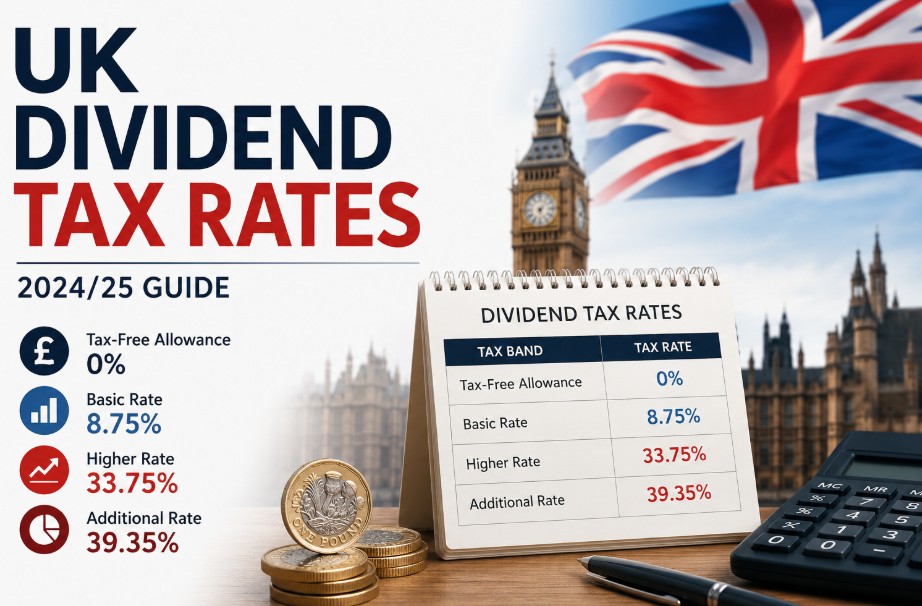
For the 2026/27 tax year, UK dividend tax rates stand at 10.75% for basic rate taxpayers, 35.75% for higher rate taxpayers, and 39.35% for additional rate taxpayers.
Dividend income is taxed above the statutory £500 tax-free Dividend Allowance and any remaining tax-free Personal Allowance.
Key Takeaways
-
Taxpayers receive a five hundred pound annual Dividend Allowance for 2026 27, which taxes eligible dividend income at a zero percent rate.
-
Dividend tax rates for the 2026 27 tax year are set at ten point seven five percent for basic rate and thirty-five point seven five percent for higher rate.
-
Shareholders receiving tax-free dividends inside a Stocks and Shares ISA retain complete immunity from HMRC dividend tax filing requirements.
-
Salary fills the lower tax bands first, meaning dividend income sits on top as the top slice of an individual’s total annual gross earnings.
What is a Dividend?
A dividend is a payment made by a limited company to distribute retained post-tax corporate profits to its shareholders. For business directors, dividends are a primary, tax-efficient way to extract profits alongside a base salary without paying National Insurance.
Corporate Profit Allocation Breakdown
When a company generates net profit after covering operating expenses and 19%–25% Corporation Tax, the board of directors splits the surplus into two pathways:
-
Retained Earnings: Kept in the business bank account to fund future operations, equipment, or growth reserves.
-
Dividend Payments: Issued directly to shareholding owners as personal income distributions.

What Dividends Are Taxed in the UK?
Most direct profit distributions from UK or foreign companies are subject to UK dividend tax once they exceed your personal tax allowances. However, dividends held within registered tax shelters like ISAs and SIPPs are 100% tax-exempt.
Taxable Dividend Distributions
The following dividend types must be declared and are subject to UK dividend tax rates (10.75%, 35.75%, or 39.35%) once they exceed your personal allowances:
-
Private Limited Company Dividends: Payments made to owner-directors or shareholders from accumulated distributable reserves.
-
Public Listed Share Dividends: Cash payouts from shares held in standard investment accounts or general trading accounts (GAs), note that selling these equity holdings separately may trigger Capital Gains Tax on shares.
-
Foreign Dividends: Distributions received from overseas companies (subject to Double Taxation Agreements and Foreign Tax Credit Relief).
-
Dividend Reinvestment Plans (DRIPs): Dividends that are automatically used to buy additional shares are still treated as cash income on the payment date and remain fully taxable.
Fully Exempt (Tax-Free) Dividends
Certain government-backed investment wrappers completely shelter dividend payments from HMRC taxation and reporting requirements:
-
Stocks and Shares ISAs: Dividends earned within an Individual Savings Account (up to the £20,000 annual contribution limit) are 100% tax-free.
-
Registered UK Pensions (SIPPs): Income generated within a pension structure accumulates without any immediate dividend tax liability.
-
Venture Capital Trusts (VCTs): Dividends from qualifying investments in UK VCTs are tax-exempt up to £200,000 per tax year.
What Are the UK Dividend Tax Rates for 2026 27?
UK dividend tax rates apply to all direct dividend distributions received by UK tax residents from domestic or foreign companies.
HMRC taxes dividend income using specialised rates that differ from standard Income Tax rates applied to employment earnings.
The lower percentages reflect the fact that company profits have already been subjected to UK Corporation Tax before distribution.
Tax Bands and Dividend Rates Table (2026/27)
| Income Tax Band | Total Annual Income Range | Standard Income Tax Rate | Dividend Tax Rate (Above £500 Allowance) |
| Personal Allowance | Up to £12,570 | 0% | 0% |
| Basic Rate | £12,571 to £50,270 | 20% | 10.75% |
| Higher Rate | £50,271 to £125,140 | 40% | 35.75% |
| Additional Rate | Over £125,140 | 45% | 39.35% |
Statutory Rates Across Recent Tax Years
The UK tax system has experienced several policy shifts regarding profit extraction. The table below details the historical progression of dividend tax rates and annual tax-free allowances set by HM Revenue & Customs:
| Tax Year | Dividend Allowance | Basic Rate | Higher Rate | Additional Rate |
| 2022/23 | £2,000 | 8.75% | 33.75% | 39.35% |
| 2023/24 | £1,000 | 8.75% | 33.75% | 39.35% |
| 2024/25 | £500 | 8.75% | 33.75% | 39.35% |
| 2025/26 | £500 | 10.75% | 35.75% | 39.35% |
| 2026/27 | £500 | 10.75% | 35.75% | 39.35% |
Regional Tax Interaction for Scottish Residents
Although the Scottish Parliament controls Scottish Income Tax bands on earned income, dividend taxation remains a reserved tax policy strictly managed by the UK Parliament.
Scottish taxpayers use Scottish Income Tax bands to determine their primary tax band, but apply the UK-wide UK dividend tax rates of 10.75%, 35.75%, or 39.35% to their dividend income.

Is the UK Dividend Allowance Tax Free for 26 27?
The UK Dividend Allowance is £500 for the 2026/27 tax year. Similar to how the Capital Gains Tax Allowance operates for asset sales, this allowance functions as a 0% tax band rather than an income deduction, meaning dividends within the allowance still count toward your total taxable income band limits.
How Is Dividend Tax Calculated in the UK?
Dividend tax is calculated using HMRC’s top-slice rule. Your non-dividend income (like salary or pension) uses up your £12,570 Personal Allowance and lower tax bands first.
Dividend income is placed on top of this salary stack, given a £500 tax-free allowance, and then taxed based on whichever band it falls into.
Step-by-Step Calculation Guide
Follow this standard process to calculate your exact dividend tax liability:
-
Calculate Total Gross Income: Add together all salary, profit distributions, and taxable income sources for the tax year.
-
Apply the Personal Allowance: Deduct the standard £12,570 Personal Allowance against non-dividend income first.
-
Position Dividend Income: Place remaining dividend earnings on top of your non-dividend earnings inside the tax bands.
- Subtract the Dividend Allowance: Deduct £500 from your total dividend income to calculate net taxable dividends.
- Apply Basic Rate Band: Tax remaining dividends up to the £50,270 total threshold at the 10.75% basic rate.
- Charge Higher Rate Band: Tax dividend portions between £50,271 and £125,140 at the 35.75% higher rate.
- Apply Additional Rate Band: Tax any dividend earnings exceeding £125,140 at the 39.35% additional rate.
Worked Examples
Scenario A: Small Business Director (£12,570 Salary + £25,000 Dividends)
-
Director Salary: £12,570 → Covered 100% by Personal Allowance (£0 tax paid).
-
Gross Dividends: £25,000 → Sits inside the basic rate band (£12,571 to £50,270).
-
Dividend Allowance: Deduct £500 → Taxable dividend balance = £24,500.
-
Tax Calculation: £24,500 × 10.75% = £2,633.75 total HMRC tax liability.
Scenario B: High-Earner Scenario (£12,570 Salary + £60,000 Dividends)
-
Total Gross Earnings: £72,570
-
Salary (£12,570): Uses Personal Allowance (£0 tax).
-
Remaining Basic Rate Space: £50,270 – £12,570 = £37,700 basic rate headroom.
-
Basic Rate Dividends: First £37,700 of dividends fills this space. Deducting the £500 allowance leaves £37,200 taxed at 10.75% = £4,000.00.
-
Higher Rate Dividends: Remaining £22,300 (£60,000 – £37,700) enters higher rate band taxed at 35.75% = £7,972.25.
-
Total HMRC Dividend Tax Liability: £4,000.00 + £7,972.25 = £11,972.25.
Warning: The £100,000 Personal Allowance Taper Trap
If your total adjusted net income exceeds £100,000, your £12,570 Personal Allowance drops by £1 for every £2 earned above £100k. At £125,140, your Personal Allowance becomes £0, creating an effective tax rate on dividends in that threshold of over 60%.
Are Foreign Dividends Taxed in the UK?
Yes, UK tax residents are taxed on their worldwide income, including dividends received from overseas corporations. Foreign dividends are added to your overall UK dividend income stack and taxed at standard UK dividend tax rates (10.75%, 35.75%, or 39.35%).
If foreign withholding tax was deducted at source by an overseas tax authority, UK taxpayers can generally claim Foreign Tax Credit Relief (FTCR) via their HMRC Self Assessment return.
This relief prevents double taxation by offsetting foreign taxes paid against your UK tax bill, up to the maximum equivalent UK tax rate.
How to Report and Pay Dividend Tax to HMRC?
Reporting depends on your dividend earnings: Under £500 requires no action. Dividends between £501 and £10,000 can be paid by adjusting your PAYE tax code or filing Self Assessment. Dividend earnings over £10,000 mandate formal Self Assessment registration.
Reporting Thresholds and Processes
The administrative requirements depend on your total gross dividend income per tax year:
| Dividend Income Level | Required HMRC Reporting Action |
| Up to £500 | No reporting required (covered by Dividend Allowance). |
| £501 to £10,000 | Contact HMRC directly to alter your PAYE tax code, OR register for Self Assessment. |
| Over £10,000 | Mandated formal registration and submission of a Self Assessment tax return. |
Essential Paperwork for Limited Company Directors
Under the Companies Act 2006, company directors issuing dividends must maintain three legal compliance steps:
-
Board Meeting & Minutes: Hold a formal meeting approving the profit declaration.
-
Solvency Test: Verify that the company has accumulated net retained profits (distributable reserves) before distributing cash.
-
Dividend Vouchers: Issue an official voucher to every shareholder detailing the payment date, company name, share count, and gross dividend amount.
How Can You Legally Reduce Dividend Tax in the UK?
You can minimize dividend tax exposure by contributing directly to an executive SIPP pension (100% CT deductible, 0% dividend tax), transferring company shares to a spouse to utilize two sets of allowances, and maximizing Stocks & Shares ISA contributions.
Comparison of Extraction Methods
The following table compares the fiscal mechanics of extracting £10,000 from a limited company using different distribution methods during 2026/27:
| Profit Extraction Method | Corporation Tax Relief | National Insurance Payable | Net Dividend Tax Payable |
| Basic Rate Dividend | None (paid from retained profit) | 0% | 10.75% (above allowance) |
| Higher Rate Dividend | None (paid from retained profit) | 0% | 35.75% (above allowance) |
| Executive Pension Contribution | Full CT deduction eligible | 0% | 0% (grows tax-sheltered) |
| ISA Share Portfolio Distribution | N/A (personal investment) | 0% | 0% (100% tax-free) |
Practical Optimization Strategies
-
Maximize Pension Contributions: Direct employer pension contributions made by your limited company into a SIPP are treated as allowable business expenses. This avoids Corporation Tax, National Insurance, and dividend tax entirely.
-
Spouse Shareholder Restructuring: Transferring company shares to a spouse or civil partner allows couples to utilise two Personal Allowances (£25,140 combined) and two Dividend Allowances (£1,000 combined), keeping more family profit within basic rate bands.
-
Capitalise on Stocks & Shares ISAs: Transferring general investment accounts into ISA wrappers ensures all ongoing dividend distributions remain completely tax-free.
Conclusion
Managing your dividend tax exposure requires balancing salary, profit extraction timing, and statutory allowances. To maintain full compliance while protecting your income:
-
Calculate your combined annual earnings to establish your active HMRC tax band.
-
Ensure limited company profit distributions are backed by formal board minutes and dividend vouchers.
-
Utilize ISAs, spouse share transfers, and pension contributions before the tax year end.
Disclaimer: This article is for informational purposes only and does not constitute professional tax, legal, or accounting advice; please consult a qualified tax adviser regarding your individual financial circumstances.
FAQ
What is the UK HMRC dividend tax rate for 2026 27?
For 2026/27, HMRC dividend tax rates are 10.75% for basic rate taxpayers, 35.75% for higher rate taxpayers, and 39.35% for additional rate taxpayers on taxable dividends exceeding £500.
Are all dividends taxed at 20%?
No. Unlike fixed interest rates, dividend tax rates in the UK are structured at 10.75%, 35.75%, or 39.35% depending on your overall personal income tax band.
How much interest and dividend income is tax-free in 2026 27?
Individual investors receive a £500 Dividend Allowance alongside a Personal Savings Allowance (£1,000 for basic rate taxpayers, £500 for higher rate taxpayers) free of UK Income Tax.
Can a company pay dividends if it operates at a loss?
No, a company can only pay dividends from accumulated retained profits (distributable reserves). Operating losses prevent dividend declarations unless accumulated past retained profits remain positive.
Do you pay National Insurance Contributions on dividend payments?
No. Dividend distributions are corporate profit shares, not employment earnings. Consequently, dividends are completely exempt from both Employee and Employer National Insurance Contributions.
What is the deadline for paying HMRC dividend tax?
Dividend tax calculated via Self Assessment must be paid by midnight on 31 January following the end of the relevant tax year, alongside any required Payments on Account.
How does HMRC treat dividend reinvestment plans?
Dividends automatically reinvested into additional company shares under a DRIP scheme remain fully taxable based on their gross cash value on the payment date.





One Comment