Tax Avoidance vs Tax Evasion: What UK Small Business Owners Need to Know
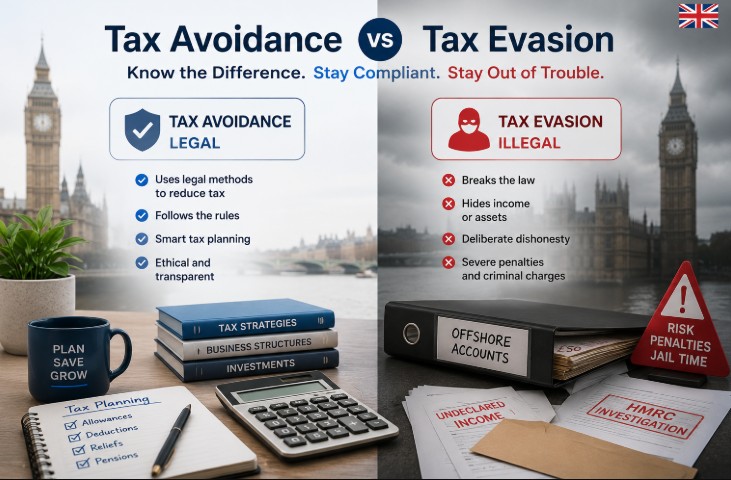
Tax avoidance vs tax evasion comes down to a clear divide in both legality and intent. Tax avoidance involves exploiting statutory provisions to reduce tax liabilities entirely within the letter of the law.
Conversely, tax evasion is a strict criminal offence involving deliberate deception, concealed income, and fraudulent misrepresentation to HM Revenue and Customs.
Key Takeaways
- Tax avoidance utilises lawful gaps in legislation to minimise liabilities, whereas tax evasion involves criminal deception and intentional concealment.
- HM Revenue and Customs investigates aggressive tax avoidance using the General Anti-Abuse Rule while prosecuting deliberate evasion as fraud.
- Small business owners face severe financial penalties, public naming thresholds, and criminal prosecutions for crossing into deliberate evasion.
- Corporate business entities face strict statutory liability under the Criminal Finances Act for failing to prevent the facilitation of tax evasion.
What Are the Financial and Legal Consequences of Tax Evasion for Small Business Owners?
Business owners and directors caught engaging in tax evasion face severe civil penalties, unlimited financial fines, public naming thresholds, and custodial prison sentences.
When HMRC uncovers deliberate fraud, investigations can look back up to twenty years into financial records, overriding standard time limits.
Civil investigations into serious tax fraud are often conducted under Code of Practice 9 (COP9), offering taxpayers a chance to make a full confession in exchange for immunity from criminal prosecution, provided complete cooperation and full disclosure are maintained.
However, where cooperation fails, or fraud is egregious, criminal prosecution follows swiftly. Convicted directors face lengthy prison sentences, mandatory disqualification from managing companies, and recovery orders under the Tribunals Courts and Enforcement Act 2007.
Additionally, HMRC enforces public naming and shaming provisions for deliberate tax defaults exceeding £25,000, causing severe reputational damage to the business.
What is the Tax Avoidance vs Tax Evasion in UK Small Businesses?
| Feature / Dimension | Permissible Tax Mitigation (Legitimate Planning) | Aggressive Tax Avoidance | Criminal Tax Evasion |
| Legal Status | Fully Legal. Explicitly sanctioned by UK statute. | Legal / Gray Area. Exploits legal technicalities, but subject to challenge. | Illegal. Unlawful non-payment or under-payment of tax. |
| Core Definition | Arranging financial affairs to minimise Corporation Tax or Income Tax via legitimate channels. | Structuring artificial transaction chains designed solely to manufacture tax advantages. | Deliberate non-payment or under-payment of taxes through active deception or concealment. |
| Commercial Substance | High: Grounded in genuine economic activity and commercial reality. | Lacks Substance: Artificial arrangements devoid of genuine commercial reality. | Fraudulent: Misrepresents or entirely conceals true commercial reality. |
| Typical Examples | Claiming legitimate sole trader expenses, making tax-relieved pension contributions, and utilizing statutory allowances such as capital allowances. | Creating artificial loss schemes, utilizing circular profit-shifting structures, and exploiting offshore loopholes with no real business operations. | Omitting cash sales entirely, keeping falsified accounting records, and under-reporting income to HMRC. |
| HMRC Regulatory Tool | Standard compliance and statutory allowance processing. | General Anti-Abuse Rule (GAAR) used to counteract abusive schemes. | Criminal Prosecution & Audits (HMRC Fraud Investigation Service). |
| Consequences & Penalties | None; compliant with UK tax law. | Tax recalculations, mandatory interest, penalties, and high legal costs. | Severe regulatory penalties, director disqualification, hefty fines, and potential imprisonment. |
How Does HMRC Distinguish Legal Tax Planning from Illegal Tax Evasion?
HM Revenue and Customs determines whether a business practice is lawful by evaluating the transparency, intent, and economic substance of the transaction.
Legal tax mitigation operates openly within the framework set out by Parliament, whereas tax evasion relies on secrecy, falsified declarations, and the deliberate omission of taxable revenue.
When reviewing business accounts, compliance officers examine whether transactions serve a genuine commercial purpose. If an arrangement is contrived or highly artificial, it triggers investigation under anti-avoidance legislation.
-
Commercial substance doctrine: Transactions must possess genuine business rationale rather than existing solely to generate a tax saving.
-
Statutory transparency: Tax planning schemes must often be disclosed to authorities under the Disclosure of Tax Avoidance Schemes (DOTAS) regime.
-
Intent to deceive: Evasion requires proof of dishonest concealment, false invoicing, or intentional misrepresentation of business income.
In practice, HMRC utilises advanced automated data analytics and third-party financial reporting feeds to flag irregularities in company tax returns and self-assessment filings.
What Are Permissible Tax Avoidance Examples for UK Small Businesses?
Small business owners can legally reduce corporation tax liability and personal tax burdens by utilizing statutory allowances and government-backed reliefs. These methods adhere strictly to the rules established by Parliament.
-
Claiming allowable business expenses, including travel costs, equipment purchases, and professional subscriptions.
-
Making employer pension contributions through a limited company to lower taxable corporate profits efficiently.
-
Utilizing capital allowances and annual investment allowances for qualifying plant, machinery, and technology.
-
Structuring director remuneration through an optimal blend of salary and dividends aligned with current UK Dividend Tax Rates to stay within statutory thresholds.
When business operators apply these standard reliefs correctly, they remain fully compliant with UK tax law without attracting adverse regulatory attention.
What occurs Tax Evasion and Fraudulent Behaviour in Small Businesses?
Tax evasion occurs when a business entity or director deliberately acts outside the law to evade paying the correct amount of tax. This illegal conduct carries severe legal consequences.
-
Suppressing cash sales or failing to record business transactions within accounting software to lower declared turnover.
-
Claiming personal, non-business expenditures as allowable company expenses to reduce corporation tax liabilities fraudulently.
-
Operating phoenix company structures designed solely to liquidate corporate debt and evade historical tax obligations.
-
Using hidden offshore accounts or unrecorded digital payment wallets to conceal business earnings from HMRC.
-
Submitting false VAT returns or falsifying invoices to claim unauthorized repayments from tax authorities.
-
Paying staff or contractors entirely cash-in-hand without operating Pay As You Earn (PAYE) or declaring the employment.
Engaging in these practices shifts a business from aggressive tax avoidance into direct criminal tax fraud, triggering intensive investigations by the HMRC Fraud Investigation Service.

How Does the Criminal Finances Act 2017 Affect Small Business Compliance?
Under Part 3 of the Criminal Finances Act 2017, UK corporate entities and partnerships face strict liability if they fail to prevent associated persons, employees, or contractors from criminally facilitating tax evasion.
This legislation means that a small business can be prosecuted criminally if an agent or representative assists a third party in evading tax on behalf of the organisation, even if senior management had no direct knowledge of the activity.
To protect against this corporate liability, business owners must implement robust prevention procedures, conduct risk assessments, and establish clear internal controls.
Guidance published by bodies such as the Institute of Chartered Accountants in England and Wales (ICAEW) advises firms to maintain strict oversight over financial intermediaries and provide clear whistleblowing channels.
Comparison of Tax Avoidance, Tax Mitigation, and Tax Evasion
| Feature | Legal Tax Mitigation | Tax Avoidance | Tax Evasion |
| Legal Status | Fully legal and encouraged by statute | Legal within the letter of the law, but subject to challenge | Strictly illegal and criminal |
| Core Method | Utilizing explicit reliefs, ISAs, and pensions | Exploiting statutory loopholes or contrived schemes | Deliberate deception, concealment, and false records |
| HMRC Stance | Welcomed as standard compliance | Challenged under the General Anti-Abuse Rule (GAAR) | Prosecuted vigorously as fraud |
| Business Impact | Lowers legitimate tax burden safely | Risk of retrospective tax demands and penalties | Severe fines, asset seizure, and imprisonment |
| Corporate Risk | None | Potential reputational risk from marketed schemes | Strict criminal liability under the Criminal Finances Act |
Original Visual Asset Brief: A structured comparative compliance matrix contrasting statutory boundaries, operational transparency, and enforcement outcomes for small business directors across mitigation, avoidance, and evasion.
What Risk Avoidance Steps Should Small Business Owners Take Today?
Protecting a business from inadvertent non-compliance requires rigorous operational controls and professional oversight.
-
Maintain transparent, contemporaneous bookkeeping records for all sole trader or corporation tax deductions.
- Verify payroll submissions and employee tax allowances using a Tax Code Checker to prevent reporting discrepancies under PAYE.
-
Engage qualified professional accountants affiliated with recognised regulatory bodies to review complex transactions.
-
Review director loan accounts and expense claims quarterly to ensure strict alignment with actual company performance.
-
Implement clear anti-facilitation policies across internal teams and external contractor agreements.
-
Monitor HMRC compliance updates and guidance from the House of Commons Library regarding legislative changes.
By adhering to these steps, business operators ensure complete transparency during HMRC compliance checks and safeguard their operations against unexpected liabilities.

Conclusion
Understanding the exact line between tax avoidance vs tax evasion is vital for every UK business operator.
Ensuring complete transparency, maintaining robust bookkeeping, and avoiding artificial schemes protects companies from severe financial penalties and criminal investigations.
Review your accounting practices today, consult qualified professionals, and ensure your business remains firmly on the compliant side of the law.
Disclaimer: This article is for informational purposes only and does not constitute formal legal or financial advice; always consult a certified professional regarding your specific tax liabilities.
FAQ
Is tax avoidance illegal for small business owners in the UK?
No, tax avoidance itself is legal as it operates within the letter of the law, though aggressive or artificial schemes can be successfully challenged and counteracted by HMRC under statutory anti-abuse rules.
Can HMRC penalise a small business for aggressive tax avoidance?
Yes, HMRC can issue accelerated payment notices, demand full back-taxes with interest, and impose heavy civil financial penalties if an avoidance scheme is deemed artificial or abusive.
What should a sole trader do if HMRC opens a tax enquiry?
A sole trader should immediately contact a qualified accountant, gather all contemporaneous financial records, verify figures, and cooperate fully with HMRC information requests and statutory deadlines.
How do director loan accounts impact small business tax compliance?
Overdrawn director loan accounts left unsettled nine months after the accounting period end can trigger Section 455 tax charges, requiring careful monitoring to avoid unexpected financial penalties.
What are the penalties for unintentional accounting errors versus deliberate evasion?
Unintentional errors typically result in corrected tax bills and lower penalties based on reasonable care, whereas deliberate concealment or evasion leads to severe fraud investigations and criminal prosecution.
What role does the General Anti-Abuse Rule play in business regulation?
The General Anti-Abuse Rule empowers HMRC to tackle abusive, contrived tax avoidance arrangements that lack economic substance, overriding artificial structures to collect correct taxes.
Are small businesses liable if a contractor commits tax evasion?
Yes. Under the Criminal Finances Act 2017, companies face strict corporate liability if they fail to prevent associated persons or contractors from criminally facilitating tax evasion on their behalf.
What constitutes reasonable care when filing company tax returns?
Reasonable care requires taxpayers to take appropriate steps to ensure returns are accurate, such as keeping proper records, checking guidance, or seeking professional advice when uncertain.