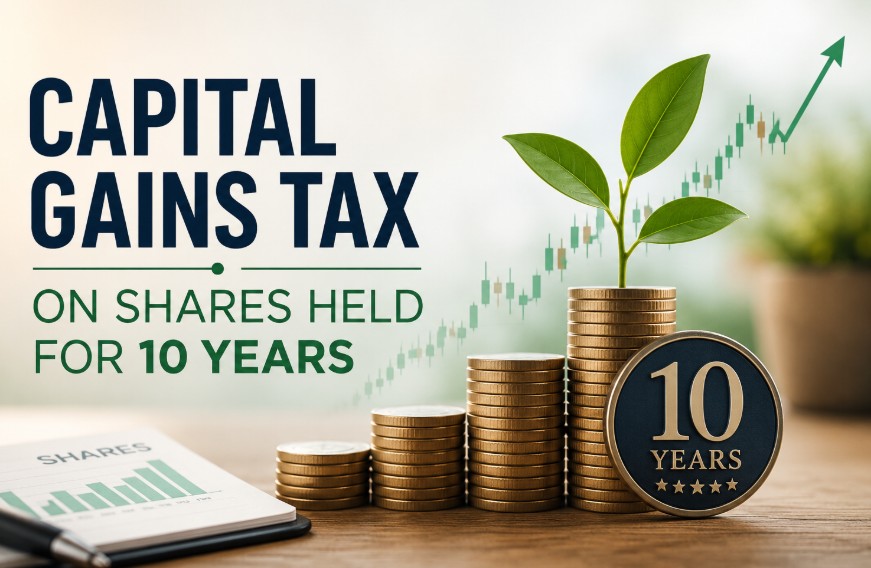
Capital Gains Tax on Shares Held for 10 Years: HMRC Rules, Calculation & Legal Relief
Holding capital gains tax on shares held for 10 years in the UK does not automatically reduce your Capital Gains Tax (CGT) rate or qualify you for special holding-period discounts.
HM Revenue and Customs (HMRC) charges CGT based on your annual income tax band and total capital net gains, regardless of whether you owned the assets for ten months or ten years.
Key Takeaways
-
UK Capital Gains Tax rates on share sales are eighteen percent for basic rate taxpayers and twenty-four percent for higher rate taxpayers.
-
Length of share ownership does not reduce CGT rates because HMRC abolished taper relief and indexation allowance for individuals.
-
Investors calculate taxable gains by subtracting the original purchase cost and eligible trading fees from the final share sale proceeds.
-
Taxpayers can reduce liability by using the three thousand pound annual allowance, transferring shares to spouses, or using Bed and ISA transfers.
What Is the Capital Gains Tax Rate on UK Shares in 2026?
As of 2026, the Capital Gains Tax rates on listed UK shares are 18% for basic rate taxpayers and 24% for higher or additional rate taxpayers. These updated rates apply across all standard equity disposals, matching non-residential capital asset brackets.
- Basic Rate Taxpayer: 18% (on gains within basic income band)
- Higher Rate Taxpayer: 24% (on gains above basic income band)
- Annual Exempt Amount: £3,000 per individual
Basic Rate vs Higher Rate Tax Bands for Listed Shares
Your personal Income Tax band determines your exact CGT liability on equity sales. To figure out which rate applies, add your total taxable gain (minus the £3,000 allowance) to your taxable income for the tax year.
| Taxpayer Status | Total Taxable Income Range | CGT Rate on Share Gains | Annual Exempt Amount |
| Basic Rate | Up to £50,270 | 18% | £3,000 |
| Higher Rate | £50,271 to £125,140 | 24% | £3,000 |
| Additional Rate | Over £125,140 | 24% | £3,000 |
If the taxable gain spans across the £50,270 income boundary, the portion below the threshold is taxed at 18%, while any gain extending above it is taxed at 24%.
Short-Term vs Long-Term Capital Gains Tax Rates in the UK
Unlike tax jurisdictions such as the United States, the UK tax code does not separate capital gains into short-term and long-term classifications. Whether an asset is acquired and sold within thirty days or held across multiple decades, the applicable tax rates remain fixed at 18% and 24%.
Does Holding Shares for 10, 5, or 20 Years Reduce Your Capital Gains Tax in the UK?
No, keeping investments for an extended period does not grant lower Capital Gains Tax rates under UK tax legislation. Selling shares held for 10 years triggers the exact same statutory CGT rates as selling assets purchased six months prior.
UK tax legislation does not grant lower Capital Gains Tax rates simply because you keep investments for an extended period. Selling shares held for 10 years triggers the exact same statutory CGT rates as selling assets purchased six months prior.
Selling investments after a long holding period often creates a substantial tax liability due to cumulative price growth.
Investors frequently assume that holding assets long-term earns a discounted tax rate, but current HMRC policy treats all capital disposals equally once gains exceed the annual threshold.
Is There a Capital Gains Tax 10-Year Rule or Taper Relief in the UK?
There is no active 10-year rule or taper relief for individual share disposals in the UK. Taper relief was officially abolished in April 2008, removing the system that progressively reduced taxable gains based on asset holding duration.
Indexation allowance, which previously adjusted purchase costs to account for inflation, was also frozen for corporate entities and phased out for individual investors.
Consequently, long-term investors face CGT on total nominal growth rather than real inflation-adjusted appreciation.
Do You Pay Capital Gains Tax on Shares Held Over 5 Years or 20 Years?
You must pay Capital Gains Tax on profits from shares held for 5, 10, or 20 years if your total net capital gains in a given tax year exceed the Annual Exempt Amount.
HMRC measures taxable exposure by subtracting the allowable purchase cost from the total disposal value at the time of sale.
When reviewing long-term investment accounts, portfolio owners often discover that holding assets across decades leads to significant paper gains.
Because the tax system does not adjust for purchasing power erosion over 20 years, inflation increases the nominal profit, moving investors into higher tax obligations upon liquidation.
How to Calculate Capital Gains Tax on Shares Held for 10 Years?
To calculate CGT on long-held assets, determine disposal proceeds, deduct allowable costs, apply HMRC Section 104 pooling rules, subtract the £3,000 allowance, and apply your income tax band rate.
-
Determine your total disposal proceeds by multiplying the number of shares sold by the execution price per share.
-
Deduct allowable transaction costs, including stockbroker trading fees, platform charges, and stamp duty paid at purchase.
-
Calculate the total allowable cost basis using HMRC Section 104 pooling rules for shares acquired over time.
-
Subtract the total cost basis and allowable expenses from the gross disposal proceeds to calculate the net capital gain.
-
Deduct your remaining £3,000 Annual Exempt Amount for the current tax year from the calculated profit.
-
Add your remaining net gain to your annual taxable income to determine whether it falls into the 18% or 24% tax band.
-
Apply the corresponding CGT rate to calculate the final tax amount due to HMRC.
-
Report the gain and pay the tax via HMRC Self Assessment or the real-time CGT service by the statutory deadline.

How to Calculate Capital Gains Tax on Shares Bought at Different Times?
When calculating gains on shares acquired through multiple tranches over 10 years, HMRC requires taxpayers to follow matching rules to establish the cost basis:
-
Same-Day Rule: Shares bought on the same day as the sale are matched first.
-
30-Day Bed and Breakfast Rule: Shares acquired within 30 days after the sale are matched second.
-
Section 104 Pool: All remaining shares are grouped into a single pool with an average cost per share.
Section 104 Pool Example
-
Acquisition 1 (Year 2016): 1,000 shares @ £5.00 = £5,000 cost
-
Acquisition 2 (Year 2020): 1,000 shares @ £10.00 = £10,000 cost
-
Total Pool: 2,000 shares = £15,000 total cost
-
Average Cost Per Share: £7.50 per share
-
Disposal (Year 2026): 1,000 shares @ £15.00 = £15,000 proceeds
-
Allowable Cost Subtracted: 1,000 shares @ £7.50 = (£7,500) cost
-
Gross Capital Gain: £7,500
In practice, tracking historical corporate actions like stock splits, rights issues, and share consolidations across a decade is essential to maintaining an accurate Section 104 pool value.
How Do I Calculate Capital Gains Tax on Foreign Shares?
Calculating CGT on foreign equities held for ten years requires converting all purchase costs and sales proceeds into Sterling (GBP) using the exchange rates on the exact dates of the transactions.
Fluctuations in exchange rates can create taxable sterling gains even if the asset price stayed flat in its original currency. A UK investor who bought US equities ten years ago must measure both share price movement and USD/GBP exchange rate shifts over that decade.
Capital Gains Tax on Shares Held for 10 Years Calculator Guidance
Using spreadsheet models or official HMRC calculation software helps avoid common pooling errors on long-held assets.
Investors should compile accurate contract notes, dividend reinvestment records, and transaction logs across the entire ten-year period before submitting data to HMRC tax tools.
How to Avoid Capital Gains Tax on Shares Held for 10 Years Legally?
While you cannot eliminate CGT through holding duration, you can minimize or neutralize tax using allowances like the Annual Exemption, spousal transfers, Bed & ISA strategies, and loss offsetting.
- Annual Exemption: Utilise the £3,000 annual allowance.
- Spousal Transfers: Transfer assets tax-free to double allowances.
- Bed & ISA: Move £20,000 annually into a tax-free ISA.
- Loss Offsetting: Register losses to reduce total gain figures.
- SIPP Contributions: Top up pension to expand basic rate tax band.
Utilizing Your £3,000 Annual Exempt Amount & Spousal Transfers
Every UK individual receives an Annual Exempt Amount of £3,000 per tax year. Capital gains below this limit are entirely exempt from CGT.
Spouses and civil partners can transfer shares to one another on a no gain, no loss basis. By gifting a portion of long-held shares to a partner before sale, a couple can combine their annual exemptions to shelter up to £6,000 in gains within a single tax year.
Bed & ISA and Bed & SIPP Strategies
A Bed & ISA transaction involves selling shares held in a taxable trading account and immediately repurchasing them within an Individual Savings Account (ISA).
Once inside an ISA, all future capital growth and dividend income are completely tax-free.
While selling the original shares triggers a CGT event, investors can execute this process incrementally each year to utilise their £3,000 annual exemption and £20,000 ISA allowance.
Executing a similar transfer into a Self-Invested Personal Pension (SIPP) shelters growth and can yield income tax relief on the contribution.
Offsetting Capital Losses Against Share Gains
If you realise losses on other investments within the same tax year, you can offset them directly against profits made on long-held shares. Allowable capital losses must be registered with HMRC within four years of the end of the tax year in which they occurred.
Unused losses can be carried forward indefinitely to shelter future capital gains, provided they are reported on time.
Pension Contributions to Lower Your CGT Band
Making personal pension contributions increases your Basic Rate Tax threshold by the gross value of the contribution.
If a share sale pushes your total taxable gain into the 24% higher-rate CGT bracket, contributing to a registered pension scheme can expand your basic rate band. This effectively shifts more of your capital gain down into the 18% CGT rate, reducing your overall tax bill.
Can You Leave the UK or Use the 6-Year Rule to Avoid Capital Gains Tax?
Relocating abroad requires staying a non-UK resident for more than five consecutive tax years due to temporary non-residence rules, and the 6-year rule applies only to residential property, not shares.
- 5-Year Rule: Residing abroad for under 5 years still leaves you liable for UK CGT on returned share sales under HMRC policy.
- 6-Year Rule: Applies strictly to main residential homes, NOT equity portfolios or share investment accounts.
Can I Leave the UK to Avoid Capital Gains Tax on Shares?
Relocating abroad does not offer an immediate escape from UK capital gains liability due to HMRC’s Temporary Non-Residence rules.
If you sell shares while living outside the UK but return within five years, those gains become taxable in the UK during the tax year you return.
To legally avoid UK CGT on share disposals by moving abroad, you must remain a non-UK resident for more than five full, consecutive tax years.
What Is the 6-Year Rule for Capital Gains Tax in the UK?
The 6-year rule relates exclusively to Private Residence Relief on primary residential properties that are temporarily rented out. It allows homeowners to treat a dwelling as their main residence for up to six years while absent.
This statutory rule does not apply to stocks, bonds, or equity portfolios. Listed equity holdings do not receive temporary relief windows under primary residence exemptions.
BADR and Unlisted Business Shares
Investors in private trading companies may qualify for Business Asset Disposal Relief (BADR) or Investors’ Relief, reducing rates to 14%–18% up to lifetime limits.
| Relief Type | Qualifying Business Asset Criteria | Reduced CGT Rate | Lifetime Limit |
| Business Asset Disposal Relief (BADR) | Employee/officer owning ≥5% shares in trading company for 2+ years | 14% (rising to 18% in April 2026) | £1,000,000 |
| Investors’ Relief | External investor in unlisted trading company shares held for 3+ years | 14% (rising to 18% in April 2026) | £10,000,000 |
Business Asset Disposal Relief (BADR) vs Standard Listed Shares
Business Asset Disposal Relief (formerly Entrepreneurs’ Relief) lowers the CGT rate for qualifying business owners and employees selling shares in their trading companies.
When reviewing decisions on unlisted equity holdings, investors must meet specific requirements, such as holding at least 5% of voting rights and maintaining employment with the business for at least two years.
Standard shares purchased on public stock markets like the FTSE 100 or NASDAQ do not qualify for BADR.
Conclusion
Selling long-held shares requires careful tax planning to manage your liability. Because holding period discounts no longer exist in the UK, long-term asset growth can lead to significant tax bills if liquidated all at once.
To manage your exposure on long-held assets:
-
Review your Section 104 cost pool to accurately track historic purchases, stock splits, and dividend reinvestments.
-
Spread large share sales across multiple tax years to make full use of your annual £3,000 exemption.
-
Transfer holdings to a spouse or civil partner before selling to combine annual exemptions.
-
Use Bed & ISA transfers each tax year to move unwrapped holdings into tax-sheltered accounts.
-
Register any investment losses with HMRC so they can be offset against current or future capital gains.
For complex holdings, international shares, or large corporate distributions, consult a qualified tax specialist or independent financial adviser before executing sales.
Disclaimer: This article is for informational purposes only and does not constitute formal financial or tax advice; consult a qualified adviser regarding your specific circumstances.
FAQ
How long do you need to hold shares to avoid capital gains tax in the UK?
Holding shares for any length of time does not make them tax-exempt in the UK. Gains on share sales remain subject to Capital Gains Tax regardless of the holding period unless the shares are held in a tax-sheltered account like an ISA.
Is there a tax-free allowance for long-term capital gains on shares?
Yes, UK investors receive an Annual Exempt Amount of £3,000 per tax year. This tax-free allowance applies equally to both short-term and long-term share disposals.
How do I report my share sale gains to HMRC?
You must report share gains exceeding your allowance using HMRC’s online Real Time Capital Gains Tax service or by submitting a Self Assessment tax return by 31 January following the end of the tax year.
What happens if I inherited shares 10 years ago?
If you inherited shares ten years ago, your cost basis is the market value of the equities on the date of the previous owner’s death, not the original purchase price paid by the deceased.
Do I pay CGT if I reinvest the share proceeds immediately?
Reinvesting funds from a share sale does not defer or eliminate your CGT liability. The initial sale is considered a taxable disposal, regardless of what you do with the proceeds afterward.
What fees can I deduct from my share sale gain?
You can deduct broker commission charges, platform transaction fees, and stamp duty reserve tax paid when acquiring or disposing of the shares to lower your net taxable gain.
Are shares held in an ISA subject to Capital Gains Tax after 10 years?
No, investments held within an Individual Savings Account (ISA) are completely exempt from UK Capital Gains Tax, regardless of how long they are held or how much they grow.