Complete £38k After Tax Guide: Net Salary Breakdown, Take-Home Pay 2026
Last Updated on
On a £38,000 salary in the UK for the 2026/27 tax year, take-home pay is £30,880 a year, or £2,573.34 a month, after Income Tax and National Insurance under a standard 1257L PAYE tax code. This assumes no pension contributions, student loan repayments, or additional untaxed income.
This net figure fluctuates based on individual circumstances, including workplace pension auto-enrolment contributions, student loan repayment plans, and tax code adjustments set by GOV.UK tax rates and thresholds.
Key Takeaways
-
On a £38,000 salary in the UK, take-home pay works out at £30,880 a year, or £2,573.34 a month, after Income Tax and 8% employee National Insurance.
-
The £12,570 tax-free Personal Allowance and £50,270 higher-rate threshold stay frozen until April 2031, so £38k sits well inside the 20% basic rate band.
-
A Plan 2 student loan on a £38k salary costs about £64.61 a month in 2026/27, since repayments are 9% of earnings above the £29,385 annual threshold.
-
At £38,000, UK gross pay sits just below the £39,039 full-time median salary reported by ONS for April 2025, making it a slightly below-average wage.
What Is Your Actual Take-Home Pay On £38k After Tax UK?
Your actual take-home pay on £38k After Tax in the UK is £30,880 per year (£2,573.34 monthly) after statutory deductions of Income Tax and National Insurance under standard PAYE parameters.
Income tax legislation applies a zero-rate personal allowance to the first £12,570 of earnings, while income between £12,571 and £50,270 is taxed at the basic rate of twenty percent.
National Insurance contributions apply additional statutory deductions above the primary threshold, shaping final net income figures across monthly and annual payment cycles.
What Is the Breakdown of £38k After Tax UK?
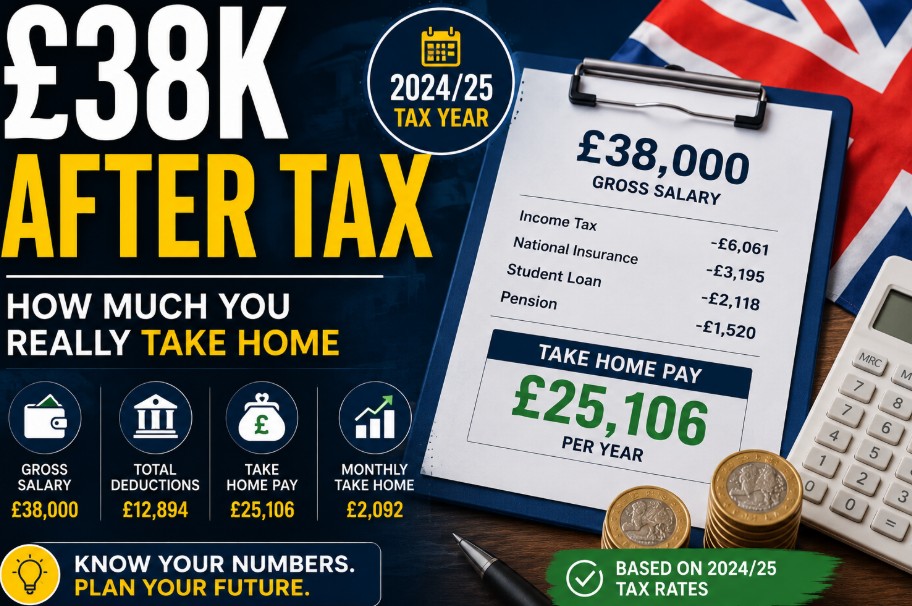
The exact breakdown of a £38,000 salary under a 1257L tax code consists of a £5,086 Income Tax deduction and a £2,034 National Insurance contribution, yielding an annual net take-home pay of £30,880.
Salary Period Breakdown Table
| Payment Period | Gross Salary | Income Tax | National Insurance | Net Take-Home Pay |
| Annual | £38,000.00 | £5,086.00 | £2,034.00 | £30,880.00 |
| Monthly | £3,166.67 | £423.83 | £169.50 | £2,573.34 |
| Weekly | £730.77 | £97.81 | £39.12 | £593.84 |
| Daily (5-day week) | £146.15 | £19.56 | £7.82 | £118.77 |
| Hourly (37.5 hrs) | £19.49 | £2.61 | £1.04 | £15.84 |
How Much Is £38k a Month After Tax UK?
On a £38,000 salary, your net monthly take-home pay is £2,573.34 before any workplace pension deductions or student loan repayments are applied.
This monthly sum represents the baseline cash flow available for rent, utility bills, council tax, groceries, and discretionary spending.
In practice, variations in payroll scheduling, leap years, or mid-year tax code updates from HM Revenue and Customs can cause minor pence-level fluctuations on individual payslips.
How Much Is £38k a Year an Hour After Tax?
Based on a standard 37.5-hour working week, an annual net income of £30,880 equates to an hourly take-home rate of roughly £15.84.
Factoring in gross figures, the hourly rate before deductions sits at £19.49, demonstrating the tangible impact of statutory tax and National Insurance withholdings on working hours.
How is the income tax calculated?
UK income tax is calculated using progressive bands: a 0% rate up to £12,570 (Personal Allowance) and a 20% basic rate applied to earnings between £12,571 and £50,270.
Understanding how a £38,000 salary is processed requires examining the underlying statutory formulas set by the UK government.
As of 2026, the £12,570 Personal Allowance and £50,270 higher-rate threshold have been frozen since 2021/22, and the November 2025 Autumn Budget extended that freeze through to April 2031. In practice this means a £38,000 salary today sits further into the basic-rate band, relative to average pay, than it would have when these thresholds were last uprated.
England, Northern Ireland, and Wales Income Tax Bands
| Tax Band | Taxable Income Threshold | Tax Rate |
| Personal Allowance | Up to £12,570 | 0% |
| Basic Rate | £12,571 to £50,270 | 20% |
| Higher Rate | £50,271 to £125,140 | 40% |
| Additional Rate | Over £125,140 | 45% |
Scottish Income Tax Bands
| Tax Band | Income Threshold | Tax Rate |
| Personal Allowance | Up to £12,570 | 0% |
| Starter Rate | £12,571 to £16,537 | 19% |
| Basic Rate | £16,538 to £29,526 | 20% |
| Intermediate Rate | £29,527 to £43,662 | 21% |
| Higher Rate | £43,663 to £75,000 | 42% |
| Advanced Rate | £75,001 to £125,140 | 45% |
| Top Rate | Over £125,140 | 48% |
Employee National Insurance Rates and Thresholds
| Earnings Band / Threshold Type | Annual Earnings Range | Employee NI Rate |
| Below Lower Earnings Limit | Up to £6,708 (£559/month) | 0% (No NI or credits) |
| Lower Earnings Limit to Primary Threshold | £6,709 to £12,570 (£1,048/month) | 0% (Earns NI credits) |
| Primary Threshold to Upper Earnings Limit | £12,570 to £50,270 (£4,189/month) | 8% |
| Above Upper Earnings Limit | Balance above £50,270 | 2% |

What is the tax code for £38k Salary in the UK?
For an individual earning a standard £38,000 annual salary with no secondary income or company benefits, the default and most common tax code issued by HM Revenue and Customs (HMRC) is 1257L.
This standard code indicates that you receive the full tax-free Personal Allowance for the current tax year before any income tax is applied to your earnings.
How to determine the tax code on salary?
Determining your personal tax code involves reviewing your employer-issued payslip, P60, or logging into your online personal tax account via the official government portal.
HMRC calculates your specific code by taking your total tax-free allowances, such as the standard Personal Allowance or marriage allowance, and subtracting any untaxed income you receive or company benefits-in-kind you are registered for.
| Salary & Income Condition | Tax Code | How Salary/Income Determines the Code |
| Standard Earnings (£0 to £100,000) | 1257L | Grants the full standard Personal Allowance (£12,570) tax-free before basic-rate deductions apply. |
| High Earners (Earnings over £100,000 up to £125,140) | Reduced Code (e.g., 1050L) | HMRC reduces the Personal Allowance by £1 for every £2 earned above £100,000, shrinking the code number. |
| Very High Earners (Income over £125,140) | 0T (or Scottish/Welsh equivalent) | Personal Allowance is entirely wiped out (£0 tax-free), meaning all income is taxed at standard progressive rates. |
| Secondary Job / Multiple Incomes | BR, D0, or D1 | Applied when a primary job already consumes your full £12,570 tax-free allowance, taxing secondary salary entirely at flat rates (20%, 40%, or 45%). |
| Company Benefits exceeding Allowances | K Codes (e.g., K475) | Used when workplace benefits-in-kind (like health insurance or a company car) outweigh your remaining tax-free allowance. |
How Do Student Loans and Pensions Impact a £38k Salary in the UK?
Workplace pensions (standard 5% employee contribution) reduce a £38k gross salary by roughly £1,588 annually (£132 monthly), while student loan plans deduct 9% of earnings above specific thresholds (6% for Postgraduate loans).
Workplace pensions and student loan repayments alter standard net salary figures significantly. To understand how these deductions affect your take-home pay, they must be broken down by how payroll systems calculate them.
Workplace Pension Auto-Enrolment Deductions
Under current UK workplace pension regulations, employers must auto-enrol eligible staff into a workplace pension scheme. This requires a minimum total contribution of eight percent, where employees typically contribute five percent of qualifying earnings.
For a £38,000 salary, a five percent employee pension contribution is calculated on qualifying earnings (£6,240 to £50,270 for 2026/27), not gross salary. That means £1,588 a year, lowering net annual pay to around £29,292 and monthly take-home pay to approximately £2,441 before tax relief adjustments.
Student Loan Repayment Plan Deductions
Student loan repayments further adjust take-home earnings if the earner attended higher education. Plan 1, Plan 2, Plan 4, Plan 5, and Postgraduate loan repayment thresholds dictate when deductions begin.
Plan 2 loans, for instance, deduct nine percent of earnings above the established repayment threshold.
When a £38k earner crosses that threshold, monthly loan repayments are automatically calculated and extracted via the PAYE payroll system alongside income tax and National Insurance.
Verified 2026/27 repayment thresholds, and what they mean in practice on a £38,000 salary:
| Loan Plan | 2026/27 Threshold | Rate | Monthly Repayment on £38k |
|---|---|---|---|
| Plan 1 | £26,900 | 9% | £83.25 |
| Plan 2 | £29,385 | 9% | £64.61 |
| Plan 4 (Scotland) | £33,795 | 9% | £31.54 |
| Plan 5 | £25,000 | 9% | £97.50 |
| Postgraduate | £21,000 | 6% | £85.00 |
Plan 2 and Postgraduate loans can run at the same time — a £38k earner with both would pay roughly £149.61 a month between the two.
-
Workplace pension contributions reduce immediate cash flow while building long-term tax-efficient retirement savings.
-
Student loan deductions apply automatically via payroll once annual earnings exceed specific plan thresholds.
-
Combining pension auto-enrolment and student loan repayments can lower monthly take-home pay below the standard £2,573 baseline.
-
Checking annual benefit statements ensures pension contributions and loan repayments are processed accurately by company payroll departments.

How Does £38k Compare to Nearby Salaries?
Moving from £38k to £40k yields an extra £1,440 per year in net take-home pay (£120 more each month), since National Insurance and Income Tax both apply at flat marginal rates within this band.
| Gross Salary | Annual Net Take-Home | Monthly Net Take-Home | Estimated Income Tax | Estimated National Insurance |
|---|---|---|---|---|
| £36,000 | £29,440 | £2,453 | £4,686 | £1,874 |
| £37,000 | £30,160 | £2,513 | £4,886 | £1,954 |
| £38,000 | £30,880 | £2,573 | £5,086 | £2,034 |
| £39,000 | £31,600 | £2,633 | £5,286 | £2,114 |
| £40,000 | £32,320 | £2,693 | £5,486 | £2,194 |
Stepping up from £38,000 to £40,000 yields an additional £1,440 per year in net take-home pay, breaking down to exactly £120 more each month.
Evaluating these incremental earnings, or looking ahead to how career growth scales toward a £50k After Tax UK threshold, helps professionals negotiate salary increases or assess the financial value of accepting new employment roles with varied compensation packages.
Is £38k a Good Salary in the UK?
Earning £38,000 sits just under the UK’s full-time median salary of £39,039 (ONS, April 2025 data), making it a solid, close-to-average income rather than a clearly above-average one. Living conditions on this salary are comfortable outside London and the South East, where housing and transport costs eat into the gap more noticeably.
Regional Disparities and Purchasing Power
Regional differences heavily influence how far your money goes:
-
Outside Major Cities: Earning £38,000 in regions like the North East, Wales, or parts of the Midlands provides comfortable financial stability, covering average mortgage or rental costs and lifestyle expenses with room for savings.
-
London and the South East: Living on £38,000 in London or the South East presents greater budgeting challenges due to elevated property prices, higher rental demands, and increased public transport costs.
What Steps Should You Take to Verify Your Payslip?
To verify your £38k payslip, check your 1257L tax code, review your workplace pension deduction percentage, cross-reference student loan thresholds, and compare year-to-date figures with your gross salary.
-
Review your current tax code on your latest payslip to ensure HM Revenue and Customs applies the correct personal allowance.
-
Confirm that your employer has correctly applied workplace pension contributions according to your elected percentage.
-
Check student loan deduction amounts against official repayment threshold rules for your specific loan plan type.
-
Cross-reference your gross year-to-date figures with your contractual annual salary to identify any payroll calculation discrepancies.
-
Inspect National Insurance category letters to ensure correct statutory deductions are applied to your earnings.
-
Contact your company payroll department or HM Revenue and Customs directly if unexpected tax code alterations appear.
Conclusion
Managing a £38,000 salary requires a clear understanding of statutory deductions, pension schemes, and tax codes.
By reviewing payslips regularly and accounting for personal financial commitments, workers can optimize their take-home pay and maintain robust household budgeting practices across the UK tax year.
FAQ
What is the exact take-home pay for £38k GBP after tax UK?
Under standard PAYE tax codes with no pension or student loan deductions, annual take-home pay equals £30,880, which translates to a monthly net income of £2,573.34.
How does a tax code change my 38k per year after tax UK calculation?
Tax codes alter your tax-free personal allowance. Codes higher than 1257L increase take-home pay, while emergency codes or BR codes increase immediate tax deductions.
How much is 38k a month after tax UK with a pension?
A standard 5% employee pension contribution reduces monthly net take-home pay from £2,573 to approximately £2,441 before accounting for tax relief benefits.
Does National Insurance change at £38k?
National Insurance is calculated as a percentage across specific earnings bands rather than changing the overall tax bracket rate for your entire salary.
Is £38k subject to higher-rate tax in the UK?
No, earnings of £38,000 fall entirely within the personal allowance and basic 20% tax rate bands, well below the higher-rate threshold of £50,270.
Is 38k a good salary in the UK?
Relative to the median, £38,000 is close to average, but factor in deductions before judging it: after tax, NI, and a standard 5% pension contribution, take-home pay is closer to £29,300 a year, which is the more useful number for budgeting than the gross figure.
How much is 40k after tax?
On a £40,000 salary in 2026/27, take-home pay is £32,320 a year, or £2,693 a month, exactly £1,440 more per year in net income than a £38,000 salary produces.
Is 38000 enough to live on?
Whether £38,000 is enough to live on depends heavily on location and personal outgoings: it covers typical living costs comfortably outside London and the South East, but budgeting is noticeably tighter in high-rent regions.
This article is for general information only, is not financial or tax advice, and figures are estimates based on standard 2026/27 rates, always check your own payslip or gov.uk/HMRC for your exact circumstances.