
How to Write an Email: Complete UK Business Guide and Templates
Writing a professional email means using a clear subject line, an appropriate greeting, getting to the main point quickly, and ending with a polite sign-off.
Using the right tone, clear formatting, UK date conventions, and the required email footer helps keep business correspondence professional, clear, and compliant with UK standards.
Key Takeaways
-
Professional UK business emails should have clear subject lines, suitable greetings, well-structured paragraphs, and the required details in the email footer.
-
Putting the main point in the first sentence helps avoid misunderstandings and can lead to quicker responses from UK businesses.
-
Standard UK business communication uses British English spelling and dates in day, month, and year order.
-
Corporate email footers should include registered company details and an appropriate privacy statement to meet relevant UK requirements.
What Is the Standard Format for an Email in the UK?
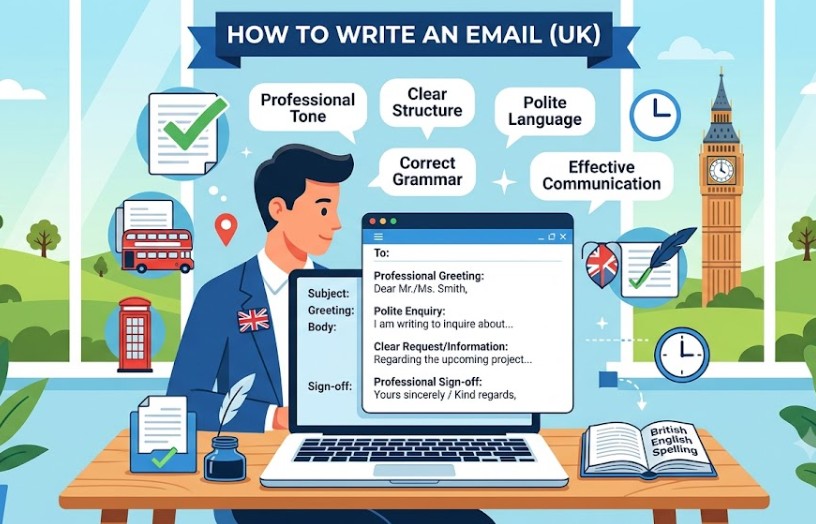
The standard format for a professional email in the UK consists of five distinct structural components: a clear subject line, a formal salutation, a concise body opening, an actionable main message, and a professional closing with a complete email signature.
Following this format helps keep the email clear, professional, and in line with relevant requirements.
1. Clear Subject Line
Keep the subject line under 60 characters and include an action tag or reference number where useful (e.g., Invoice 4092: Payment Query). Avoid vague terms such as Update.
2. Appropriate Salutation
-
Formal / Legal: Dear Mr/Ms [Surname] (or Dear Sir/Madam if unnamed).
-
Standard Commercial: Dear [First Name] or Hello [First Name].
-
Internal / Casual: Hi [First Name] or Hello Team.
3. Concise Body Opening (BLUF)
Use the Bottom Line Up Front (BLUF) approach by stating the main purpose or request in the first sentence.
4. Main Body and Call to Action
-
Formatting: Use short paragraphs and bullet points when listing information, figures, or deadlines.
-
UK Standards: Use British spelling and UK date formatting, such as 14 October 2026.
-
Clear CTA: Clearly state the next steps or when you need a response.
5. Professional Closing and Signature Footer
-
Sign-offs: Use Kind regards (standard business), Yours sincerely (formal/named), or Yours faithfully (formal/unnamed). Avoid informal sign-offs such as Cheers or Thanks.
-
Mandatory Legal Footer (Companies Act 2006 and UK GDPR): Include your name, job title, full registered company name, registration number, place of registration, registered address, and an appropriate privacy or confidentiality statement.
| Structural Component | Quick Reference |
| Subject Line | [Reference Tag] Clear, Concise Purpose |
| Salutation | Dear [Name] / Hello [Name] |
| Opening | Core request in sentence 1 (BLUF) |
| Body and CTA | Bulleted details, DD/MM/YYYY dates, clear next steps |
| Sign-off | Kind regards, / Yours sincerely, |
| Footer | Sender details + Registered corporate and GDPR disclosures |
How to Write an Email for a Business Purpose
Writing an email for a business purpose means using a clear subject line, stating your objective early, and keeping the format easy to scan.
Using the Bottom Line Up Front (BLUF) approach can help speed up responses by putting the main request in the first sentence.
Keep paragraphs short, use bullet points where helpful, and finish with a clear next step along with your contact and legal details.
Subject: Action Required: Q3 Marketing Budget Sign-Off (Ref: FIN-2026-08)
Dear [Recipient Name],
I am writing to request your formal sign-off on the revised Q3 marketing budget for [Project Name].
Following our review, we have adjusted resource allocations to prioritize digital channels:
-
Search Engine Marketing: £15,000 (10% increase)
-
Content and PR: £10,000 (unchanged)
-
Events and Sponsorships: £5,000 (reallocated to offset SEM)
Please find attached the itemized breakdown (PDF). Could you please reply with your approval or amendments by 5:00 PM on Thursday, 3 September 2026?
Kind regards,
[Your Name]
[Your Title] | [Company Name]
[Contact Details and Registered Company Information]

How to Write an Email for a Formal Complaint to a Supplier or Partner?
A formal complaint email to a supplier should remain objective, explain the contract breach or service failure, include the relevant agreement or order number, and give a clear deadline for resolving the issue.
In commercial disputes, courts and arbitrators often pay close attention to written records. Avoid inflammatory language.
State the facts, explain the financial or operational impact, and clearly say what remedy you require, such as a refund, replacement, or account credit, and by when.
Subject: Urgent: Formal Complaint – Breach of Delivery SLA (Order Ref #PO-9921)
Dear [Supplier Name],
I am writing to formally log a complaint regarding Order #PO-9921, which was scheduled for delivery on 25 August 2026 under our Service Level Agreement.
The shipment arrived incomplete, and 40% of the units received were damaged due to improper packaging. This failure has halted our production line and disrupted client delivery timelines.
We require the following resolution by 5:00 PM on Friday, 4 September 2026:
Immediate dispatch of replacement units at your expense.
A written credit note for the missing inventory.
Please find attached the signed delivery docket and photos of the damaged goods in PDF format. Please confirm that you have received this notice and let us know your plan to resolve the issue.
Yours sincerely,
[Your Name]
[Your Title] | [Company Name]
[Contact Info and Registered Company Details]
How to Write an Email to HMRC or the Home Office?
Emails or portal messages sent to government bodies such as HM Revenue and Customs (HMRC) or UK Visas and Immigration (UKVI) / Home Office may require specific identification details.
Include the relevant Unique Taxpayer Reference (UTR), National Insurance Number, VAT Registration Number, or Home Office Reference Code in the main body.
State the relevant legislation or type of query at the start, answer the requested points clearly, and make sure attached documents follow the required naming conventions.
Subject: Tax Query: UTR 98765-43210 – Corporation Tax Relief Claim FY2025/26
Dear Sir/Madam,
I am writing regarding our Corporation Tax calculation for the accounting period ending 31 March 2026 for [Company Name Ltd] (UTR: 98765-43210).
Please find attached the completed Form CT600 along with supporting financial statements in PDF format. We require written confirmation of the adjusted R and D expenditure credit applied to this period.
Could you please acknowledge receipt of this submission and confirm the expected processing timeline for the revised assessment?
Yours faithfully,
(NAME, ADDRESS, CONTACT NUMBER)
How to Write an Email to a Solicitor in the UK?
When communicating with a UK solicitor regulated by the Solicitors Regulation Authority (SRA), being clear and precise can help avoid unnecessary legal work and costs. Place your case reference number or matter code in the subject line.
State the exact decision required or factual information being provided. Avoid emotional language, stick to the events in chronological order, attach the relevant documents in PDF format, and ask for confirmation that they have been received.
Subject: Instruction: Case Ref #LEG-88402 – Commercial Lease Review
Dear (NAME),
I am writing to instruct your firm regarding the break clause revision for our commercial lease at 14 High Street.
Please find attached the draft lease agreement provided by the landlord’s counsel. We require your formal written advice on Section 4 (Tenant Covenants) prior to 14 October 2026.
Could you please confirm receipt of these documents and provide an estimate of the fee for this review?
Yours sincerely,
(NAME, ADDRESS)
How to Write an Email for a Job Application or Resignation in the UK?
Employment-related emails can have legal implications under UK employment law and relevant ACAS guidance.
For job applications, state the job title and reference number clearly. Briefly explain how your qualifications match the role and confirm that your CV is attached.
For resignation emails, clearly state that you are resigning, give the required notice period, confirm your final working date, and offer to help with the handover.
Subject: Formal Notice of Resignation – [Your Name]
Dear [Manager Name],
Please accept this email as formal notification that I am resigning from my position as Content Manager.
In accordance with my employment contract, my notice period is one month, making my final working date Friday, 9 October 2026.
I am committed to completing current project handovers and assisting the team with a smooth transition over the coming weeks.
Kind regards,
[Your Name]
What Are the Most Important UK Formatting and Legal Rules for Emails?
To keep UK business emails professional and in line with data protection and commercial requirements, outgoing messages should follow the relevant formatting and legal rules.
Key Guidelines and Requirements
-
British Date Conventions (DD/MM/YYYY): Write dates in day-month-year order, such as 14/10/2026 or 14 October 2026. Writing 10/11/2026 in the UK means 10 November, whereas in the US it means October 11. Spell out the month in cross-border emails to avoid confusion.
-
Professional Tone (Plain English): Keep the tone polite while making the message clear and direct. Avoid complicated jargon, old-fashioned legal terms, or passive-aggressive phrases such as Per my previous email. Use constructive alternatives like I have re-attached the relevant details for ease of reference.
-
Mandatory Corporate Disclosures: Under the Companies (Trading Disclosures) Regulations 2008 and the Companies Act 2006, all UK private limited companies (Ltd) and LLPs must include specific registration details in their signature footer.
-
UK GDPR and Privacy Rules: Enforced by the Information Commissioner’s Office (ICO), businesses handling personal data must include confidentiality disclaimers in signatures and functional opt-out/unsubscribe mechanisms in commercial marketing emails.
-
Attachment Security and SLA Expectations: Use PDF format for attachments where appropriate, and encrypt files that contain sensitive personal data. Where your business uses response targets, aim to reply to general enquiries within 24 business hours and urgent client matters within 2–4 hours, or send a brief acknowledgement if more time is needed.
Mandatory UK Email Footer Elements
| Legal / Operational Requirement | Specific Details to Include | Relevant Legislation / Body |
| Full Registered Company Name | Official legal name (e.g., Example Logistics Ltd) | Companies Act 2006 |
| Registration Number | Official number issued by Companies House | Companies (Trading Disclosures) Regulations 2008 |
| Place of Registration | Region of incorporation (e.g., Registered in England and Wales) | Companies Act 2006 |
| Registered Office Address | Official physical address (not a P.O. Box unless registered) | Companies Act 2006 |
| Confidentiality Disclaimer | Notice restricting unauthorized distribution | UK GDPR / ICO Guidance |
| VAT Number (Optional) | Standard practice for tax-registered UK entities | HM Revenue and Customs (HMRC) |
How Do You Write a Follow-Up Email Without Sounding Pushy?
When following up on an unanswered email, wait at least 3 to 5 business days before re-contacting the recipient, unless the matter is genuinely time-sensitive.
Briefly repeat the original request or key point, whether you are following up on a commercial proposal or sharing a Business Plan Template with stakeholders. Attach the previous email for context and suggest a clear next step.
Subject: Re: Proposal for SEO Consultation – Quick Follow-Up
Dear [Name],
I am following up on the proposal sent last Tuesday regarding our digital content review.
I understand you have a busy schedule. Could you let me know if you have had a chance to review the terms, or if you require any additional details to help make your decision?
Kind regards,
[Your Name]
How Can You Check Your Email Before Pressing Send?
Before sending a business email, check your draft against a simple checklist to protect your reputation and make sure it meets the relevant requirements.
-
Verify the Recipient List: Double-check all addresses in the To, CC, and BCC fields to prevent data leaks or accidental dispatches.
-
Review the Subject Line: Ensure the subject line clearly states the topic and contains relevant reference numbers or action tags.
-
Check Spelling and Localisation: Confirm that the text follows UK English spelling conventions (e.g., -ise endings, colour) and uses British date formatting (DD/MM/YYYY).
-
Confirm Attachments: Ensure all referenced documents are attached, saved in PDF format, and free of sensitive unencrypted data.
-
Inspect the Email Footer: Verify that your signature block contains your full registered company details, registration number, and legal confidentiality disclaimer.

Conclusion
Mastering UK business email standards, from structured subject lines and direct openings (BLUF) to compliant legal footers, ensures clear, effective, and legally sound commercial communication.
Adopting British formatting, proper tone, and systematic pre-send checks protects your professional reputation, speeds up response times, and guarantees compliance with UK GDPR and the Companies Act.
Disclaimer: This guide is provided for informational purposes only and does not constitute formal legal or professional advice.
FAQs
How do I start writing a formal email in the UK?
Start with a formal salutation like Dear Mr Smith or Dear Ms Jones, followed immediately by a single sentence stating the clear purpose of your email using the Bottom Line Up Front structure.
What does a professional UK business email address look like?
A professional UK business email address uses a custom company domain name formatted as [email protected] or [email protected], rather than a free webmail provider like Gmail or Yahoo.
How do you write a date in a UK business email?
Write dates using the British numerical order of day, month, year (14/10/2026) or spell the month out completely as 14 October 2026 to prevent confusion with overseas formatting.
How do I address someone whose name or gender I do not know?
Use Dear Sir/Madam or address the individual by their official job title, such as Dear Hiring Manager or Dear Customer Support Team, and close with Yours faithfully.
How many paragraphs should a business email contain?
A standard business email should contain two to four short paragraphs, keeping overall length under 200 words whenever possible to ensure fast reading on mobile devices.
Can I retract an email sent by mistake in the UK?
You can use the recall feature in email clients like Microsoft Outlook or Gmail if triggered within a few seconds, though delivery cannot be guaranteed once received by external servers.




One Comment