How to Handle Companies House Late Filing Penalties: Appeals, Costs, HMRC Rules
Last Updated on
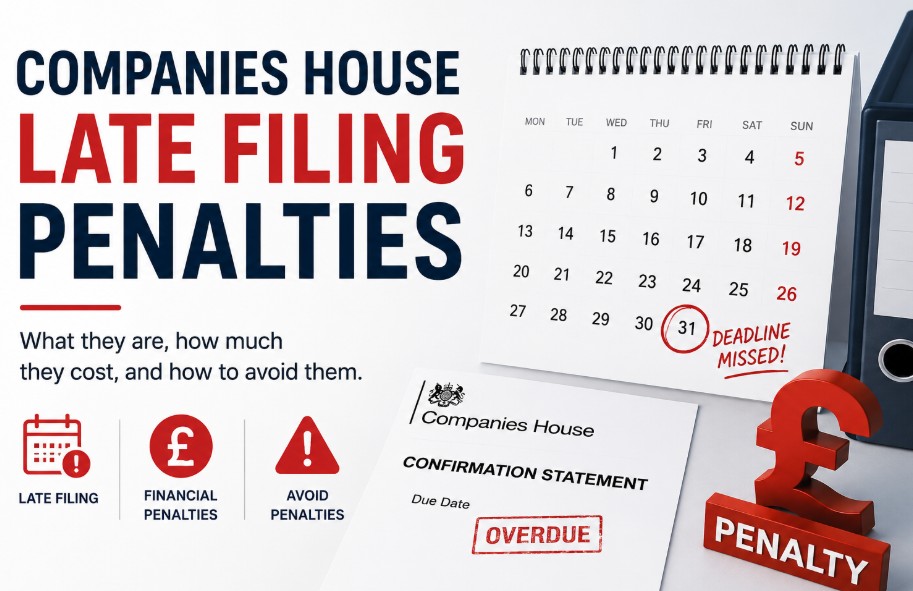
Companies House late filing penalties are automatic statutory civil fines issued to UK companies that fail to submit their annual accounts by their legal deadline.
These progressive financial penalties apply the day after the deadline passes, regardless of whether the company is small, active, or completely dormant.
Key Takeaways
-
Private limited company penalties start at £150 for accounts up to one month late and escalate to a maximum of £1,500 after six months.
-
Filing accounts late for two consecutive financial years automatically doubles the penalty amount at every tier of the escalating fee structure.
-
All late filing penalties issued by the Registrar of Companies are classified as civil fines and are not allowable expenses for Corporation Tax.
-
Failing to submit annual accounts or confirmation statements on time is a criminal offence that can lead to personal prosecution of directors.
What are Companies House late filing penalties?
Companies House late filing penalties are automatic financial fines levied by the UK government against businesses that miss their annual accounts deadline. Generated electronically the day after the deadline expires, these civil penalties escalate over time and apply uniformly to active and dormant corporate entities alike.
Under the Companies Act 2006, directors carry the absolute legal responsibility to ensure that their statutory documents are delivered to the Registrar of Companies on time.
No reminder or warning notice is issued before the penalty hits your account. These progressive fines apply uniformly across all types of companies, whether the entity is small, large, active, or completely dormant.

What is the deadline for filing accounts?
Avoid penalties by activating free digital email alerts in the Companies House portal, sending bookkeeping data to your corporate accountant within 90 days of year-end, and using the GOV.UK WebFiling portal to submit accounts instantly and avoid postal delays.UK WebFiling portal to instantly submit accounts and bypass postal delays.
For corporate updates, understanding Companies House change of name guidelines helps prevent mismatches between your filings and public records. Activate Automated Email Alerts: Sign up for the free digital reminder system on the Companies House portal to receive immediate email tracking alerts ahead of key deadlines.
However, new companies get extra breathing room for their very first set of accounts to accommodate the initial setup phase. The differences between first-year and subsequent filings are structured as follows:
First Accounts vs. Subsequent Accounts
| Company Type | First Accounts Filing Deadline | Subsequent Accounts Filing Deadline |
| Private Limited Company (LTD) / LLP | 21 months from the exact date of incorporation. | 9 months from the financial year-end (Accounting Reference Date). |
| Public Limited Company (PLC) | 18 months from the exact date of incorporation. | 6 months from the financial year-end (Accounting Reference Date). |
How much is the late filing penalty for Companies House?
Under the scaling framework set by the Registrar of Companies, late filing penalties scale based on how long the accounts remain outstanding.
Private limited company fines range from £150 for up to 1 month late, climbing to £1,500 for delays exceeding 6 months. Public limited company penalties are much higher, ranging from £750 to £7,500.
The table below outlines the progressive penalty structure:
| Delay Period (From Due Date) | Private Limited Company / LLP | Public Limited Company (PLC) |
| Up to 1 month | £150 | £750 |
| More than 1 month but under 3 months | £375 | £1,500 |
| More than 3 months but under 6 months | £750 | £3,000 |
| More than 6 months | £1,500 | £7,500 |
To calculate your specific penalty, you must measure the exact timeframe from the day after your filing deadline to the date the accounts are successfully delivered and accepted by Companies House.
What is the Companies House late filing penalties second year rule?
The second year rule dictates that if a company files its annual accounts late in two consecutive financial years, the statutory penalty for the second year is automatically doubled at every tier.
This increases the maximum private company fine from £1,500 to £3,000. For example, if a private limited company filed its 2024 accounts two weeks late, it received a standard £150 penalty.
If the same company files its 2025 accounts three weeks late, the penalty doubles to £300. If the filing is delayed by more than six months in that second consecutive year, the penalty reaches a costly £3,000.

Differentiating Penalties for Accounts vs. Confirmation Statements & HMRC
While late accounts trigger automatic progressive civil fines up to £1,500, missing your annual review is a criminal offence that can result in director prosecution and company strike-off.
Knowing how to file a confirmation statement online helps businesses prevent these sudden enforcement actions, while separate HMRC penalties deal strictly with corporate tax returns.
As a major risk factor, HMRC doubled its fixed penalties for late Corporation Tax returns (CT600) for the first time in decades, exposing negligent companies to dual financial penalties.
Regulatory Penalty Comparison Table
| Attribute / Rule | Companies House: Annual Accounts | Companies House: Confirmation Statement (CS01) | HMRC: Corporation Tax Return (CT600) |
| Filing Objective | Submits financial statements detailing the company’s fiscal performance. | Verifies public register details (directors, shares, registered office). | Submits the company tax return to calculate corporate tax liabilities. |
| Standard Deadline | 9 months from financial year-end (6 months for PLCs). | Within 14 days of the annual review period anniversary. | 12 months from the end of the accounting period. |
| Immediate Late Penalty | Progressive financial civil penalty starting at £150 (LTD) or £750 (PLC). | No immediate automatic financial penalty. | Fixed financial penalty of £200 from day one. |
| Maximum Penalty Tier | £1,500 for LTDs; £7,500 for PLCs (if over 6 months late). | No maximum fine tier; directly escalates to criminal action. | £400 fixed fine + 20% of any unpaid Corporation Tax (at 12 months). |
| Doubling Mechanisms? | Yes. Penalties automatically double if filed late 2 years in a row. | No. | Yes. Multiplies up to £2,000 for three consecutive late submissions. |
| Severe Consequences | Debt collection agencies, County Court Judgments (CCJs), and strike-off. | Rapid compulsory strike-off and personal prosecution of directors. | Daily interest charges and asset recovery actions from debt enforcement teams. |
| Legal Classification | Civil Fine (Not tax-deductible) | Criminal Offence (Section 853A Companies Act). | Civil Penalty & Tax Surcharges (Not tax-deductible) |
What is the HMRC penalty for late filing compared to Companies House?
When you run a limited company, you must file annual accounts with Companies House and a Company Tax Return (Form CT600) with HMRC.
As of April 2026, HMRC doubled its fixed penalties for late corporation tax returns for the first time in decades. If you submit your CT600 late, you will face HMRC penalties even if your company has no tax to pay or is dormant.
The table below illustrates how the two penalty systems run in parallel, creating a double jeopardy risk for negligent directors.
| Filing Delay | Companies House Accounts Penalty (LTD) | HMRC Corporation Tax Return (CT600) Penalty |
| 1 Day Late | £150 | £200 (increased from £100) |
| 3 Months Late | £375 | £400 total |
| 6 Months Late | £750 | £400 + 10% of any unpaid Corporation Tax |
| 12 Months Late | £1,500 | £400 + an additional 10% of unpaid tax |
Are Companies House late filing penalties allowable for tax?
No, Companies House late filing penalties are not allowable for tax. HMRC tax rules state that civil penalties or regulatory fines cannot be claimed as tax-deductible business expenses, meaning they must be added back to accounting profits during tax calculations.
Why are Companies House late filing penalties not allowable under corporation tax rules?
The statutory rules set out by HMRC are absolute: Companies House late filing penalties are not tax-deductible. Under UK tax law, civil penalties and fines imposed for infractions of regulatory requirements cannot be claimed as allowable business expenses.
When your accountant prepares your Company Tax Return (CT600), any Companies House late filing penalties must be added back to your accounting profit to calculate your taxable profit.
This means your company pays Corporation Tax on the funds used to settle the fine, increasing its real economic cost.
Can I appeal a Companies House late filing penalty?
Yes, you can appeal a Companies House late filing penalty using the official GOV.UK online portal. However, the Registrar will only write off a penalty if you can prove exceptional, unforeseen circumstances that were entirely out of the control of the company directors.
What is a reasonable excuse for a late filing penalty?
A reasonable excuse for a late filing penalty is an exceptional event that physically prevents document submission, such as a major fire or flood that destroys primary company records, a total system outage of the WebFiling portal, or sudden life-threatening hospitalization of key staff.
-
Sudden Catastrophic Events: A fire, flood, or natural disaster that physically destroyed your primary company records or computer systems directly prior to the deadline.
-
Severe System Outages: Unforeseen and documented system-wide crashes of the Companies House online filing portal on the day of your deadline, preventing electronic submission.
-
Critical Illness of Key Staff: Sudden, life-threatening hospitalization of the sole director or the single key individual responsible for filing, provided there was no other person capable of completing the submission.
What are invalid Companies House late filing penalties appeal reasons?
Invalid reasons for a Companies House appeal include accountant mistakes or illness, company dormancy, financial inability to pay the fine, ignorance of filing deadlines, or standard delays encountered in the postal service.
The legal responsibility to file always rests on the directors.
-
Accountant Negligence: Claiming your accountant, bookkeeper, or advisor was ill, made a mistake, or missed the deadline. The legal responsibility to file accounts rests solely on the company directors, not third-party advisors.
-
Dormancy: Arguing that the company was dormant, had no transactions, or made a financial loss. Dormant companies are still legally required to file accounts on time.
-
Ignorance of Deadlines: Stating that you did not receive a reminder letter, were unaware of the filing deadlines, or did not know how to submit accounts.
-
Postal Delays: Claiming the accounts were lost or delayed in the post, unless you can provide absolute postal proof of timely dispatch.
-
Financial Hardship: Arguing that the company cannot afford to pay the fine.
How to get out of a late filing penalty?
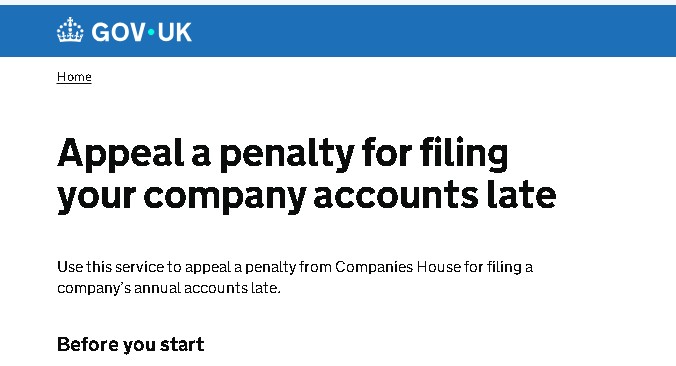
To get out of a late filing penalty, you must first file the overdue annual accounts. Once accepted, you submit a formal online appeal through the GOV.UK portal using your company number, penalty reference code, and documented proof of an exceptional circumstance.
-
File the Accounts First: You cannot appeal a late filing penalty until the overdue annual accounts have been successfully delivered and accepted by Companies House.
-
Submit the Online Appeal: Use the official GOV.UK online appeal service. You will need your 8-digit company registration number and the unique penalty reference number shown on your penalty notice.
-
Provide Documentary Proof: Upload clear scans or PDFs of any supporting evidence (such as medical letters, police reports, or technical portal error codes).
-
Wait for Review: Companies House will automatically suspend all debt collection and recovery actions while your appeal is being formally reviewed.
-
Escalate if Rejected: If the initial appeal is rejected, you can escalate your case by writing to the Senior Casework Manager in the Late Filing Penalties Department.
-
Independent Adjudicator: If still unsuccessful, you can request a further review by the Independent Adjudicators, who will objectively evaluate whether Companies House followed correct processes and behaved reasonably.
How do you know if you have Companies House late filing penalties?
You can verify if you have an active penalty by checking your physical mail for a formal postal penalty notice sent to your registered office, or by performing a real-time regulatory search via the official GOV.UK Find and Update Company Information portal.
The main tracking methods include:
-
Official Postal Notices: Companies House immediately issues a formal physical penalty notice directly to your registered office address the day after a deadline is missed.
- Online Status Checks: If you suspect you have missed a deadline, you can check your company’s real-time regulatory status using the official GOV.UK tracking tool. Given the strict nature of the ongoing Companies House company crackdown, using this portal is the fastest way to spot active overdue accounts or outstanding compliance enforcement warnings before they escalate.
-
Debt Agency Communications: If a penalty notice is left ignored, the status will become clear when Companies House formally hands the case over to third-party debt collection agencies to recover the funds.
How to avoid Companies House late filing penalties?
Avoid penalties by activating free digital email alerts inside the Companies House portal, ensuring bookkeeping data is handed to your corporate accountant within 90 days of year-end, and using the GOV.UK WebFiling portal to instantly submit accounts and bypass postal delays.
-
Activate Automated Email Alerts: Sign up for the free digital reminder system on the Companies House portal to receive immediate email tracking alerts ahead of key deadlines.
-
Implement a Three-Month Buffer: Never wait until the ninth month to package records for your corporate accountant. Ensure your internal bookkeeping tools are ready to pass over within 90 days of your financial year-end.
-
Transition Exclusively to Digital Filing: Submit your annual statements via the official GOV.UK WebFiling portal. Paper submissions processed via post face standard physical transit delays; if they arrive late, the fine triggers automatically. To clear this hurdle easily, ensure you know how to request and use your Companies House personal code to log in and securely execute digital submissions.
-
Utilize Form AA01 Appropriately: If your business requires genuine operational changes to its reporting dates, submit a formal request to change your Accounting Reference Date before your actual deadline expires. You cannot apply for a deadline extension or structural changes once the filing clock has run out.
How to pay off Companies House late filing penalties?
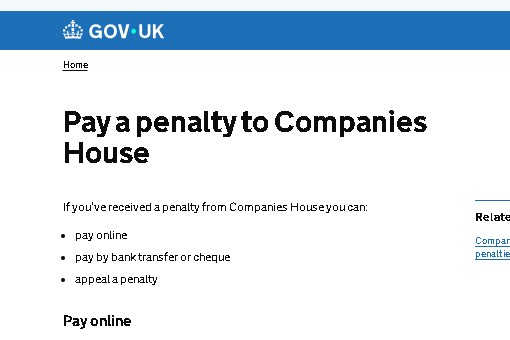
You can pay your late filing penalty online via the GOV.UK portal using a credit or debit card, or via electronic bank transfer (BACS/CHAPS). You must quote your 8-digit company number as the payment reference to ensure the balance is reconciled.
-
Electronic Bank Transfer (BACS/CHAPS): The safest method is a direct bank transfer to the official Companies House account. Note that corporate credit cards cannot be processed over the telephone.
-
Mandatory Reference Coding: When initiating the bank transfer, you must use your 8-digit company registration number as the unique payment reference. Without this exact identifier, the internal finance team cannot pair the funds to your profile, leaving the penalty marked as unpaid.
-
Remittance Validation: Immediately after paying, you must send a copy of your bank remittance advice note via email to [email protected], clearly stating your legal business name and company number to finalize the account reconciliation.
-
Instalment Agreements: If the business is experiencing documented cash flow problems, you can contact the support team at [email protected] to arrange a short-term structured monthly installment schedule to settle the outstanding balance.
Common reasons that Companies House late filing penalties rise
Late filing fees escalate due to the second-year doubling penalty rule, the misconception that dormant non-trading companies are exempt from filing deadlines, relying entirely on third-party accountants, and waiting out the uncompleted appeal process without submitting the missing records.
-
The Second Year Doubling Mechanism: If you fail to file on time for two consecutive financial years, the standard fee structure instantly doubles at every single duration tier. For private limited companies, a delay of over six months turns from a standard £1,500 fine into a severe £3,000 penalty on that second occasion.
-
Misunderstanding Inactive Status: Many directors assume that keeping a business dormant or non-trading stops the compliance clock. It does not. Dormant entities face the exact same escalating daily penalties as highly active businesses if their annual paperwork is delayed.
-
Accountant and Third-Party Reliance: Believing that hiring an outside accountant frees you from legal liability is a costly mistake. Under UK law, the corporate directors bear absolute responsibility. If your accountant gets sick, misses a deadline, or experiences a software crash, your company still receives the progressive penalty notice.
-
Delayed Appeals Processing: Appealing a fine does not pause the calculation timeline if your accounts remain unsubmitted. You cannot even access the formal online appeal gateway until the late accounts are fully uploaded, reviewed, and accepted on the register. Leaving filings uncompleted while trying to argue a case simply allows the penalty to climb into the higher financial bands.
Conclusion
Managing company filings is a critical pillar of statutory business compliance in the UK. To protect your business from unnecessary costs and corporate damage, ensure you establish robust compliance practices:
-
Activate Email Alerts: Register for the free Companies House email reminder service to track your filing dates automatically.
-
Coordinate with Advisors Early: Never wait until the ninth month to send records to your accountant. Instruct them at least three months prior to your deadline.
-
Go Digital: Submit your accounts and confirmation statements online to guarantee instant receipt and avoid postal delays.
FAQ
How long do you have to pay a Companies House fine?
You should pay the late filing penalty within 28 days of the date printed on the official penalty notice. Failing to pay or appeal within this timeframe will result in the debt being passed to collection agencies.
Can a penalty be written off or waived?
Fines are only written off in genuinely exceptional circumstances where filing on time was physically impossible due to external events out of your control, such as a localized natural disaster. Lack of funds or accountant errors will not result in a waiver.
Do dormant companies have to pay late filing penalties?
Yes, dormant companies must still file statutory accounts annually with Companies House. If dormant accounts are submitted late, they are subject to the exact same progressive penalty fees as active, trading businesses.
Can I set up a payment plan for a penalty?
If your business is experiencing temporary financial difficulty, Companies House will usually accept a structured monthly payment plan over a short period. You must email your written request to [email protected].
Who is personally liable for paying a company penalty?
While the civil late filing penalty is legally issued to the company entity, directors can face personal prosecution and personal fines in criminal court for failing to file statutory accounts.
What happens if I file by post and it gets delayed?
If you submit your accounts via paper post and they arrive after your statutory deadline, the automatic penalty will apply. Companies House strongly encourages all businesses to use digital web filing to ensure instant, recorded delivery.
Disclaimer: This article is for informational purposes only and does not constitute formal legal or professional financial advice; always consult a certified UK accountant or legal professional regarding specific statutory company compliance matters.