
Companies House Company Crackdown: The Complete 2026 Compliance, Verification Guide
Last Updated on
The UK corporate registry landscape is undergoing its most sweeping enforcement shift in decades. Under the active Companies House company crackdown, the regulatory body has transitioned from a passive directory into an active law enforcement gatekeeper.
For business owners, directors, and shareholders across the United Kingdom, maintaining corporate compliance now requires immediate identity validation to prevent severe financial penalties, frozen filings, or forced corporate termination.
What Is the Companies House Company Crackdown?
The Companies House company crackdown is a sweeping regulatory and enforcement initiative designed to transform the UK’s corporate registry from a passive repository of information into an active law enforcement gatekeeper.
Spearheaded by the implementation of the Economic Crime and Corporate Transparency Act (ECCTA), this crackdown marks the end of self-certified, unverified corporate entity creation in the United Kingdom.
The Identity Shift from Anonymity to Biometrics
For nearly two centuries, the UK registration landscape operated on absolute trust, accepting self-certified filings without demanding concrete proof of a person’s real-world identity.
The current regulatory pivot permanently strips away this historic anonymity, requiring definitive biometric proof of life to permanently sever the link between UK corporate structures and fictional personas.
Rather than simply accepting digital documents at face value, Companies House now actively audits, cross-references, and validates the data submitted to its database.
The core focus of the crackdown is ensuring absolute transparency regarding who owns, manages, and controls every business structure across England, Scotland, Wales, and Northern Ireland.
Why Is the Companies House Company Crackdown Happening?
The crackdown targets structural loopholes that allowed bad actors to quickly form shell companies using hijacked addresses or fictional names, exposing the UK economy to rampant financial fraud, identity theft, and global money laundering networks.
For decades, the UK’s low barriers to company formation made it highly vulnerable to corporate abuse.
Because Companies House lacked the statutory powers to verify data accuracy, anyone looking to how to register a company could set one up in minutes using fictional names, hijacked residential addresses, or stolen identities. This lack of oversight created distinct regulatory loopholes:
-
Combating Financial Crime and Money Laundering: Anonymous shell networks were frequently exploited by bad actors to launder illicit funds and obscure the true beneficial owners of UK assets.
-
Eliminating Identity Theft and Fraud: Fraudsters routinely registered fraudulent businesses using the home addresses of innocent citizens without their consent, driving a massive surge in demand for a secure, verified registered office address service.
-
Protecting the Integrity of the UK Economy: By purging inaccuracies, false filings, and unverified overseas corporate directors, the government aims to restore international trust in the UK commercial landscape and ensure that the public register is a reliable tool for banks, creditors, and clients.
How Does a Companies House Company Crackdown Exist?
The crackdown operates via a tri-layered enforcement system: mandatory biometric identity verification, automated registry data-scrubbing algorithms, and immediate escalation to civil fines, forced company strike-offs, or criminal prosecutions by the Insolvency Service.
The enforcement mechanism unfolds across three distinct layers:
Mandatory Identity Verification (IDV)
Every new and existing director, Person with Significant Control (PSC), and Authorised Corporate Service Provider (ACSP) must verify their identity using biometric documents (like a passport or photo driving licence) via platforms like GOV.UK One Login.
If an individual fails this verification, they cannot legally file documents or be appointed to a corporate role.
Proactive Investigation and Data Scrubbing
Companies House officers use automated tools to scan the registry for suspicious patterns, inconsistent filing dates, and high-risk addresses.
The registrar now has the legal authority to reject inconsistent filings, remove false data directly from the public index without a court order, and cross-reference information with domestic security databases.
Escalated Statutory Enforcement
When a non-compliant or suspicious entity is flagged, Companies House executes a strict enforcement sequence:
-
Warning Communications: Issuing formal non-compliance notices (as seen with the 983,000 warning letters sent out during the early enforcement wave).
-
Financial Intervention: Levying escalating administrative fines up to £10,000 directly against both the corporate entity and individual directors.
-
Registry Flagging: Appending permanent unverified warning tags to individual profiles on the public-facing portal.
-
Forced Closure: Moving persistent offenders straight to the compulsory strike-off process, resulting in corporate termination and the immediate forfeiture of bank accounts and assets to the Crown.
Which Businesses Must Register with Companies House?
All legally incorporated UK structures, including Ltds, PLCs, LLPs, and guaranteed companies, must comply with the crackdown regardless of company size. Individual sole traders are entirely exempt, as they register directly through HMRC.
Here is a straightforward breakdown of who is included, who is excluded, and who the government is actively targeting.
The Businesses That MUST Comply
Any business that operates as a separate, legally incorporated entity must register with Companies House. Size does not matter here; small startups and micro-businesses face the exact same rules as massive corporations.
The monitoring mechanisms apply directly to:
-
Private Limited Companies (Ltd): The most common structure for small businesses and contractors.
-
Public Limited Companies (PLC): Larger businesses that sell shares to the public.
-
Limited Liability Partnerships (LLP) & Limited Partnerships (LP): Common structures for professional firms like accountants, lawyers, and investment funds.
-
Companies Limited by Guarantee: Typically used by charities, clubs, and non-profits.
The Only Major Exception
If you run a business as a sole trader (self-employed), you do not have a profile on Companies House. Your business is managed exclusively through HM Revenue and Customs (HMRC) for tax purposes.
Because your business is not a separate legal entity, you are exempt from these specific Companies House verification rules.

Who Is the Main Target of This Companies House Company Crackdown?
While every registered director must verify their identity, the regulatory crackdown is specifically designed to flush out specific high-risk setups. The rules are targeted based on control and influence, rather than how much money a business makes.
The primary targets include:
-
Persons with Significant Control (PSCs): Anyone who owns or controls more than 25% of a company’s shares or voting rights. They face the exact same biometric identity checks as company directors.
-
Overseas Entities and Foreign Directors: A major goal of this crackdown is closing international loopholes. If a foreign company operates an established branch inside the UK, its individual directors must complete the UK identity verification process, regardless of where they physically live in the world. This prevents bad actors from using international shell companies to anonymously own UK assets or property.
What Happens If You Do Not Confirm Your Identity with Companies House?
Failing to complete identity verification initiates an automated enforcement sequence that escalates from electronic system rejections to criminal prosecution.
As of current regulatory mandates, completing identity verification has become an absolute statutory prerequisite for registering any new corporate entity or formalising fresh executive appointments.
If an unverified individual attempts to submit an AP01 form to appoint a new director, the electronic gateway rejects the document immediately, rendering the appointment legally invalid until the individual complies with the verification protocol.
The Strict 2026 Deadlines and Transition Windows
The formal identity verification framework launched its transition window on 18 November 2025, providing a strict 12-month period for existing corporate officers to submit their information. This creates a rolling series of deadlines across 2026.
- Mandatory New Verification Begins: Identity verification becomes a strict statutory pre-condition for all new company incorporations and fresh director appointments. Electronic gateways automatically reject unverified AP01 forms.
- PSC Non-Director Deadlines Begin: Existing Persons with Significant Control (PSCs) who do not serve as directors face individual 14-day compliance windows linked directly to their month of birth (e.g., a March birthday means verification must start on 1 March 2026).
- Existing Director Rolling Deadlines: Existing directors must verify their identity and submit their personal verification code alongside their company’s first Annual Confirmation Statement (CS01) filed within this window.
- Transition Grace Period Closes: The 12-month transition window expires. Full enforcement powers drop, enabling Companies House to escalate criminal prosecutions, civil fines up to £10,000, and corporate strike-offs.
What happens if you don’t file a confirmation statement on time?
The entire corporate profile is flagged as non-compliant. Under the updated powers granted to the registrar, the consequences of persistent non-compliance are severe:
-
Immediate Financial Penalties: The registry can levy escalating fines up to £10,000 directly against both the corporate entity and individual directors without requiring an initial court order.
-
Public Registry Flagging: The public-facing Companies House company overview portal appends a permanent unverified warning tag next to the non-compliant individual’s name, impacting banking arrangements and client due diligence.
-
Insolvency Service Referral: Flagrant evasion cases are systematically routed to the Insolvency Service. As of mid-2026, over a dozen targeted investigations have been initiated to actively wind up entities suspected of deliberate regulatory evasion.
-
Compulsory Strike-Off: The legal entity is forcibly terminated and moved to the Companies House dissolved companies list, resulting in the immediate forfeiture of all corporate bank accounts and commercial assets to the Crown.

The Forced Companies House Strike-Off Process vs. Closing Down
Closing down a company involves a voluntary DS01 application by choice. A forced Companies House strike-off is an involuntary disciplinary action executed by the registrar for systemic compliance failures, liquidating all corporate assets to the Crown.
Business owners must differentiate between an orderly, voluntary closure and an involuntary regulatory strike-off triggered by compliance failures. Can you just shut down a company whenever you want? While a director can choose to close a solvent business, they must follow a formal application procedure.
The structural differences below outline how these two paths diverge in process, costs, and consequences:
Voluntary Closure vs. Involuntary Strike-Off
| Metric / Feature | Voluntary Closure (Dissolution) | Involuntary Strike-Off (Disciplinary) |
| Initiated By | Company Directors / Board of Owners | The Registrar of Companies House |
| Primary Trigger | Business choice (retirement, restructuring, or solvent cessation) | Systemic compliance failure (missing filings, unverified directors) |
| Legal Document | DS01 Digital Application Form | Official Gazette Warning Notification |
| Statutory Cost | Small standard electronic filing fee | £0 (But risks penalty charges up to £10,000) |
| Pre-requisites | Must not have traded, changed names, or sold stock for 3 months | Occurs automatically after statutory warnings are ignored |
| Objection Window | 2 Months if a creditor disputes the closure | 2 Months to submit an urgent stay of execution |
| Asset Outcome | Distributed legally among shareholders and owners | All assets and frozen bank accounts forfeit to the Crown |
How to File a Confirmation Statement and Verify Your Identity Securely?
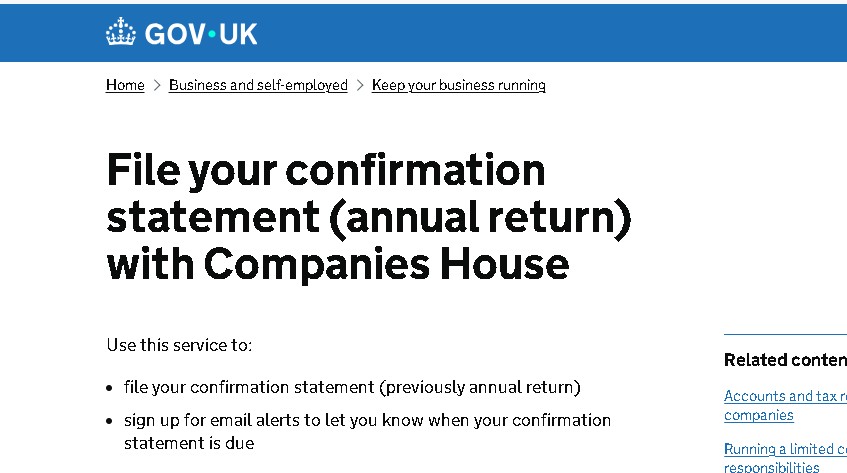
File your annual confirmation statement digitally using the direct web gateway. Ensure all directors and PSCs holding over 25% control have pre-verified their identity via GOV.UK One Login, an ACSP, or the Post Office to generate their required verification codes.
The annual confirmation statement verifies that all public data regarding your business structure, including your registered office address, share allocations, and executive records, remains entirely accurate.
Can I do a confirmation statement myself?
Yes, company officials can easily submit this documentation using online filing software or the direct web gateway.
When looking at what a Companies House confirmation statement looks like, it functions as a consolidated digital summary checklist confirming your operational profile.
Under the updated transparency laws, the form now requires the full names of all shareholders within your internal logbooks and an explicitly verified personal identity code for all core leaders.
The Steps for Filing and Verification
- Determine Shareholder and PSC Verification Status: Audit your ownership logs. Minority shareholders holding less than 25% of shares or voting rights are exempt. Any individual holding more than 25% qualifies as a Person with Significant Control (PSC) and must complete verification.
- Select Your Regulatory Identity Validation Route: Choose your verification pathway: the free GOV.UK One Login app (ideal for standard UK passport/driving licence holders), the Post Office Branch Network (for in-person processing), or an approved ACSP accountant/solicitor (best for international directors).
- Secure the Unique Personal Identity Code: Complete your identity validation by scanning your physical biometric credentials and completing a facial check. Once verified by the system, save the permanent unique personal verification code issued to you.
- Access the WebFiling Gateway or Software: Log in safely to the official Companies House portal using your company credentials and enter your unique eight-digit company registration number.
- Input Verification Codes and Audit Corporate Profile: Review your registered office address, internal shareholder lists, and officer details. Input the personal verification codes for all active directors and PSCs directly into the text fields.
- Submit the Confirmation Statement (CS01): Confirm that the informational breakdown is accurate, authorize the electronic signature, and submit the statement. Check your email for a formal receipt showing a Verified status tag on the public register.
Regulatory Identity Validation Methods
| Validation Pathway | Cost Metrics | Operational Requirements | Ideal User Profile |
| GOV.UK One Login | Entirely Free | Requires a smartphone, a valid biometric identity document, and a personal digital account. | Standard UK residents holding a modern passport or driving licence. |
| Post Office Branch Network | Standard In-Person Fee | Requires filling out your initial passport or driving licence details online first, then presenting a generated barcode at a participating local branch. | Individuals who prefer physical document processing or encounter app compatibility issues. |
| Authorised Corporate Service Provider (ACSP) | Varies by Agency | Handled through an approved third-party intermediary, such as a registered accountant or solicitor. | Complex organizations, international directors, or businesses managing multiple corporate officers. |
Accessing Your Companies House Company Details Safely
Securing your business records requires regular review of your information to ensure no unauthorized changes have occurred. Security remains a critical priority for directors following a notable technical event earlier this year.
Between October 2025 and March 2026, a five-month vulnerability in the WebFiling platform allowed logged-in users to access and potentially alter external company details without explicit consent under specific circumstances.
While the registry has patched this vulnerability, directors should systematically check their public profiles to ensure their data remains secure.
Step-by-Step Verification and Security Checklist
-
Access the Public Index: Navigate to the official online search tool and input your unique eight-digit company registration number to review your public Companies House company list data.
-
Audit Core Filing Histories: Review all documentation logged over the past year, paying close attention to any unexpected address changes or unauthorized executive appointments.
-
Establish Your Digital Identity: Log in to the official identity verification platform using a secure GOV.UK One Login profile.
-
Submit Valid Biometric Credentials: Use a smartphone camera to scan a biometric document (such as a valid UK driving licence or international passport) to confirm your identity.
-
Secure Your Personal Identity Code: Once approved, save the unique personal verification code issued by the system. This code stays with you permanently and applies across all current and future corporate appointments.
-
Link Code to Corporate Filings: Input your personal verification code into your next annual confirmation statement to formally link your verified identity to your business profile.
How do I know if I have successfully verified my identity with Companies House?
Once the system confirms your details, your profile will display a unique personal verification code, and a confirmation notice will be sent to your registered email address. The public registry will then update to show a verified status next to your director or PSC listing.
Summary
The current corporate environment requires business owners to be proactive about regulatory compliance.
To protect your operations from potential penalties or forced closure, ensure all directors and Persons with Significant Control (PSCs) complete their identity verification ahead of your next annual confirmation statement deadline.
Taking these steps early helps secure your business records and keeps your company in good standing with the registry.
Verified against official Companies House and Department for Business and Trade transparency frameworks.
Disclaimer: This article provides regulatory information for educational purposes and does not constitute formal legal advice.
FAQ
How to check if a company is real or fake?
Search the business name on the public registry portal to view its current filing status. Real entities display clear financial histories, verified office locations, and active officer listings, whereas fake entries often present inconsistent filing dates or appear on the Companies House dissolved companies list.
Is it safe to confirm identity online using GOV.UK One Login?
Yes, the platform utilizes government-grade cryptographic security protocols and identity-matching algorithms to process biometric details safely, ensuring personal credentials remain protected against unauthorized access.
What gaps or company loopholes are being closed by this crackdown?
The crackdown eliminates anonymous corporate registrations, unverified third-party paper filings, the use of unverified overseas corporate directors, and the exploitation of false or hijacked residential addresses.
What identity documentation satisfies the new UK anti-fraud criteria?
Acceptable documents include a biometric passport, a full or provisional UK photo driving licence, a UK biometric residence permit, or an identity profile verified through a registered professional agent (ACSP).
Can an accountant verify my identity for Companies House?
Yes, provided your accountant or firm is registered with the registry as an Authorised Corporate Service Provider (ACSP) and maintains active anti-money laundering supervision.
What is proof of identity in the UK for this process?
Proof requires linking verified government-issued photo identification to an individual’s biometric profile, confirming that the person registering or managing a company matches their real-world identity.
Does this crackdown apply to dormant companies?
Yes, all limited entities listed on the active register must complete identity verification for their directors and PSCs, regardless of whether the business is actively trading or dormant.




One Comment