100k After Tax UK: Complete Take-Home Salary Breakdown, Tax Traps & Pension Solutions
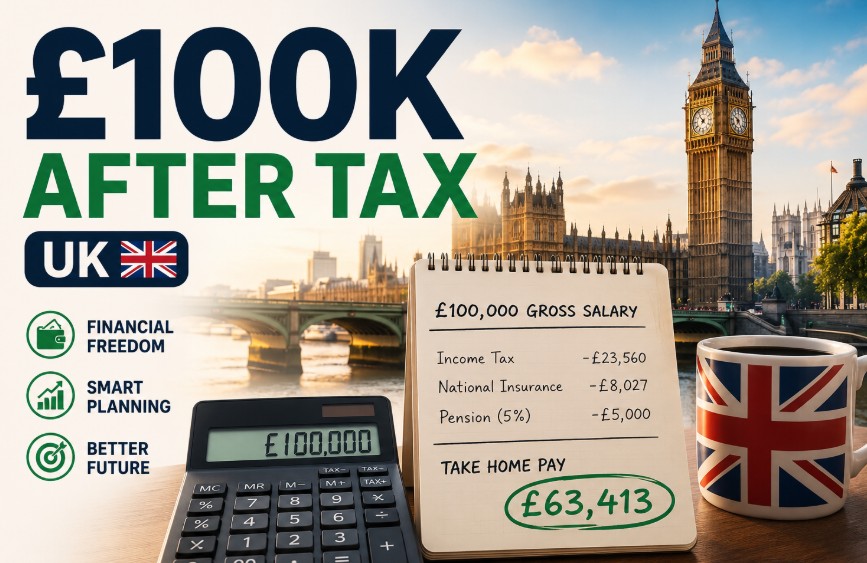
Earning £100k after tax UK results in a net annual income of approximately £70,545 for a standard PAYE employee in England and Wales with no pension deductions or student loans.
This figure fluctuates significantly depending on geographic location, workplace pension contributions, student loan repayment plans, and whether income is earned through PAYE or self-employed dividends.
Key Takeaway
-
Understanding the exact take-home figures for a six-figure salary prevents unexpected budgeting shortfalls throughout the financial year.
-
Navigating the 100k tax trap requires strategic pension adjustments to protect your hard-earned personal allowance from tapering away.
-
Comparing PAYE and self-employed structures clarifies how limited company dividends alter net annual earnings and tax liabilities.
-
Evaluating student loan deductions and regional tax variations ensures accurate financial planning for high-earning professionals.
How Much Is £100,000 After Tax UK?
For an individual living in England, Northern Ireland, or Wales under standard PAYE tax codes with zero pension contributions, a gross salary of £100,000 results in an annual net take-home pay of £70,545, after total combined tax and National Insurance deductions of £29,505.
Evaluating the exact monthly, weekly, and daily figures for a £100k salary provides clarity for financial management. The exact financial breakdown is structured below.
Annual, Monthly, Weekly, and Daily Breakdown Table
| Pay Period | Gross Amount | Net Amount (England/Wales) | Total Tax and NI Deductions |
| Annual | £100,050 | £70,545 | £29,505 |
| Monthly | £8,337 | £5,878 | £2,459 |
| Weekly | £1,923 | £1,356 | £567 |
| Daily (5-day week) | £384 | £271 | £113 |
Weighing up a fresh job offer or a promotion means looking past the headline gross salary to focus on actual spendable cash, much like evaluating an 80k salary, helping you dodge nasty lifestyle inflation shocks.
In practice, monthly cash flow remains steady, but sudden changes in tax codes can trigger unexpected HMRC adjustments that alter the net figures shown above.
How Scotland’s Tax Bands Change the £100k Take-Home Calculation?
Taxpayers residing in Scotland fall under Scottish Income Tax rates rather than rest-of-UK bands.
Due to steeper advanced and top-rate percentages north of the border, a £100,000 salary yields a slightly lower net annual take-home figure, typically reducing annual net pay by several hundred pounds compared to English tax codes.
How Does Earning a Six-Figure Salary Impact Net Income?
When professionals cross the six-figure threshold, calculating net earnings involves examining statutory deductions administered by HMRC, where progressive income tax bands and National Insurance contributions interact dynamically to reduce raw nominal pay into actual spendable bank deposits.
Once your gross earnings climb into higher brackets, income tax bands and National Insurance contributions kick in simultaneously, quietly trimming that raw headline figure down to your actual bank deposit.
How Do Higher Rate Deductions Actually Work?
The UK tax system applies a progressive structure where earnings are taxed across distinct thresholds rather than a flat percentage.
For someone earning £100,000, the Personal Allowance covers the first portion tax-free, followed by the basic rate and the higher rate of 40% on income above the higher rate threshold.
National Insurance contributions are calculated separately on a primary threshold basis, meaning the effective tax rate blends multiple statutory percentages into a single final take-home figure.
How Is Income Tax and National Insurance Calculated?
Income Tax in the UK is calculated using a progressive marginal system. This means you do not pay a flat rate across your entire salary; instead, your income is divided into distinct portions (or bands), and each slice is taxed at its corresponding rate.
Alongside Income Tax, employees also pay Class 1 National Insurance Contributions (NICs) on their earnings. The breakdown across the Personal Allowance, regional tax systems, and National Insurance mechanics is structured below:
The Personal Allowance & The £100,000 Taper
| Allowance Rule | Threshold / Mechanics | Tax Rate / Impact |
| Standard Personal Allowance | Up to £12,570 | 0% tax-free allowance |
| The £100,000 Taper Zone | £100,001 to £125,140 | Allowance reduces by £1 for every £2 earned |
| Effective Marginal Rate (Taper) | £100,001 to £125,140 | 60% effective rate (due to combined taper and 40% tax) |
Regional Income Tax Bands
While England, Wales, and Northern Ireland share a unified set of tax bands, Scotland operates under independent tax brackets set by the Scottish Parliament.
England, Wales & Northern Ireland Tax Bands
| Tax Band | Taxable Income Range | Tax Rate |
| Personal Allowance | £0 to £12,570 | 0% |
| Basic Rate | £12,571 to £50,270 | 20% |
| Higher Rate | £50,271 to £125,140 | 40% |
| Additional Rate | Over £125,140 | 45% |
Scotland Tax Bands
| Tax Band | Taxable Income Range | Tax Rate |
| Starter Rate | Up to £3,967 | 19% |
| Scottish Basic Rate | £3,968 to £16,956 | 20% |
| Intermediate Rate | £16,957 to £31,092 | 21% |
| Higher Rate | £31,093 to £62,430 | 42% |
| Advanced Rate | £62,431 to £125,140 | 45% |
| Top Rate | Over £125,140 | 48% |
National Insurance Contributions (NICs)
Unlike Income Tax, National Insurance thresholds do not taper away at £100,000, meaning high earners continue to pay the flat secondary rate on income stretching past the upper limit.
| Class 1 NIC Tier | Earnings Threshold Range | Employee Contribution Rate |
| Zero Rate (Primary Threshold) | Up to £12,570 per year (£1,048/month) | 0% |
| Main Rate | £12,570 to £50,270 per year | 8% |
| Higher Rate (Above UEL) | Over £50,270 per year | 2% |
What Is the Tax Code for a £100k Salary in the UK?
The standard tax code for an individual earning a single income stream up to £100,000 is 1257L.
-
What 1257L means: The numbers represent your tax-free personal allowance divided by 10 ( becomes 125), while the letter L indicates that you are entitled to the standard tax-free personal allowance. Under this code, your employer allocates your tax-free allowance evenly across your pay periods (e.g., roughly £1,047.50 tax-free per month).
-
The £100,000 Shift: If your salary is exactly £100,000 with no other adjustments, you still technically retain your full 1257L code because your base earnings sit right at the threshold. However, if you receive a bonus, a pay rise above £100,000, or additional taxable income, HMRC will typically adjust your tax code downward (or issue a secondary code like 0T) to account for the tapering of your Personal Allowance.
How Is the Tax Code Decided on a Salary Amount?
HMRC decides and assigns tax codes based on information provided by your employer, pension provider, or you as an individual. They calculate your code by evaluating what you are allowed to earn tax-free against any adjustments or benefits you receive.
The determination process relies on:
-
Income Adjustments: HMRC adds up your expected taxable income for the year. If you earn over £100,000, HMRC reduces your code to claw back the Personal Allowance you are losing due to the taper.
-
Company Benefits and Expenses: If you receive company benefits (such as a company car, health insurance) or owe tax from a previous year, HMRC lowers your tax code so extra tax is collected automatically via the PAYE (Pay As You Earn) system.
-
Multiple Income Streams: If you have more than one job or a pension alongside employment, HMRC splits your allowances across your jobs, allocating different codes to each employer to ensure you aren’t underpaying or overpaying overall.

Is £100k a Good Salary in the UK?
Securing a six-figure income places an individual within the top 3% to 4% of full-time earners across the United Kingdom, rendering it an exceptional professional milestone, though urban living costs in regions like London can temper overall purchasing power.
What Percentage of British People Earn Over £100k?
Official Office for National Statistics data indicates that earning £100,000 places an individual well within the top tier of full-time earners across the United Kingdom, representing roughly the top 3% to 4% of the working population.
This rarity highlights why achieving this financial milestone is a common career objective for ambitious specialists and corporate leaders.
Is £100k Now Middle Class or Considered a High Salary in the UK?
While historical definitions of class relied heavily on occupation, shifting up from a baseline 70k income frames a £100k figure as an upper-middle-class or high professional bracket.
In high-cost regions, mortgage costs, childcare expenses, and private schooling can make this salary feel comfortable rather than extravagant, maintaining everyday middle-class lifestyle constraints despite the high nominal figure.
What Jobs Pay £100k in the UK?
Professions commanding six figures typically include senior medical consultants, corporate lawyers, investment bankers, enterprise software architects, and C-suite executives.
Meanwhile, a true top 1% salary in the UK climbs significantly higher, generally starting above £180,000 to £200,000 depending on the specific economic region and sector.
How Do Student Loans and Pensions Impact Your £100k Salary?
Mandatory deductions like student loan repayments subtract fixed percentages above regional thresholds, whereas workplace pension contributions via salary sacrifice successfully lower adjusted net income to protect take-home pay and mitigate high tax brackets.
How Does 100k after tax UK Handle Student Loan Repayments?
Graduates maintaining active loan balances under Plan 1, Plan 2, Plan 4, Plan 5, or Postgraduate loan schemes face additional deductions calculated as a fixed percentage of income exceeding specific thresholds.
For a £100,000 earner, a Plan 2 loan deducts 9% of earnings above the repayment threshold, which can subtract over £6,000 annually from gross pay, further lowering the net cash received.

How Do Workplace Pensions and Salary Sacrifice Optimize Net Income?
Participating in a workplace pension scheme through salary sacrifice reduces gross taxable income before tax, and National Insurance is calculated.
Diverting a portion of a six-figure salary into a pension pot lowers the official adjusted net income, mitigating high tax brackets and accelerating retirement savings simultaneously.
Why Earning Between £100k and £125k Hurts?
The £100k tax trap occurs because HMRC reduces your tax-free Personal Allowance by £1 for every £2 earned between £100,001 and £125,140, forcing income in this bracket to suffer both the standard 40% rate and an extra 20% taper penalty, resulting in a punishing 60% marginal tax rate.
What Is the 100k Tax Trap in the UK?
For every £2 earned above £100,000, HMRC reduces your tax-free Personal Allowance by £1 until it reaches zero at an income of £125,140.
This means income within this bracket suffers both the standard 40% higher rate tax and an extra 20% tax due to the lost allowance, creating a punishing 60% marginal tax rate.
Is It Better to Earn £99k or £100k in the UK?
A common query among high earners is whether crossing into the six-figure zone actually reduces take-home pay due to marginal traps. Earning £99,000 keeps your full personal allowance intact, whereas earning slightly over £100,000 triggers the allowance taper on the excess amount.
| Income Level | Personal Allowance | Effective Marginal Tax Rate | Net Take-Home Pay Estimate |
| £99,000 | £12,570 (Full) | Standard Higher Rate (40%) | ~£70,100 |
| £100,000 | £12,570 (Full) | Standard Higher Rate (40%) | ~£70,545 |
| £110,000 | £7,570 (Reduced) | 60% Taper Rate | ~£72,500 |
| £125,140+ | £0 (Fully Lost) | Standard Higher Rate (40%) | ~£80,100 |
How Much Is £120k Taxed Compared to £100k?
Earning £120,000 results in a substantial portion of the Personal Allowance being erased, meaning total tax liabilities scale disproportionately larger than the linear increase in gross salary.
A common pattern is that professionals earning between £100k and £125k intentionally utilize pension contributions to bring their adjusted net income back down to the £100,000 threshold, avoiding the 60% trap entirely.
How Does Self-Employment Change £100k After Tax UK?
Freelancers and limited company directors navigate a completely different tax rulebook; sole traders face standard income tax alongside Class 2 and 4 National Insurance, while directors usually trim their liabilities by drawing a modest salary topped up with lower-taxed company dividends.
Sole Trader vs Limited Company Dividend Strategies
Sole traders pay Class 4 and Class 2 National Insurance contributions alongside standard income tax rates on net profits.
Conversely, limited company directors can optimize their tax burden by taking a small salary up to the primary National Insurance threshold and extracting the remainder of their £100k earnings via company dividends, which benefit from lower dividend tax rates.
Handling Bonuses and Irregular Cash Flow
Managing variable income requires careful forecasting to avoid sudden jumps into higher tax brackets during isolated months.
When a large corporate bonus pushes annual earnings past £100,000, PAYE systems often apply emergency or cumulative tax adjustments that temporarily depress monthly take-home pay until HMRC reconciles the annual account.
Conclusion
Maximizing a six-figure income requires proactive oversight of pension contributions, tax codes, and corporate structuring options.
By understanding how statutory deductions, student loans, and marginal tax traps interact, professionals can protect their net earnings and secure long-term financial stability without falling victim to unexpected HMRC liabilities.
FAQ
How much do you get after tax on 100k in the UK?
An individual in England with no student loans or pension deductions takes home approximately £70,545 net per year, translating to around £5,878 per month after all statutory deductions.
How much is £100,000 a month after tax?
The monthly net take-home pay on a standard £100,000 annual salary is approximately £5,878, assuming standard tax codes and zero supplementary deductions or pension contributions.
How much to earn 100k after tax UK?
To achieve a net take-home pay of £100,000 after tax in the UK, an individual requires a gross annual salary of approximately £152,000 under standard PAYE tax bands.
What is my tax code if I earn £100,000?
The standard tax code for an individual with one job and no additional income sources is 1257L, though this code adjusts if benefits-in-kind or previous underpayments exist.
Does the £100k tax trap apply to gross or net income?
The £100k tax trap applies to your Adjusted Net Income, which is your total taxable income minus specific deductions like gift aid donations and gross pension contributions.
How rare is it to make 100k a year?
Making £100,000 a year is relatively rare, placing an earner within roughly the top 3% to 4% of full-time employees across the entire United Kingdom workforce.
Is it better to earn 99k or 100k in the UK?
Earning £100k is mathematically better for overall net income because gross take-home pay increases, even though the marginal tax rate begins to rise slightly on earnings above that mark.
Disclaimer: This article is for informational purposes only and does not constitute formal financial, tax, or legal advice; always consult a qualified professional or HMRC guidelines regarding your personal tax circumstances.