Complete £65k After Tax UK Breakdown: Take-Home Pay, Tax Brackets, and Deductions Guide
Earning £65k after tax in the UK requires a comprehensive understanding of HM Revenue and Customs (HMRC) progressive tax brackets, National Insurance thresholds, and workplace deductions under current PAYE regulations.
For an individual earning a gross annual salary of £65,000, your final take-home pay is shaped by statutory state deductions before accounting for optional commitments like pensions or student loans.
Key Takeaways
-
Earning a gross salary of sixty-five thousand pounds in England yields an estimated annual net take-home pay of forty-eight thousand two hundred fifty-eight pounds.
-
The standard personal allowance remains at twelve thousand five hundred seventy pounds, meaning income up to this threshold incurs zero income tax liability.
-
Earnings moving past the threshold typical of a £50k salary step directly into the higher-rate tax bracket, applying a forty percent marginal rate to the taxable surplus.
-
National Insurance contributions are calculated at varying percentage thresholds across primary earnings limits, directly reducing total annual gross remuneration.
How much is the 65k After Tax UK?
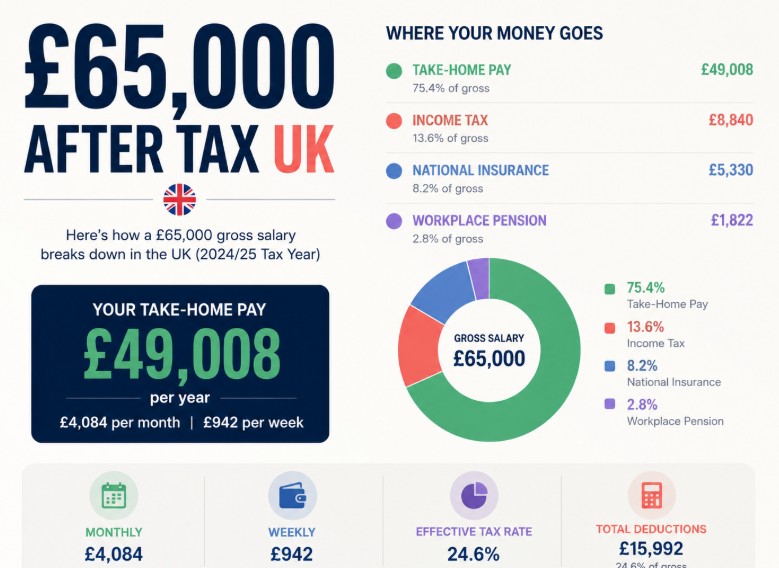
A £65,000 gross salary breaks down to £4,021.47 per month, £928.03 per week, and £24.75 per hour (based on a 37.5-hour work week) in net take-home pay after standard tax and National Insurance deductions in England.
Hourly, Daily Table
For those evaluating their earnings on a granular time scale based on a standard working year (approx. 260 working days or 52 weeks at 37.5 to 40 hours per week), the breakdown of a £65,000 gross salary versus net take-home pay (after standard Income Tax and National Insurance in England) is outlined below:
| Time Period | Gross Amount (£) | Net Take-Home Amount (£) |
| Hourly (Based on 37.5 hrs/wk) | £33.33 | £24.75 |
| Daily (Based on 5 days/wk) | £250.00 | £185.61 |
Weekly, Monthly, Yearly Table
The macro breakdown of your gross earnings versus net take-home pay across standard financial reporting cycles is structured as follows:
| Frequency | Gross Salary (£) | Estimated Net Pay (£) |
| Weekly | £1,250.00 | £928.03 |
| Monthly | £5,416.67 | £4,021.47 |
| Yearly | £65,000.00 | £48,257.60 |

What is the Breakdown of £65k After Tax UK?
The statutory breakdown of a £65,000 salary comprises a tax-free Personal Allowance of £12,570, basic rate tax of £7,540 on income up to £50,270, higher rate tax of £5,402 on the remaining surplus, and National Insurance contributions of £3,800.40.
To understand how your gross salary of £65,000 transitions into your final net take-home pay under standard PAYE regulations in England, Wales, and Northern Ireland, the statutory deductions are distributed across distinct tax tiers:
| Statutory Breakdown Component | Tax Band / Rate | Taxable Amount / Calculation Base (£) | Tax Due / Contribution (£) |
| Gross Annual Salary | — | £65,000.00 | — |
| Personal Allowance | 0% (Tax-free) | £12,570.00 (Threshold up to £12,570) | £0.00 |
| Basic Rate Taxable Income | 20% | £37,700.00 (Income between £12,571 and £50,270) | £7,540.00 |
| Higher Rate Taxable Income | 40% | £14,730.00 (Income between £50,271 and £65,000) | £5,402.00 |
| Total Income Tax Due | — | — | £12,942.00 |
| National Insurance (NI) | 8% | £47,700.00 (Earnings between £12,570 and £50,270) | £3,800.40 |
| Net Annual Take-Home Pay | — | — | £48,257.60 |
How Much is £65,000 a Year After Tax in England, Wales, and Northern Ireland?
In England, Wales, and Northern Ireland, total annual deductions on a £65,000 salary amount to £12,942 in Income Tax and £3,800.40 in National Insurance, leaving a net annual take-home pay of £48,257.60.
Calculating exact take-home pay involves examining the breakdown of personal allowances, basic rate tax limits, and higher rate thresholds established for the current tax cycle.
The following data table illustrates the exact statutory breakdown of a £65,000 annual salary under standard tax codes for England, Wales, and Northern Ireland.
| Salary Component | Annual Amount (£) | Monthly Amount (£) | Weekly Amount (£) |
| Gross Annual Salary | 65,000.00 | 5,416.67 | 1,250.00 |
| Personal Allowance | 12,570.00 | 1,047.50 | 241.73 |
| Taxable Income | 52,430.00 | 4,369.17 | 1,008.27 |
| Income Tax Due | 12,942.00 | 1,078.50 | 248.88 |
| National Insurance Contributions | 3,800.40 | 316.70 | 73.08 |
| Net Take-Home Pay | 48,257.60 | 4,021.47 | 928.03 |
The progression from gross figures to net cash involves distinct tax bands. The first £12,570 is tax-free. Income between £12,571 and £50,270 is taxed at the basic rate of 20 percent, while income from £50,271 up to £65,000 incurs a 40 percent higher-rate income tax charge.
How Does Scotland Compare for £65,000 Earners?
Earners residing in Scotland face unique Scottish income tax bands, resulting in a slightly lower net take-home pay of £47,165.30 per year (£3,930.44 monthly) due to a 42% higher-rate tax band applied at a lower threshold.
While the Personal Allowance remains identical across the entire UK, Scotland applies unique intermediate, higher, and top tax rates that alter the final net take-home pay for professionals earning above standard thresholds.
The table below outlines the tax distribution and net income for a £65,000 earner residing in Scotland.
| Scottish Tax Band / Component | Annual Amount (£) | Monthly Amount (£) |
| Gross Annual Salary | 65,000.00 | 5,416.67 |
| Personal Allowance | 12,570.00 | 1,047.50 |
| Total Scottish Income Tax | 14,034.30 | 1,169.53 |
| National Insurance Contributions | 3,800.40 | 316.70 |
| Net Take-Home Pay (Scotland) | 47,165.30 | 3,930.44 |
Because Scotland implements a 42 percent higher-rate tax band starting at a lower threshold than the rest of the UK, individuals earning £65,000 north of the border experience a slightly lower net take-home figure, demonstrating how regional tax policy directly influences personal disposable income.
How is Income Tax Calculated?
Income tax in the UK is not levied as a single flat percentage across your entire salary. Instead, it uses a progressive marginal tax system, meaning your income is divided into distinct chunks or bands, with each band taxed at a progressively higher rate:
England, Wales, and Northern Ireland Income Tax Bands
| Tax Band | Tax Rate | Taxable Income Range |
| Personal Allowance | 0% | Up to £12,570 |
| Basic Rate | 20% | £12,571 to £50,270 (£37,700 width) |
| Higher Rate | 40% | £50,271 to £125,140 |
| Additional Rate | 45% | Over £125,140 |
Scotland Income Tax Bands
| Scottish Tax Band | Tax Rate | Taxable Income Range |
| Personal Allowance | 0% | Up to £12,570 |
| Starter Rate | 19% | £12,571 to £16,537 |
| Basic Rate | 20% | £16,538 to £29,526 |
| Intermediate Rate | 21% | £29,527 to £62,430 |
| Higher Rate | 42% | £62,431 to £125,140 |
| Top Rate | 48% | Over £125,140 |
National Insurance (NI) Contribution Rates (2026/27 Tax Year)
Class 1 Employee National Insurance (Standard Category A)
| Earnings Threshold / Band | Contribution Rate | Calculation Basis |
| Up to £12,570 per year (Primary Threshold) | 0% | Nil contribution on earnings up to £12,570 (£1,048/month) |
| £12,570 to £50,270 per year (Upper Earnings Limit) | 8% | Main employee rate applied across standard earnings |
| Above £50,270 per year | 2% | Reduced rate applied to any surplus earnings above the upper limit |

What is the Tax Code for £65k Salary?
For an individual with standard tax circumstances, meaning they have one primary job, no untaxed secondary income, and no company benefits-in-kind requiring adjustments, the standard tax code for a £65,000 salary is 1257L.
-
What 1257 means: It denotes that you are entitled to £12,570 of tax-free income (by dropping the final digit from the allowance amount).
-
What L means: It signifies that you are entitled to the standard tax-free Personal Allowance.
Tax Code Classification on Different Salary Amounts
Tax codes change dynamically depending on an individual’s financial situation, employment status, and deductions. The table below outlines how common tax code classifications alter across different income and circumstance profiles:
| Tax Code | Circumstance / Meaning | How It Affects Salary |
| 1257L | Standard tax code for individuals with one job and no untaxed income/benefits. | Applies the full £12,570 standard personal allowance before tax is calculated. |
| BR (Basic Rate) | Applied to secondary jobs or pensions where your personal allowance has already been used up. | Every pound earned under this code is taxed immediately at the basic rate (20%). |
| D0 | Applied to secondary income streams or high earners whose basic allowance is exhausted. | Every pound earned under this code is taxed immediately at the higher rate (40%). |
| 0T | Used when HMRC does not have enough employment history or details to issue a standard code. | Grants zero personal allowance; basic rate applies up to £50,270, followed by higher and additional rates. |
| K Codes (e.g., K425) | Used when you have company benefits, untaxed income, or owe tax from previous years that exceeds your allowance. | Adds value to your taxable income rather than subtracting it, increasing monthly deductions. |
What is the 60% Tax Trap?
The 60% tax trap is a punishing marginal rate that impacts earners with adjusted net incomes between £100,000 and £125,140 due to the tapering of the personal allowance, meaning a £65,000 salary sits safely below this threshold and is completely clear of it.
The infamous 60% tax trap is a distinct quirk of the UK tax system that impacts individuals with adjusted net incomes between £100,000 and £125,140. Within this specific bracket, for every £2 earned above £100,000, £1 of the tax-free Personal Allowance is withdrawn.
This effective loss of allowance, combined with the standard 40% higher-rate tax, creates a punishing marginal tax rate of 60%.
At a gross salary of £65,000, you sit comfortably below the threshold where the personal allowance begins to taper. While you do pay a 40% marginal rate on earnings above £50,270, you are entirely clear of the 60% tax trap zone.
Essential Steps for Monitoring Higher Brackets
Navigating higher earnings brackets requires an awareness of marginal tax rates and specific statutory clawbacks that affect high-earning households:
-
Identify the exact threshold where personal allowances begin to taper, which occurs strictly for adjusted net incomes exceeding £100,000.
-
Calculate the marginal tax rate for earners between £50,271 and £65,000, combining 40 percent income tax with applicable National Insurance rates.
-
Review total compensation to determine if employer-provided benefits in kind push taxable values higher.
-
Assess whether salary sacrifice arrangements can reduce taxable income below specific threshold boundaries.
-
Monitor annual tax code adjustments issued by HMRC to prevent underpayment or overpayment coding errors.
-
Evaluate pension contribution adjustments to optimize long-term tax relief efficiency.
-
Consult official government guidance documentation when experiencing mid-year salary adjustments or job transitions.
How Do Additional Deductions Change Your Take-Home Pay?
Secondary payroll deductions such as automatic workplace pension contributions (e.g., 5%) and student loan repayments (e.g., Plan 2 at 9%) further reduce monthly cash flow, shifting net pay from the base take-home of £4,021.47 down to roughly £3,458.97.
How Do Student Loan Repayments Affect Earnings?
Graduates making repayments on Plan 1, Plan 2, Plan 4, Plan 5, or Postgraduate loans will see automatic deductions processed via PAYE once earnings exceed the relevant repayment threshold.
For instance, a Plan 2 loan deducts 9 percent of earnings above the current threshold, reducing monthly take-home pay by a noticeable margin for mid-career professionals.

How Do Workplace Pension Contributions Impact Net Income?
Under automatic enrolment regulations, employees contribute a percentage of qualifying earnings toward a workplace pension scheme.
A standard employee contribution of 5 percent on a £65,000 salary further reduces monthly net cash take-home figures, though this reduction is counterbalanced by employer matching and valuable tax relief.
The following comparative summary displays how secondary deductions modify the baseline net take-home pay.
| Deduction Scenario | Annual Net Pay (£) | Monthly Net Pay (£) |
| Base Take-Home (Tax & NI Only) | 48,257.60 | 4,021.47 |
| With 5% Workplace Pension | 45,007.60 | 3,750.63 |
| With Pension & Plan 2 Student Loan | 41,507.60 | 3,458.97 |
Is £65,000 a Good Salary in the UK Today?
A salary of £65,000 is considered a strong financial standing, placing an earner comfortably above entry-level benchmarks like a £38k salary, positioning them well within the upper quartile of full-time UK employees where median earnings hover around £39,039.
Data published by the Office for National Statistics indicates that median full-time earnings in the UK hover around £39,039. A salary of £65,000 places an earner comfortably within the upper quartile of full-time UK employees.
A common pattern is that while £65,000 provides significant purchasing power and comfortable living standards across northern England, Wales, Scotland, and the Midlands, the same income feels considerably tighter in central London or the South East due to elevated housing, rental, and commuting expenses.
Financial comfort ultimately depends on household structure, fixed debt obligations, and regional expenditure profiles.
Conclusion
Navigating a £65,000 salary requires careful attention to statutory tax thresholds, regional variations, and personal deduction commitments such as pensions and student loans.
By understanding exact PAYE calculations, earners can effectively plan their budgets and optimize their long-term financial health.
Disclaimer: This guide is for informational purposes only and does not constitute formal financial or legal tax advice; consult HMRC or a certified accountant for personal queries.
FAQ
How much is £65,000 a month after tax in England?
In England, a £65,000 annual salary yields approximately £4,021.47 per month in net take-home pay after standard Income Tax and National Insurance deductions are applied through PAYE.
What is the marginal tax rate on a £65k salary?
Earnings up to £50,270 are taxed at basic rates, while income between £50,271 and £65,000 falls into the higher-rate band, incurring a 40 percent income tax rate plus applicable National Insurance.
What percentage of people in the UK earn over £65k?
A salary of £65,000 places an individual well above the national median, positioning them comfortably within the top 15 to 20 percent of full-time earners across the United Kingdom.
Is £60k or £65k enough to live comfortably in London?
While £65,000 provides an independent and comfortable lifestyle for a single person in outer London, high rental costs and transport expenses in central zones require careful budgeting.
How do I check my HMRC tax code for accuracy?
Taxpayers can review their active tax code by logging into their personal Personal Tax Account via the official GOV.UK website or by using the official HMRC mobile application.
Does a pay rise from £65k push all earnings into a higher tax bracket?
No, the UK tax system operates on progressive marginal bands. Only income crossing specific thresholds is taxed at the higher rate, meaning existing earnings below that limit retain lower tax rates.
What is the difference between gross and net salary?
Gross salary is total contracted earnings before statutory deductions, whereas net salary represents actual disposable funds remaining after income tax and National Insurance contributions are processed.
How does salary sacrifice reduce my tax liability?
Salary sacrifice arrangements reduce gross taxable pay by exchanging a portion of salary for non-cash benefits like pension contributions, lowering both income tax and National Insurance owed.