UK National Living Wage 2026: Official Rates and Small Business Guide
Last Updated on
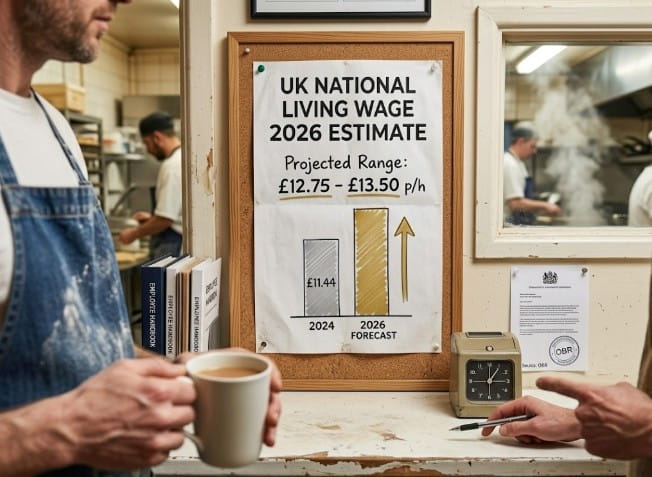
The UK National Living Wage for 2026 estimated at £12.71 per hour for workers aged 21 and over. This rate, confirmed by the Low Pay Commission, came into effect on 1 April 2026. This represents a 4.1% increase from the previous year, aimed at maintaining the legal floor at two-thirds of median hourly earnings.
What does the National Living Wage mean?
National Living Wage is the mandatory minimum hourly rate that employers in the UK must pay workers aged 21 and over. Introduced in 2016, it is distinct from the National Minimum Wage, which technically applies to those under the age of 21 and apprentices.
Unlike the voluntary Real Living Wage (calculated by the Living Wage Foundation based on the cost of a basket of goods), the NLW is a statutory requirement. This means failing to pay it is a criminal offence enforced by HMRC.
What is the new UK National Living Wage for April 2026?
As of April 2026, the statutory UK National Living Wage 2026 estimate has transitioned into a finalised rate of £12.71 per hour. This adjustment ensures that the UK remains a high-wage economy while accounting for the current cost of living.
For younger workers, the government is narrowing the gap toward a single adult rate. Notably, 18–20-year-olds have seen the largest jump, an 8.5% increase to £10.85 per hour.

Official 2026 UK Wage Rates
Below are the official UK wage rates for 2026. These rates, confirmed by the Low Pay Commission, came into effect on 1 April 2026.
This year’s adjustment focuses on maintaining the legal floor at two-thirds of median earnings while narrowing the gap for younger workers to move toward a single adult rate in the future.
| Age Category | April 2025 Rate | April 2026 Rate (Estimate) | % Increase |
| 21 and Over (NLW) | £12.21 | £12.71 | 4.1% |
| 18–20 Year Olds | £10.00 | £10.85 | 8.5% |
| Under 18 | £7.55 | £8.00 | 6.0% |
| Apprentices | £7.55 | £8.00 | 6.0% |
| Accommodation Offset | £10.66 | £11.10 | 4.1% |
How does the National Living Wage work?
The NLW works as a price floor for labour, ensuring that economic growth is shared with the lowest-paid workers in society. Each year, the independent Low Pay Commission (LPC) analyses inflation, employment data, and business health to recommend a new rate to the government.
Why is the NLW important?
-
Poverty Alleviation: It provides a buffer against the rising cost of essentials like food and energy.
-
Reduced Inequality: By pegging the rate to 66% of median earnings, it prevents the wage gap from widening.
-
Increased Productivity: Higher wages often lead to better staff retention and morale, encouraging businesses to invest in training rather than high turnover.
-
Economic Stimulus: Low-income earners tend to spend their wage increases back into the local economy, supporting small businesses.

Is 21 the age for the National Living Wage?
Yes, 21 is the current age threshold for the National Living Wage. To qualify for the top rate of £12.71, you must be an employee or worker (including agency staff and zero-hours workers) aged 21 or older.
The government has indicated a long-term goal to eventually align the 18-20 rate with the full NLW, but for 2026, the distinction remains. Anyone below 21 falls under the National Minimum Wage tiers rather than the National Living Wage.
National Minimum Wage vs the National Living Wage
Many people use these terms interchangeably, but they represent different tiers of the same legal system.
| Feature | National Living Wage (NLW) | National Minimum Wage (NMW) |
| Eligibility | Workers aged 21 and over | Workers aged under 21 & Apprentices |
| Legal Status | Statutory (Mandatory by law) | Statutory (Mandatory by law) |
| 2026 Rate | £12.71 per hour | £8.00 – £10.85 per hour |
| Purpose | Linked to % of median earnings | Tiered based on age and experience |
How has the wage changed since 2020?
The UK has seen aggressive growth in the legal minimum to combat persistent inflation and support low-income households.
| Year (Starting April) | Age 21+ (Living Wage) | Age 18–20 | Under 18 | Apprentice |
| 2026 | £12.71 | £10.85 | £8.00 | £8.00 |
| 2025 | £12.21 | £10.00 | £7.55 | £7.55 |
| 2024 | £11.44 | £8.60 | £6.40 | £6.40 |
| 2023 | £10.42 (23+) | £10.18 (21-22) | £7.49 | £5.28 |
| 2022 | £9.50 (23+) | £9.18 (21-22) | £6.83 | £4.81 |
| 2021 | £8.91 (23+) | £8.36 (21-22) | £6.56 | £4.30 |
| 2020 | £8.72 (25+) | £8.20 (21-24) | £6.45 | £4.15 |
How much is the National Minimum Wage in 2026 per year?
For a full-time employee working 37.5 hours per week, the UK national living wage 2026 estimate translates to a gross annual salary of approximately £24,784.50. If the contract is for a 40-hour week, the yearly figure rises to £26,436.80.
These figures are gross, meaning they are calculated before Income Tax, National Insurance (NI), or pension contributions are deducted.
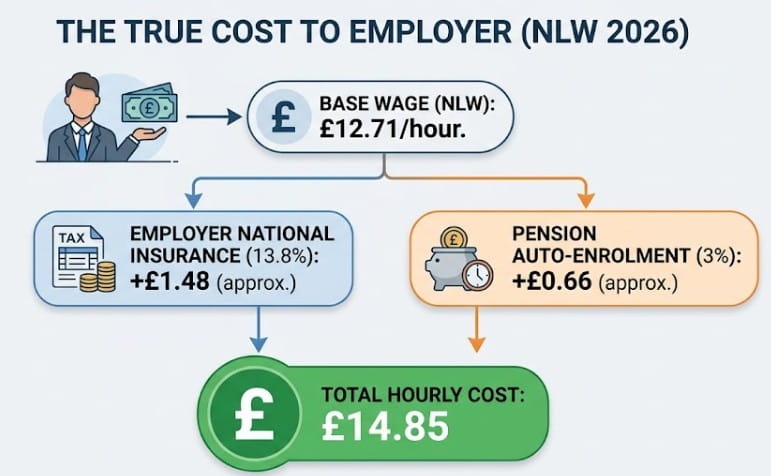
For small business owners, the true cost of a hire at this level is significantly higher. Once you factor in Employer National Insurance (13.8%) and Pension Auto-enrolment (3%), the actual hourly cost to the business for an NLW worker is closer to £14.85.

2026 Annual Salary Breakdown (37.5-Hour Week)
-
Gross Annual: £24,784.50
-
Monthly Gross: £2,065.38
-
Estimated Monthly Take-Home (Net): ~£1,780.00
-
Weekly Gross: £476.63
What is the National Insurance for £12.71 an hour?
For the 2026/27 tax year, the Primary Threshold for National Insurance is £242 per week. A full-time NLW worker earning £476.63 per week will pay roughly £18.77 per week in Class 1 National Insurance (calculated at the standard 8% rate on earnings above the threshold).
The True Cost of a Minimum Wage Employee
For small business owners, the true cost of a hire is significantly higher than the hourly rate. When you factor in Employer National Insurance (13.8%) and Pension Auto-enrolment (3%), the actual hourly cost to the business for a 21+ worker is closer to £14.85.
What is the UK National Living Wage 2026 estimate for the NHS?
The NHS pay structure, known as Agenda for Change (AfC), is heavily influenced by the statutory UK national living wage 2026 estimate. For the 2026/27 financial year, the lowest pay point in the NHS (Band 2) has been set at £12.92 per hour.
This 21p buffer above the legal minimum helps the NHS remain a competitive employer, though pay band compression remains a challenge for the Pay Review Body. This is an important factor for staff calculating their long-term NHS pension after 20 years of service.
This upward pressure often requires the NHS Pay Review Body to adjust the entire scale to ensure staff receive a meaningful pay differential, a challenge also seen in regional adjustments, such as the NHS Scotland Pay Rise, which set a precedent for cross-border wage expectations.
Is £16 an hour good in the UK for 2026?
Earning £16 per hour (£31,200 annually) puts you comfortably above the legal minimum statutory UK national living wage 2026 estimate. However, its value depends entirely on your location:
-
In Northern England (Sheffield, Hull): £16/hour provides a stable lifestyle, covering rent and modest savings.
-
In London/South East: High rental costs mean £16/hour can feel restrictive.
-
Global Comparison: While £16/hour is roughly ₹2,016 in India, the UK’s cost of essentials like utilities and rent is approximately 3.4 times higher than in major Indian metros.
Cost of Living Benchmarks (2026)
-
Is £2,000 a month enough? For a single person outside London, £2,000 net per month is generally sufficient for a modest lifestyle.
-
Is £4,000 a month good? Yes, this is considered a strong salary (roughly £60k–£65k gross per year), placing you in the top 15-20% of UK earners.
-
Cheapest city to live in: Cities like Hull, Blackpool, and Leicester often rank as the most affordable for those living on or near the minimum wage.
How should small businesses prepare for April 2026?
Resilient firms are moving toward a productivity trade-off, investing in better tech and training to offset the 4.1% rise in labour costs.
Preparing for the UK national living wage 2026 estimate increase requires more than just a payroll update; it requires a strategic review of your business’s financial health. With the adult rate rising to £12.71, small business owners must evaluate their overheads well in advance of the April deadline.

6-Step Checklist for Small Business Payroll Planning:
-
Audit Current Pay Scales: Identify every staff member currently earning below £12.71 (or £10.85 for those under 21).
-
Calculate Total Employer Cost: Factor in the 4.1% increase plus the corresponding rises in Employer National Insurance and Pension contributions.
-
Review Price Margins: Determine if your current pricing can absorb a ~4% increase in labour costs or if you need to adjust customer rates.
-
Assess Pay Differentials: If your supervisors currently earn £13.50, the gap between them and entry-level staff will shrink to just 79p. Consider whether their pay needs a proportional rise.
-
Update Apprenticeship Contracts: Ensure any apprentices moving into their second year (if aged 19+) are moved to the correct age-band rate.
-
Communicate Early: Inform staff of their new rates in March to boost morale and ensure transparency before the April pay slip arrives.
Rather than simply absorbing the cost, resilient small businesses are increasingly investing in staff training and streamlined workflows to ensure that every hour of paid labour yields higher output, effectively balancing the books without reducing headcount.
How to claim the National Living Wage in 2026?
You do not need to apply for the National Living Wage; it is your legal right. Your employer is required by law to update your pay automatically in the first pay cycle following your 21st birthday or the 1 April rate increase.
What to do if you’re being underpaid?
If your payslip shows a rate below £12.71 (for 21+), follow these steps:
-
Talk to your employer: It may be a simple payroll error.
-
Contact ACAS: They provide free, confidential advice on wage disputes.
-
HMRC Complaint: You can report underpayment to HMRC anonymously. They have the power to fine employers up to £20,000 per worker and force back-pay for up to 6 years.
Will the minimum wage go up again in 2027?
Yes. The Low Pay Commission’s central projection for the 2027 National Living Wage is £13.18 per hour. Depending on economic growth, the final 2027 rate is expected to fall between £13.02 and £13.34.
Navigating the 2026 Wage Shift
The move to £12.71 per hour represents a steady continuation of the UK’s high-wage transition. For employees, it provides a much-needed buffer against inflation. For small business owners, it necessitates careful cash flow management and a focus on operational efficiency.
As wages rise, many workers and business owners are also reassessing their long-term financial security and retirement goals.
For those nearing the end of their career, it is crucial to understand how these earnings impact state support and whether you can still qualify for Pension Credit alongside other retirement income.
FAQ about UK National Living Wage 2026 Estimate
What will the National Minimum Wage be in 2026 in the UK?
The National Living Wage (for those 21+) will be £12.71 per hour. For those aged 18–20, the rate is £10.85, while 16–17-year-olds and apprentices will receive £8.00 per hour.
What is the real Living Wage in the UK from April 2026?
The voluntary real Living Wage is £13.45 across the UK and £14.80 in London. These rates are higher than the government’s legal minimum because they are based on actual living costs.
What pay rise should I expect in 2026 in the UK?
Workers on the minimum wage will see a 4.1% to 8.5% rise, depending on age. Across all sectors, average private-sector pay rises are projected to be between 3% and 4%.
How much is 70k a year per hour?
A £70,000 annual salary breaks down to approximately £35.90 per hour based on a standard 37.5-hour week. This is nearly triple the 2026 National Living Wage.
Is it illegal to pay less than the 2026 estimate?
Yes. Paying less than the statutory rates (£12.71 for 21+) is a criminal offence. HMRC can issue notices of underpayment which include arrears for workers and heavy fines for the business.
Can I retire at 60 with £300k in the UK?
Depending on household income and children, NLW workers may still be eligible for Universal Credit. Those nearing retirement should also check eligibility for Pension Credit or Attendance Allowance if health issues arise.