

Suspended from Work Pending Investigation: What Are My Rights in the UK? (2026 Guide)
If you find yourself suspended from work pending investigation, your first priority should be to secure a written statement outlining the reasons and the expected timeline.
Being suspended from work pending investigation is an incredibly stressful experience, but under UK employment law, it is strictly a neutral act, not a disciplinary sanction.
If you are currently at home waiting for news, understanding your legal protections is the first step toward protecting your career.
-
Review your contract: Check for clauses regarding pay and benefits during suspension.
-
Contact ACAS: Their helpline provides free, impartial advice on whether your employer is following the Code of Practice.
-
Keep a diary: Note all communications, as these will be vital if the case proceeds to an Employment Tribunal.
-
Prioritise Wellbeing: Suspension is isolating; utilise any Employee Assistance Programmes (EAP) your company offers.
Suspended from work pending investigation what are my rights?
In the UK, suspension is legally viewed as a neutral act, meaning it shouldn’t imply you’ve done anything wrong. Because you are still technically employed while the facts are gathered, you retain several key statutory protections.
If you find yourself suspended from work pending investigation, what are my rights is likely the first and most urgent question on your mind. Navigating this process with your HR department is essential to ensure procedural fairness from the very start.
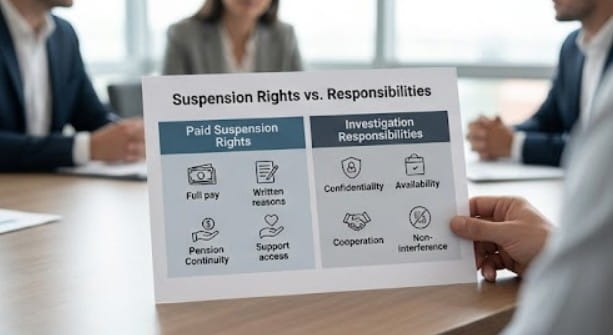
To protect your position, you should ensure your employer upholds the following:
- Right to Full Pay: You must receive your normal wages and contractual benefits unless your contract explicitly states otherwise (which is rare).
- Right to Written Reasons: Your employer must explain in writing why you are being suspended.
- Right to a Fair Investigation: The process must be objective, handled without unreasonable delay, and reviewed regularly.
- Right to Confidentiality: Your employer should not imply guilt to your colleagues or third parties during the process.
The Legal Status of Your Suspension
In the UK, suspension is legally considered a neutral act. Effectively, removing an employee from the workplace should not imply guilt or pre-judge the outcome of an ongoing investigation.
On the ground, if an employer suspends an employee as a knee-jerk reaction without considering alternatives, such as temporary redeployment or remote working, the suspension may be viewed as a breach of contract.
Following the Employment Rights Act 2025 reforms, the emphasis on procedural fairness has intensified. This is especially true for those navigating the legal requirements for small businesses, where administrative errors during a suspension can lead to costly tribunal claims.
What are my rights if I am suspended from work?
When an employer initiates a suspension, they are not ending the employment contract. Instead, they are directing you to stay away from the workplace to allow for an unbiased fact-finding mission.
Your primary rights include the preservation of all contractual benefits, such as health insurance, company car access, and pension contributions. Following the Employment Rights Act 2025 reforms, the emphasis on procedural fairness has intensified.
Employers must now prove that they considered alternatives, such as remote working or temporary redeployment, before resorting to suspension. If they failed to do this, the suspension could be viewed as a breach of the implied term of mutual trust and confidence.
Does suspension from work affect my UK pension?
No, under the Pensions Act 2014 and subsequent auto-enrolment regulations, your pension rights remain protected during a paid suspension.
-
Employer Contributions: Because you are on full pay, your employer must continue to make pension contributions at the usual rate.
-
Salary Sacrifice: If you use salary sacrifice for pension contributions, these arrangements typically continue as normal since your referable salary remains unchanged.
-
Pensionable Service: The period of suspension counts toward your total years of service, which is vital for defined benefit (DB) schemes.
Can you be suspended from work without being told why?
Technically, no. While an employer may not disclose every granular piece of evidence in the initial meeting to protect the investigation’s integrity, they are legally required to explain the factual basis for the suspension.
Failure to provide a clear, written reason can be grounds for a grievance or a future claim of constructive dismissal at an Employment Tribunal.
How long is a reasonable time period for a suspension?
While you may be suspended from work pending investigation, there is no fixed statutory time limit for this period in the UK.
However, ACAS guidelines are clear: the process must be kept as brief as possible to protect the employee’s mental health and professional reputation.

An investigation that drags on for months without justification can be deemed a breach of the employment contract.
The standard 7-step investigation process in UK workplaces
-
Initial Assessment: The employer determines if the allegation is serious enough to warrant a formal investigation.
-
Appointment of Investigator: A person not involved in the incident is chosen to gather facts.
-
Evidence Gathering: Collection of emails, CCTV, or documents relevant to the case. Employers must ensure they are storing business information legally when handling sensitive investigation data to remain compliant with the UK Data Protection Acts.
-
Witness Interviews: Taking statements from colleagues or third parties.
-
The Investigation Meeting: You are invited to give your version of events.
-
Review of Alternatives: Regularly checking if the suspension is still necessary as evidence is cleared.
-
Recommendation: The investigator decides if there is a case to answer at a formal disciplinary hearing.
Can I be dismissed during a workplace investigation in the UK?
While you cannot usually be dismissed purely because you are under investigation, an employer can move to a disciplinary hearing if the investigation uncovers evidence of gross misconduct.
In 2026, the Fair Work Agency (FWA) will monitor these processes more closely to ensure small businesses do not skip vital steps.

Many individuals facing these challenges often consider a fresh start by researching starting a fashion business or other home-based ventures to regain professional independence.
The 5 Fair Reasons for Dismissal in the UK
If an investigation leads to a disciplinary hearing, the employer must prove one of the five fair reasons for dismissal:
-
Conduct: Misconduct or gross misconduct (e.g., theft, violence).
-
Capability: Inability to do the job or poor health.
-
Redundancy: The role is no longer required.
-
Statutory Legality: Continuing to employ you would break the law (e.g., a driver losing their license).
-
Some Other Substantial Reason (SOSR): A catch-all for other serious business reasons, such as a total breakdown in trust.
Suspension vs. Dismissal Summary
While both involve being away from the workplace, the legal and financial implications of suspension are vastly different from termination.
| Feature | Suspension | Dismissal |
| Employment Status | Employed (Contract Active) | Employment Terminated |
| Pay Status | Full Pay (Usually) | Pay Ceases (Except Notice Pay) |
| Legal Status | Precautionary / Neutral | Final Sanction |
| Access to Workplace | Restricted | Prohibited |
| Benefit Accrual | Continues | Stops |
Common Mistakes to avoid during your investigation meeting
During an investigation meeting, your words are recorded and can be used in a later disciplinary hearing. A common mistake is providing off-the-record comments.
From a procedural standpoint, there is no such thing as off the record in a formal HR investigation.When reviewing decisions, tribunals often look at whether the employee was given a fair chance to respond.
It is best to avoid:
-
Speculating on the motives of others.
-
Admitting to things you are unsure about under pressure.
-
Using aggressive or defensive language that could be interpreted as a separate conduct issue.
Can I resign or go off sick while suspended?
Yes, you have the right to resign at any time, but doing so during an investigation may affect your references. Alternatively, if the stress of the process impacts your health, you can go off sick.
Following the Employment Rights Act 2025 reforms and the 2026 Fair Work Agency (FWA) mandates, Statutory Sick Pay (SSP) is now a day-one right. If the stress of a suspension impacts your health, you may move from suspension pay to SSP immediately.
The FWA now monitors small businesses specifically to ensure “procedural suspension” isn’t used as a shortcut to bypass fair dismissal laws.
Signs of an unfair or unlawful suspension
Suspension is considered unfair or a breach of contract if it is used as a punishment before any facts are known. To illustrate, consider a scenario in which a retail manager was suspended immediately after a minor stock discrepancy.
The employer did not check the digital logs first, which would have shown a simple software error. Because the employer did not consider alternatives to suspension, the manager successfully claimed a breach of mutual trust.
Does getting suspended affect your future in the UK?
While a suspension itself is not a conviction, it remains on your internal HR file. If you are exonerated, the suspension should have no impact on your future.
However, if the process leads to a career change, understanding the licenses for holiday home businesses or similar hospitality roles can help you transition smoothly into a new sector without legal complications.
Final Takeaways
If you are currently sidelined, use this checklist to ensure your employer is adhering to the latest Fair Work Agency (FWA) and 2025/2026 legal standards:
-
Full Pay: You must receive your normal salary and benefits.
-
Written Reasons: Your employer must provide a formal reason for the suspension.
-
Neutral Act: It is a precautionary measure, not a punishment or a “guilty” verdict.
-
Fair Investigation: The process must be objective and completed without “unreasonable delay.”
FAQ about being suspended from work pending investigation what are my rights?
Can I be suspended without pay?
Only if your employment contract explicitly allows for unpaid suspension, which is extremely rare. Otherwise, withholding pay is usually an unlawful deduction from wages.
How long can a workplace investigation take in the UK?
There is no set limit, but most should be completed within 2–4 weeks. If it takes longer, the employer should provide written reasons for the delay.
Has anyone returned to work after suspension?
Yes, and successful reintegration is common. It is often helpful to request a formal ‘return to work’ meeting to clear the air, clarify how the matter will be handled internally, and ensure no lingering prejudice remains in the team dynamic.
Can I look for another job while suspended?
You are free to attend interviews, but you remain bound by your “duty of fidelity.” You cannot start a new role or work for a competitor while still receiving pay from your current employer.
Can I bring a companion to the investigation meeting?
You do not have a statutory right to a companion at an investigation meeting, but the ACAS Code of Practice suggests it is good practice for employers to allow it.
What happens if I go off sick while suspended?
You would usually move from suspension pay to sick pay (SSP or contractual sick pay). Under the 2026 rules, SSP is payable from the first day of illness.
Is suspension the same as being fired?
No. Suspension is a temporary pause to allow for fact-finding. You remain an employee with all your legal rights intact.





One Comment