

What is Constructive Dismissal UK? Your 2026 Legal Guide
Last Updated on
What is constructive dismissal UK? Constructive dismissal is a UK claim available when an employee resigns over a fundamental breach of contract by their employer, such as unpaid wages or harassment. In 2026, most employees still need two years’ service to claim, except for automatically unfair or discrimination-related reasons, and must notify Acas within three months minus one day.
Key Takeaway
- Most employees still need two years’ service to claim constructive dismissal, but this drops to six months from 1 January 2027 under new law.
- Claimants must notify Acas within three months minus one day of their last working day, though this limit rises to six months from 1 October 2026.
- The unfair dismissal compensatory award cap rose to £123,543 from 6 April 2026 and is due to be scrapped entirely from January 2027 under new law.
- The Vento injury to feelings bands for 2026 run from £1,300 up to £62,900, relevant where a constructive dismissal claim also involves discrimination.
What counts as constructive dismissal in the UK?
To be classed as constructive dismissal, the employer’s behaviour must fall under specific legal categories of contract violation. It is not enough to be unhappy; you must be able to point to a specific repudiatory breach.
To legally qualify as constructive dismissal in the UK, your situation must meet three specific criteria:
-
The Breach: Your employer must have broken a fundamental term of your contract (express or implied).
-
The Reaction: You must resign because of that specific breach.
-
The Timing: You must resign promptly. Staying too long can be seen as affirming the breach, which may void your claim.
The Last Straw Doctrine
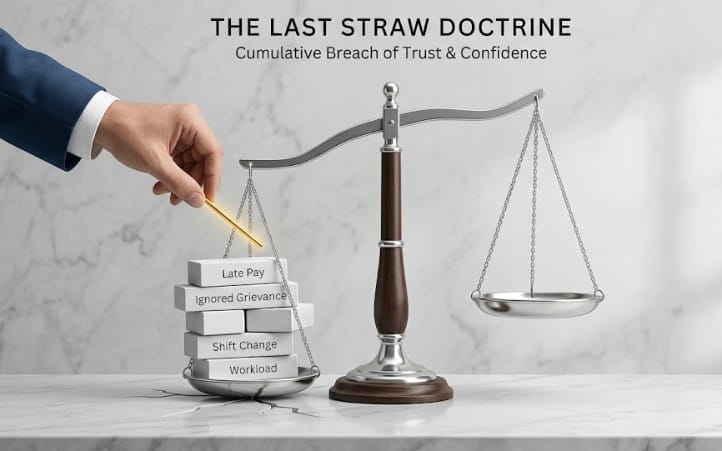
In UK employment law, a claim doesn’t always rely on one major event. Under the Last Straw Doctrine, a series of smaller incidents (which may not be fundamental on their own) can culminate in a final act that justifies your resignation.
This is often the foundation of successful claims involving toxic work cultures or quiet firing.
Recognising an Untenable Situation
An untenable situation arises when the working environment becomes psychologically or professionally unsustainable. For example, a senior manager might find their responsibilities stripped away and replaced with menial tasks (often called quiet firing).
In practice, if you feel forced to choose between your mental health and your paycheck due to targeted mistreatment, you are likely facing an untenable situation that meets the legal threshold.
How to prove constructive dismissal?
Because you are the one who resigned, the burden of proof rests on you. You must prove the employer’s behaviour was a repudiatory breach. If you find yourself in a position where you need to transition into a new career path after such an ordeal, some people look toward Jobs That Pay £50K a Year Without a Degree to regain financial stability while they recover.
Essential Evidence Checklist:
-
The Paper Trail: Save all emails, Slack messages, and WhatsApps documenting mistreatment.
-
Diary Logs: Keep a contemporary record of dates, times, and descriptions of specific incidents.
-
Witness Statements: Identify colleagues who saw the behaviour first-hand.
-
Red Flag Terms: Look for HR terminology like not a culture fit or mutual separation, which often signal a push-out attempt.
-
The Vento Scale: If your claim involves discrimination, document the psychological impact; this determines your Injury to Feelings award. The bands (effective from 6 April 2026) are:
Common Examples of Constructive Dismissal
| Band | Range |
|---|---|
| Lower band | £1,300 – £12,600 |
| Middle band | £12,600 – £37,700 |
| Upper band | £37,700 – £62,900 (exceptional cases can exceed this) |
A change to hours, pay or location isn’t automatically a breach. A tribunal can find it fair if your contract already allowed the change (for example, under a mobility clause), your employer consulted you first, or the change was a genuine alternative to redundancy.
The strength of a claim in this category usually comes down to how the change was handled, not just that it happened.
How do I know if it’s constructive dismissal or unfair dismissal?
The primary difference lies in who fired whom. In unfair dismissal, the employer terminates the contract. In constructive dismissal, you terminate it because the employer made staying impossible. Both fall under the broader umbrella of Unfair Dismissal in an Employment Tribunal.
In some cases, an employee might resign during a period of long-term illness if the employer fails to provide support; however, it is vital to understand how long you can be on sick leave before dismissal to determine if your rights have been breached.

Understanding Automatic Unfair Dismissal
In some cases, the reason for the employer’s breach makes the dismissal automatically unfair.
This applies if the breach relates to:
- Whistleblowing (protected disclosures).
- Pregnancy or maternity leave.
- Exercising statutory rights (like asking for the National Minimum Wage).
- Health and safety activities.
Discrimination under the Equality Act 2010, including on the grounds of race, sex, disability, age, religion or belief, or sexual orientation, this is a separate route into a claim and doesn’t need to fit the automatically unfair categories above.
If you’ll have reached 2 years’ service by the time your employment ends, a TUPE business transfer or failing to declare a spent conviction can also count as automatically unfair grounds.
While some situations involve a gradual breakdown of trust, others involve immediate termination for gross misconduct; knowing how to handle these allegations can often prevent a permanent mark on your employment record.
How to claim constructive dismissal?
Claiming is a strategic process that must be followed strictly to avoid being thrown out by a tribunal.
-
Raise a Formal Grievance: Before resigning, you should ideally raise a written grievance. This shows a tribunal you tried to resolve the issue. If you are an entrepreneur or freelancer who finds the corporate environment untenable and prefers working for yourself, understanding the Jobs That Pay £50K a Year Without a Degree is a common first step toward creating your own stable work environment.
-
Resign with Immediate Effect: Your resignation letter must clearly state that you are leaving because of the employer’s breach.
-
Acas Early Conciliation: You must notify Acas to start Early Conciliation within 3 months minus one day of your last day. You cannot go to a tribunal without an Acas certificate.
-
File an ET1 Form: If conciliation fails, you file your formal claim with the Employment Tribunal.
Qualifying Periods and Eligibility Criteria in 2026
Right now, in 2026, most employees still need 2 years’ continuous service to bring a constructive dismissal claim, this hasn’t changed yet, despite reforms being on the way.
- Current 2-Year Rule: Employees generally need 2 years’ continuous service with their employer before they can claim constructive dismissal.
- Day 1 Rights: Claims involving automatically unfair reasons, such as whistleblowing, pregnancy or maternity, health and safety, asserting a statutory right, or discrimination under the Equality Act 2010, don’t require any minimum service.
- Coming in 2027: Under the Employment Rights Act 2025, the qualifying period is set to fall to 6 months, but the government has confirmed this won’t apply until 1 January 2027, and only to employees who have 6 months’ service by that date.
- Contractual Identification: You must be able to pinpoint the exact term (express or implied) that was broken.
- The Promptness Rule: You must resign promptly after the breach. Continuing to work for a prolonged period may be viewed as affirming the new, broken terms.
- Direct Causality: Your resignation letter must state clearly that the breach is the specific reason you are leaving.
- Mandatory Conciliation: You must notify Acas to start the Early Conciliation process before filing an ET1 form.
- Statutory Time Limits: You currently have three months minus one day from your last day of employment to start your claim, see the note below on the change coming in October 2026.
What is the average payout for constructive dismissal UK?
Most successful claims settle well below the statutory caps. Ministry of Justice tribunal data (the most recently published full year) puts the median unfair dismissal award at £6,746, the caps below represent a ceiling, not a typical outcome, and large reported awards are usually driven by an added discrimination or whistleblowing element rather than constructive dismissal alone.
Compensation is divided into a Basic Award and a Compensatory Award. The Basic Award is a formula based on your age, weekly pay (capped at £751 from 6 April 2026), and years of service.
-
Basic Award: A statutory formula based on your age, length of service, and weekly pay (capped at £751 in early 2026).
-
Compensatory Award: Designed to cover your actual financial loss. The cap for 2026 is £123,543 or one year’s gross pay (whichever is lower).
-
Acas Uplift: If your employer failed to follow the Acas Code of Practice, a tribunal can increase your payout by up to 25%.
| Component | 2026 Statutory Limits |
| Basic Award (Max) | £22,530 |
| Compensatory Award Cap | £123,543 |
| Discrimination Claims | Uncapped |
| Acas Uplift | Up to 25% (if the employer fails to follow the code) |
These caps aren’t permanent. Under the Employment Rights Act 2025, the government intends to remove the compensatory award cap entirely from 1 January 2027, the same date the qualifying period changes, meaning compensation would then be based solely on actual financial loss, with no upper limit for ordinary unfair dismissal claims.
How to avoid common mistakes when claiming constructive dismissal?
Understanding the legal threshold of what is constructive dismissal UK is only half the battle; you must also avoid the Affirmation Trap.
In practice, if you continue to work for a prolonged period after the breach occurs without lodging a formal grievance, a tribunal may rule that you accepted the new terms. To protect your right to claim, you must act promptly once the contract is broken.

Can I still claim after signing a settlement agreement?
No. If you sign a settlement agreement with your employer, you give up your right to bring a constructive dismissal claim to an employment tribunal over the matters it covers.
Settlement agreements are common where both sides agree the employment relationship has broken down, but they’re legally binding once signed with independent legal advice, so it’s worth getting that advice before signing rather than after.
Do not resign in a fit of anger; instead, seek legal advice or contact Acas to understand your specific standing under the 2026 regulations. Remember, affirming the breach by staying too long or failing to document the last straw are the most common reasons claims fail.
How Does Constructive Dismissal Impact SMEs, Startups, and Business Operations?
Constructive dismissal creates severe legal, financial, and operational risks driven by contractual breaches. For SMEs, micro-businesses, and enterprise operations, unmanaged claims lead to heavy tribunal penalties, mounting legal costs, workflow disruption, productivity losses, and lasting damage to employer brand reputation.
Core Business & Strategic Impacts
-
Financial & Compensation Exposure: Defending tribunal claims brings significant legal fees and potential awards capped at £123,543 (plus up to 25% Acas uplifts), creating acute cash-flow risks for smaller firms.
-
Operational Disruption: Abrupt resignations after contract breaches leave critical delivery gaps, disrupt clients, and overstretch remaining staff across lean teams.
-
Productivity & Workplace Morale: Unaddressed grievances or quiet firing tactics erode morale, drive higher turnover, and diminish output across B2B and B2C operations.
-
Compliance & Regulatory Risk: Flawed management, unagreed contract changes, or weak grievance handling drastically increase liability under evolving UK employment law.
-
Market Competitiveness & Brand Equity: Public tribunal records and poor workplace reputation hurt talent acquisition and damage prospective client trust.
Conclusion
If you’re facing a serious breach of contract at work, the immediate priorities are the same regardless of the 2027 reforms: raise a written grievance, keep dated evidence, don’t let time pass without acting, and get advice before resigning.
Check your qualifying service under the current 2-year rule (unless your reason is automatically unfair or discrimination-related), and don’t miss the 3-months-minus-a-day Acas deadline, remembering that this window is due to extend to 6 months for acts from 1 October 2026 onward.
If you’re offered a settlement agreement, get independent legal advice before signing, since it will end your right to claim.
Disclaimer: This article is for informational purposes only and does not constitute formal legal advice; consult Acas or a qualified employment solicitor regarding your specific situation.
FAQ
What are the grounds for constructive dismissal in the UK?
The main grounds are a fundamental breach of contract by your employer, unpaid wages, unsafe conditions, bullying, a serious unagreed change to your role, or a loss of trust and confidence- that you resign in direct, prompt response to.
How much compensation do you get for constructive dismissal in the UK?
It varies widely by case, but the median published tribunal award for unfair dismissal is around £6,746. The statutory cap on the compensatory award is £123,543 (from April 2026), though most claims settle well below it.
What to do if you feel you are being pushed out of your job?
Raise a written grievance before resigning, keep a dated record of incidents, and get legal advice on whether the conduct amounts to a fundamental breach. Resigning without doing this first can weaken a later claim.
What are the five requirements for constructive dismissal?
Broadly: a breach of an express or implied contract term; the breach must be fundamental; you must resign in response to it; you must act promptly without affirming the breach; and you generally need sufficient qualifying service (or an automatically unfair or discrimination-based reason).
Do I still need two years’ service to claim constructive dismissal in 2026?
Yes, for most claims. The reduction to 6 months’ service doesn’t take effect until 1 January 2027. Claims based on automatically unfair reasons or discrimination don’t require any minimum service now or after the change.
Can I claim constructive dismissal if I’ve signed a settlement agreement?
No. A validly signed settlement agreement, made with independent legal advice, ends your right to bring a tribunal claim over the issues it covers, including constructive dismissal.
Is the constructive dismissal time limit changing in 2026?
The 3-months-minus-a-day limit to start Acas conciliation still applies today. It’s due to extend to 6 months minus a day from 1 October 2026, but only for claims based on acts occurring on or after that date.