
No Win No Fee Employment Solicitors: The Complete 2026 UK Guide
No win no fee employment solicitors (Damages-Based Agreements) in the UK allow UK employees to pursue legal claims without upfront costs. If you win, the solicitor deducts a pre-agreed fee, typically capped at 25% of your compensation. If you lose, you pay no legal fees.
Under the Employment Rights Act 2025, most employees now have Day One protection against unfair dismissal, making legal support more accessible than ever.
What is No Win No Fee?
No Win No Fee is a legal funding arrangement where you only pay your solicitor if your case is successful. Formally known as a Damages-Based Agreement (DBA), it ensures that if you lose your employment tribunal claim, you owe no legal fees to your solicitor.
This allows UK employees to access justice for unfair dismissal or discrimination without the financial risk of upfront costs.
Who are no win no fee employment solicitors?
No win no fee employment solicitors are specialist legal professionals who represent employees in workplace disputes (such as unfair dismissal, discrimination, or harassment) without requiring an initial retainer or hourly payments.
In the UK, this is formally structured as a Damages-Based Agreement (DBA). This model levels the playing field, allowing you to challenge corporate HR departments and their legal teams regardless of your personal budget.
How much do solicitors take for no win no fee?
For employment tribunal claims in 2026, the success fee is legally capped at 35% (including VAT). However, most competitive UK firms operate at a 25% cap.
Example payout in 2026:
-
Total Settlement: £20,000
-
Solicitor’s Fee (25%): £5,000
-
Your Payout: £15,000
Always check if the fee includes VAT and disbursements (third-party costs like expert medical reports). Reliable firms provide a Key Facts Summary before you sign.
What are the downsides of no win no fee?
The primary disadvantage is the deduction from your settlement. If you receive a small award, the 25% fee can feel substantial relative to the award.
Additionally, some agreements require you to pay for ATE Insurance, though cost awards against employees in UK tribunals remain rare and are usually reserved for dishonest claims.
Can you lose money in a no win no fee case?
While you won’t pay for your solicitor’s time if you lose, there are hidden factors to check in your contract to ensure zero financial loss:
-
Review the Initial Contract: Ensure the DBA specifically covers all potential hidden costs.
-
Verify ATE Insurance: Check if the firm provides insurance to cover the opponent’s costs.
-
Identify Disbursements: Confirm who pays for medical reports or travel expenses upfront.
-
Assess Settlement Offers: Understand that rejecting a reasonable offer against advice may end the no win no fee protection.
-
Check for Drop-Out Clauses: Some contracts charge hourly rates if you withdraw your instructions mid-case.
-
Review the Success Fee Cap: Ensure the deduction does not exceed the statutory limit.
Why the April 2026 Reforms Matter to Your Claim?
The UK legal landscape changed significantly on 6 April 2026. The implementation of the Employment Rights Act 2025 and the launch of the Fair Work Agency (FWA) have shifted the power balance back to the employee.
These reforms have expanded day one rights, meaning employees no longer always need two years of service to claim unfair dismissal. This shift means that no win no fee employment solicitors can now take on cases that were previously viewed as too high-risk due to short lengths of service.
| Feature | Pre-2026 Rules | Post-April 2026 Reform |
| Qualifying Period | Often, 2 years of service | Day-One Protection (subject to probation) |
| Unfair Dismissal Cap | £118,223 | £123,543 (or 52 weeks’ pay) |
| Sick Pay (SSP) | 3-day waiting period | Day-One Payment (No waiting days) |
| Enforcement | Individual Tribunal claims | Fair Work Agency (FWA) oversight |

When can I claim for unfair dismissal?
You can claim for unfair dismissal if your contract was terminated for a reason that is not one of the 5 fair reasons for dismissal: capability, conduct, redundancy, statutory illegality, or some other substantial reason (SOSR).
This applies across all sectors, from corporate offices to manual trades; for example, those running or employed by a gardening business must meet specific legal requirements to ensure their dismissal procedures and contracts are compliant with 2026 standards.
In 2026, the threshold for what constitutes a fair process has heightened, requiring employers to demonstrate substantive evidence of support before dismissing for capability.
In capability cases involving health, employees often ask how long they can be on sick leave before dismissal; solicitors can help determine if your employer followed the 2026 statutory guidelines for medical absence.
What are 5 examples of serious misconduct?
-
Theft or Fraud: Stealing company property or falsifying expenses.
-
Physical Violence: Assaulting a colleague or customer.
-
Gross Negligence: Actions that result in significant safety risks or financial loss.
-
Serious Insubordination: Deliberate and flagrant refusal to follow lawful, safe instructions.
-
Harassment: Severe breaches of the Equality Act, including sexual or racial harassment.
However, knowing how to avoid dismissal for gross misconduct is vital, as procedural errors by HR can often turn a fair dismissal into a valid legal claim.
| Claim Type | Max Payout Potential (2026) | Evidence Required |
| Unfair Dismissal | Statutory cap (approx. £123,543) or 1yr salary | Procedural failings/lack of fair reason |
| Discrimination | Uncapped | Evidence of protected characteristic bias |
| Whistleblowing | Uncapped | Proof of Protected Disclosure |
Proving harassment and red flag workplaces
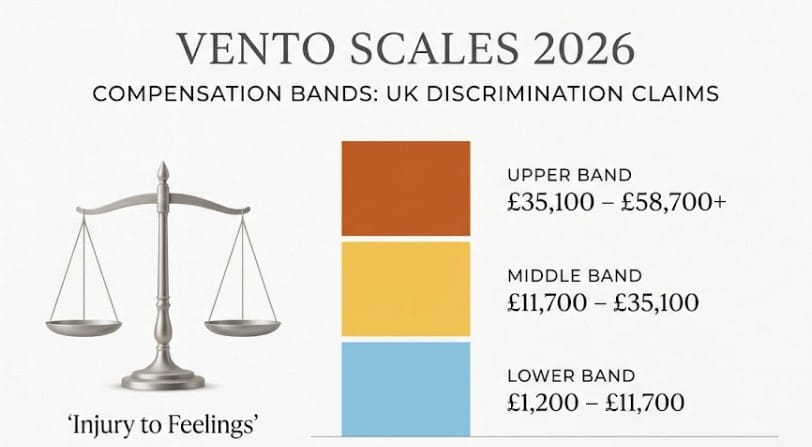
In 2026, tribunals are scrutinising red flag words like not a culture fit as proxies for discrimination. For discrimination claims, compensation includes Injury to Feelings, which is calculated using the Vento Scales.
These scales categorise the severity of the harassment into three bands (Lower, Middle, and Upper), ensuring that victims are compensated for the emotional distress caused by the employer’s actions.
What is proof of mental harassment?
Proof often consists of a contemporaneous diary of events, saved emails/Slack messages, and medical records showing a decline in mental health.
Employers must ensure they are storing business information legally and in accordance with GDPR; if they fail to provide your data during a Subject Access Request (SAR), it significantly strengthens your legal position.
For example, if an employee is repeatedly excluded from meetings after announcing a pregnancy, the proof is the pattern of exclusion rather than a single explanation or statement.

How to prove emotional abuse at work?
-
Documentation: Keep a log of dates, times, and witnesses.
-
Grievance Records: Formally lodge a complaint to trigger the company’s internal process.
-
Witness Statements: Corroboration from colleagues who observed the behaviour.
-
Impact Evidence: Fit notes from a GP citing work-related stress.
Is it better to settle or go to a tribunal?
Statistically, the vast majority of UK workplace disputes settle via ACAS Early Conciliation or private negotiation before reaching a courtroom.
-
Settling: Offers a guaranteed sum and avoids the emotional stress of a public hearing.
-
Tribunal: Necessary if the employer refuses a fair offer. A No Win No Fee solicitor is vital here, as employers are more likely to settle when they see you have professional backing capable of taking them to a full hearing.
Is it worth using a solicitor or the Fair Work Agency?
With the Fair Work Agency now active as of April 2026, many wonder if they still need a solicitor. While the FWA can enforce holiday pay and National Minimum Wage breaches, a No Win No Fee solicitor is still essential for:
-
Uncapped Claims: Discrimination and Whistleblowing awards remain uncapped and require complex legal arguments.
-
Negotiating Settlements: Solicitors often secure 30-50% higher settlements via ACAS than individuals acting alone.
-
Psychological Safety: 2026 standards now view psychological safety as a core health requirement; solicitors are trained to prove these nuanced mental harassment cases.
How do you vet a solicitor in 2026?
-
Check the SRA Register: Ensure they are regulated by the Solicitors Regulation Authority.
-
Review Their Win Rate: Ask for their specific success rate in the Fair Work Agency era.
-
Transparency on Fees: Do they provide a Key Facts summary with no hidden costs?
-
Tech-Savvy: Do they use digital evidence platforms to handle your SAR data and Slack logs?
-
Specialisation: Ensure they only handle Employment Law, not general litigation.
Final Summary and Next Steps
Successfully challenging an employer in 2026 comes down to two things: acting within strict time limits and having the right paper trail. If you believe you have been treated unlawfully, your first step should be to secure your evidence, download emails and record timelines.
Next, verify the limitation date for the 3-month rule. Finally, consult a solicitor to assess your case under a Damages-Based Agreement. This allows you to pursue justice without the burden of upfront costs, ensuring that your employer’s legal budget does not dictate the outcome of your career.
FAQ about no win no fee employment solicitors
What is the 3-month rule in a job?
This is the strict legal deadline. You must usually start the ACAS Early Conciliation process within three months (minus one day) of the incident or your dismissal date. Missing this date usually bars your claim.
What is the maximum payout for unfair dismissal?
As of 2026, the compensatory award for unfair dismissal is capped at roughly £123,543 or 52 weeks’ gross salary (whichever is lower). Discrimination and whistleblowing claims remain uncapped.
What are the 7 types of harassment?
Under the Equality Act, these include harassment related to age, disability, gender reassignment, race, religion/belief, sex, and sexual orientation. Sexual harassment also carries specific preventative duties for employers.
Can HR take legal action against an employee?
While rare, employers can sue for breach of contract (e.g., violating non-compete clauses or damaging company property). However, HR cannot sue you simply for bringing a good-faith tribunal claim.
What are 5 signs of emotional abuse?
Common indicators include gaslighting (denying events happened), public belittling, setting impossible targets to induce failure, social isolation, and inconsistent application of rules to a specific individual.
What is a psychologically unsafe workplace?
This is an environment where employees feel unable to speak up about mistakes or concerns without fear of retaliation. 2026 legal standards now view psychological safety as a core health and safety requirement.
Can I lose my house if I lose a no win no fee case?
No. Employment tribunals are generally no-cost jurisdictions. Unless your claim is found to be dishonest or totally hopeless, you do not pay the employer’s legal fees.