UK VAT Threshold 2026: HMRC Rules, Limits, and Registration Guide for SMEs
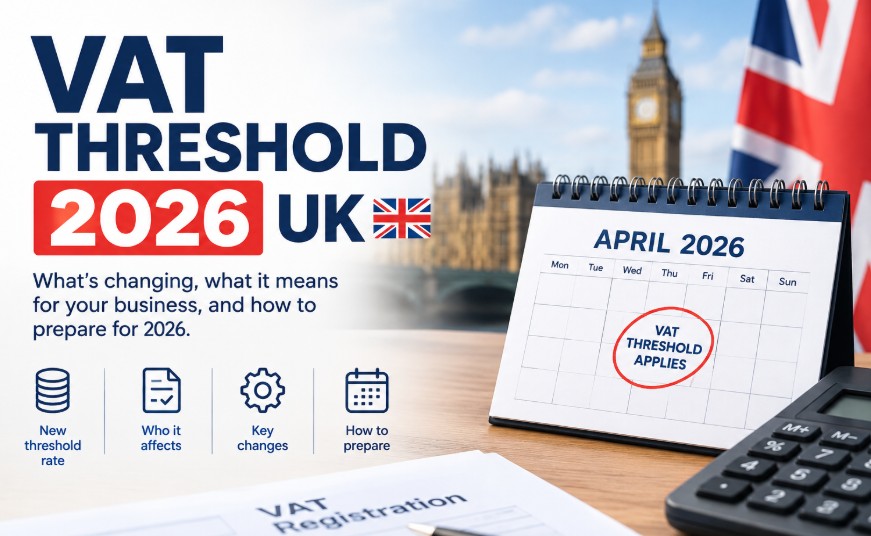
The UK VAT threshold 2026 is the mandatory taxable turnover limit set by HM Revenue and Customs above which sole traders, partnerships, and limited companies must register for Value Added Tax, charge applicable tax on sales, and submit digital returns under the Making Tax Digital framework.
Key Takeaways
-
The compulsory UK VAT registration threshold stands at £90,000 of taxable turnover accumulated over a rolling 12-month period.
-
Businesses must notify HM Revenue and Customs within 30 days of the end of the month in which the registration limit was breached.
-
Taxable turnover must be calculated continuously on a rolling monthly basis rather than across fixed calendar or tax years.
-
The VAT deregistration limit is £88,000, allowing eligible registered entities to cancel their VAT status if turnover drops.
What Is the Current UK VAT Threshold 2026 for Small Business?
The UK VAT registration threshold for small businesses is £90,000 of taxable turnover accumulated over any rolling 12-month period.
Businesses that cross this statutory limit must register with HM Revenue and Customs (HMRC) within 30 days of the end of the breaching month.
-
Rolling 12-Month Measurement: HMRC continuously monitors commercial growth by looking backward across any consecutive 12-month period, rather than relying on a fixed tax or calendar year.
-
The 30-Day Forward-Looking Rule: If a business realizes its taxable turnover will single-handedly exceed £90,000 within the next 30 days alone (such as securing a major corporate contract), registration becomes immediately mandatory from the point of realization.
-
Statutory Notification Deadline: Once the threshold is breached, businesses must notify HMRC via the online digital gateway within 30 days of the end of the month in which the limit was crossed.
How to Calculate Taxable Turnover on a Rolling 12-Month Basis?
Taxable turnover must be calculated at the end of every month by looking backward across the preceding 12 months, rather than relying on a fixed tax year.
-
Sum the total value of all taxable sales made during the current calendar month.
-
Add this sum to the recorded taxable sales totals of the previous 11 months.
-
Drop the oldest month’s figure from the calculation as each new month is added.
-
Check whether the cumulative total equals or exceeds the £90,000 statutory limit.
-
Identify any single-month forward-looking contracts that instantly breach the limit under the 30-day rule.
-
Record the exact date of the breach to establish the statutory 30-day notification window.
-
Access the HMRC online gateway to initiate digital registration if the cumulative total is breached.
Continuous monthly tracking prevents accidental late registration and subsequent financial penalties from HM Revenue and Customs.
What counts as taxable turnover for VAT purposes?
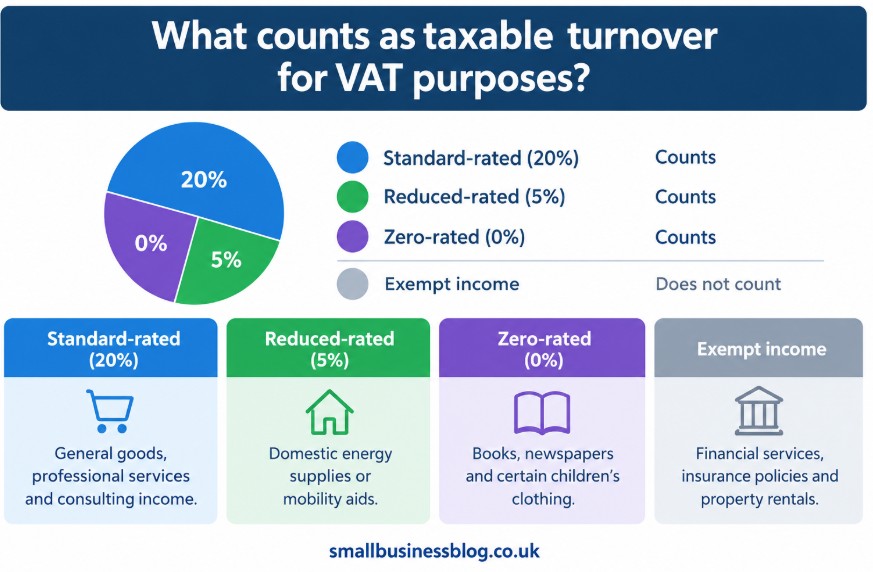
Taxable turnover includes the total value of all non-exempt sales made within the UK, measured before any deductions for business expenses. This calculation incorporates standard-rated sales at 20%, reduced-rated sales at 5%, and zero-rated sales at 0%.
-
Standard-rated sales (20%): General commercial goods, professional services, and consulting income count fully toward the threshold.
-
Reduced-rated sales (5%): Specific domestic energy supplies or mobility aids contribute fully to the turnover calculation, though business owners should note that certain specialized supplies or health-related items may align with guidelines detailed under medical conditions that qualify for VAT relief.
-
Zero-rated sales (0%): Books, newspapers, and certain children’s clothing generate zero tax for the customer but do count toward the £90,000 threshold calculation.
-
Exempt income: Financial services, insurance policies, and property rentals are excluded entirely and do not count toward the taxable limit.
When reviewing decisions, compliance officers note that omitting zero-rated supplies from the monitoring sheet is a frequent error that leads to delayed mandatory registration.
How can I track my turnover?
Accurate tracking requires integrating accounting software that complies with Making Tax Digital (MTD) standards to maintain real-time visibility over incoming revenue streams.
-
Digital Ledger Integration: Automatically categorize invoices and cash receipts into taxable versus exempt income streams inside cloud accounting platforms.
-
Monthly Rolling Dashboards: Configure automated ledger reports to summarize trailing 12-month totals at the close of every calendar month.
-
Project Pipeline Reviews: Audit upcoming commercial contracts and high-value client agreements to spot potential forward-looking spikes before work commences.
In practice, sole traders who rely on manual spreadsheet entries often miss sudden revenue acceleration, making automated digital tracking an essential safeguard.
Should I register for VAT voluntarily before I hit the threshold?
Businesses trading below the £90,000 limit can choose to register for VAT voluntarily to alter their financial recovery profiles and commercial standing.
-
Input Tax Recovery: Reclaiming the VAT paid on business overheads, software subscriptions, inventory purchases, and capital equipment can yield significant cash flow benefits. Those evaluating simplified accounting methods alongside voluntary registration can also explore alternative structures such as the VAT Flat rate scheme to streamline calculations.
-
Enhanced Corporate Credibility: Operating with a registered VAT number signals scale and operational maturity to larger corporate clients who might otherwise hesitate to engage micro-entities.
-
Administrative Overhead: Compliance requires submitting regular digital returns and maintaining rigorous records, adding bookkeeping costs that must be weighed against tax recovery benefits.
Weighing input tax recovery against administrative overhead determines the ideal timing for voluntary registration.
Can I split my business to avoid VAT?
No, splitting a business solely to stay below the VAT threshold is illegal, and HMRC has the legal power to aggregate your entities and demand backdated taxes and penalties if caught.
HM Revenue and Customs actively investigates business disaggregation under Schedule 1 of the Value Added Tax Act 1994.
If HMRC determines that multiple entities share financial, organisational, and economic links, such as sharing premises, equipment, management, or serving the same client base, the authorities possess the legal power to direct a retrospective business aggregation.
When reviewing decisions involving related corporate structures, the First-tier Tribunal (Tax Chamber) routinely upholds HMRC aggregation directions, forcing businesses to pay backdated tax alongside severe civil penalties for artificial avoidance.
How do I avoid going over the VAT threshold?
Businesses cannot artificially suppress genuine commercial sales, conceal revenue, or manipulate invoicing dates to evade statutory registration.
-
Revenue Pacing: Carefully schedule project milestones and delivery dates across accounting periods to smooth out cash flow spikes where commercially feasible.
-
Subcontractor Delegation: Route overflow client work to independent external partners rather than exceeding operational capacity in a way that forces a sudden turnover surge.
-
Strategic Pricing Adjustments: Factor future tax liabilities into pricing models early so that crossing the £90,000 boundary does not compress profit margins unexpectedly.
Proactive financial forecasting ensures that reaching the threshold marks a managed phase of business expansion rather than an administrative crisis.
What Happens If You Exceed the VAT Threshold and Miss the Deadline?
Failing to notify HM Revenue and Customs within the mandatory 30-day window results in late registration penalties and back-pay obligations for uncharged VAT.
If you encounter difficulties during compliance or need to clarify submission requirements, you can reach out directly via HMRC VAT customer services for support.
| Scenario | Legal Trigger | HMRC Notification Deadline | Primary Compliance Requirement |
| Rolling 12-Month Breach | Cumulative taxable turnover reaches £90,000 | Within 30 days of the end of the breaching month | Register online via HMRC gateway |
| Single Contract Breach | Instant taxable supply value equals or exceeds £90,000 | Within 30 days of the date the limit was reached | Account for VAT from the date of the supply |
| Voluntary Registration | Turnover below £90,000 | None (voluntary discretion) | Submit regular digital returns once active |
The Office for Budget Responsibility (OBR) tracks compliance metrics across the SME sector, while non-compliance cases can be escalated to the First-tier Tribunal (Tax Chamber) when penalty disputes arise.
When Can a Business Deregister for VAT?
Businesses can apply to cancel their VAT registration if their taxable turnover drops below the deregistration threshold of £88,000.
To qualify for deregistration, entities must demonstrate to HMRC that their future taxable turnover will not exceed £88,000 across the subsequent 12-month period. Applications are submitted digitally through the business’s HMRC online account.
Furthermore, if a business ceases trading entirely or permanently stops making taxable supplies, mandatory deregistration must be completed within 30 days of the cessation event, complying with Making Tax Digital (MTD) record archiving rules overseen by the Valuation Office Agency and HMRC frameworks.
Conclusion
Monitoring taxable turnover requires consistent monthly reviews of rolling 12-month receipts to catch statutory thresholds before deadlines lapse.
Business owners approaching £90,000 should audit accounting ledgers, verify zero-rated versus exempt sales, and prepare digital infrastructure for Making Tax Digital compliance, ensuring your designated HMRC VAT bank details are properly aligned for smooth future Direct Debit settlements.
Prompt registration through the official government portal prevents punitive financial penalties and protects commercial relationships.
Disclaimer: This guide is for informational purposes only and does not constitute formal financial or legal advice; consult HMRC or a certified accountant for your specific business requirements.
FAQs
Will the VAT increase in 2026?
The statutory VAT registration threshold remains frozen at £90,000 with no legislative changes announced to alter the core limit during this fiscal period.
How much is VAT in England in 2026?
Standard VAT remains at 20%, with reduced rates of 5% and zero-rating (0%) applying to specific goods and services across England and the wider UK.
What happens if you miss the VAT registration deadline?
Failing to notify HMRC within 30 days of crossing the threshold triggers financial penalties and liability for uncollected tax from the effective registration date.
Can overseas sellers use the UK VAT threshold?
Non-established taxable persons making sales to UK customers must register from their very first transaction, as the £90,000 threshold does not apply to overseas entities.
Is VAT calculated on a calendar year basis?
No, HMRC monitors turnover continuously over any rolling 12-month window rather than aligning with standard calendar or tax years.