
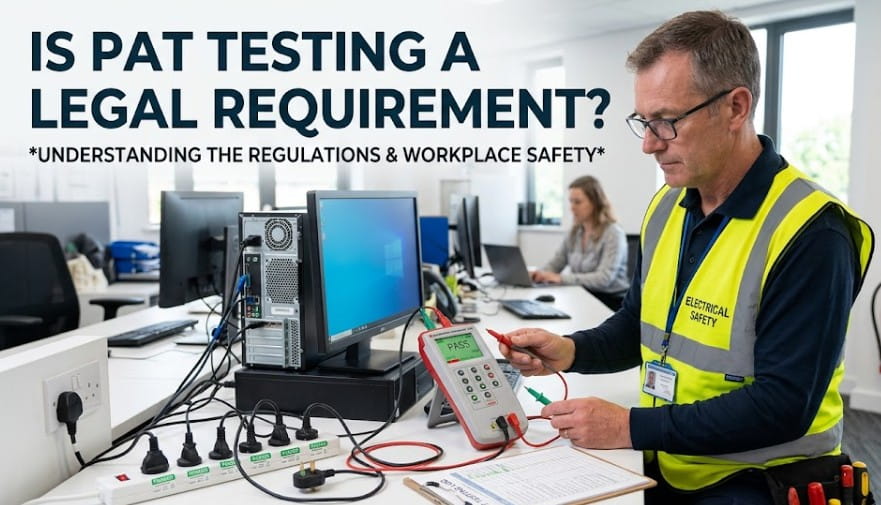
Is PAT Testing a Legal Requirement? The Truth for UK Businesses & Landlords
Last Updated on
Is PAT testing a legal requirement under the current United Kingdom safety frameworks? PAT testing is not named as a legal requirement in UK statute. However, the Electricity at Work Regulations 1989, the Health and Safety at Work etc. Act 1974, and PUWER 1998 all legally require employers, landlords, and business owners to keep electrical equipment safe, and regular PAT testing is the standard, defensible way to prove that duty is being met.
Key takeaways
- PAT testing itself is not named in UK law, but the Electricity at Work Regulations 1989 make maintaining safe equipment a legal duty for employers.
- Scottish landlords face an explicit statutory duty under the Housing (Scotland) Act 2006, requiring PAT at intervals of no more than 5 years.
- There is no fixed annual testing interval under UK law, HSE guidance HSG107 requires a risk-based schedule based on equipment type and use.
- Average UK PAT testing costs in 2026 run roughly £1 to £3 per item, plus a typical minimum call-out charge of around £40 to £80.
What is PAT Testing?
Portable Appliance Testing (PAT) is the routine inspection and diagnostic evaluation of electrical appliances to ensure they are entirely safe for continuous operation. The process combines a structured manual assessment with specialised electronic testing using calibrated equipment.
This diagnosis checks for hidden electrical faults, including insulation degradation, incorrect fuse ratings, and earthing continuity failures that cannot be detected by the naked eye alone.
The word portable is a slight industry misnomer under UK safety definitions. The testing process covers any piece of electrical hardware that connects directly to the mains power supply via a flexible cable and a standard plug or a fused spur.
This encompasses static white goods like breakroom refrigerators, IT hardware like desktop computers, and heavy workshop machinery alongside genuinely mobile items like extension leads, power drills, and office kettles.
Is PAT Testing Compulsory under UK Law?
No, PAT testing itself is not compulsory by name, but ensuring absolute electrical safety is mandatory. Regulatory enforcement officers evaluate your safety framework based on your preventative actions and continuous risk management rather than the presence of specific green test labels.
While the direct phrase does not appear within British statutes, the underlying obligation to prevent electrical hazards is absolute. In practice, regulatory enforcement officers evaluate your safety framework based on your preventative actions rather than the presence of specific green test labels.
Several foundational pieces of legislation dictate workplace and operational safety across the United Kingdom.
-
The Health and Safety at Work etc. Act 1974: This Act places a duty of care on employers to ensure the health, safety, and welfare of their staff, which includes maintaining safe work systems and equipment.
-
The Electricity at Work Regulations 1989 (Regulation 4(2)): This specific regulation explicitly demands that all electrical systems and equipment be maintained in a safe condition, so far as is reasonably practicable, to prevent danger.
-
The Provision and Use of Work Equipment Regulations 1998 (PUWER): This framework requires that all equipment provided to employees is suitable for its intended purpose and regularly inspected to ensure continuous safety.
Portable appliance testing is highly valued because it provides an objective, repeatable methodology to satisfy these diverse legal demands. By combining systematic visual checks with diagnostic testing, it establishes a verifiable audit trail showing that an employer has acted reasonably to eliminate risk.
Neglected upkeep is a fast track to overheating, structural fires, and severe shock hazards. Taking a proactive approach to inspections keeps your team safe on-site while protecting your business from costly liability claims.
Electrical Compliance Realities
| Common Myth | Regulatory Reality | Official Reference |
|---|---|---|
| Every plug-in device requires a green PASS sticker every 12 months. | Testing intervals are risk-based; low-risk office equipment rarely needs annual testing. | HSE HSG107 |
| You must hire an external, fully certified electrician to perform testing. | Any competent person with the right knowledge and calibrated equipment can test. | Electricity at Work Regulations 1989, Reg 16 |
| Brand new electrical items must be formally PAT tested before their very first use. | New items with a valid UKCA (or CE, pre-2023 stock) mark need only a visual check on arrival, the first formal test is scheduled at the next risk-based interval, not fixed by law. | PUWER 1998 Reg 10 / HSE INDG271 |
Is PAT Testing a Legal Requirement Across Different Sectors?
Yes, a system for maintaining electrical equipment safety is a legal requirement across all sectors, but the strictness and frequency vary based on risk and user vulnerability. Sectors handling high-volume use or vulnerable groups face much tighter regulatory scrutiny.
Legal obligations for UK businesses and workplaces
For standard businesses, maintaining appliances in safe working order is a firm legal requirement under workplace health and safety rules. Employers must be able to prove they have a system in place to monitor and maintain appliance integrity over time.
Understanding these frameworks is just as essential as mapping out the specific legal requirements for a gardening business or any other commercial venture.
Every asset, from an office computer to a breakroom kettle, must be kept in safe working order. While a retail shop or a quiet corporate headquarters operates in a lower risk band than a factory, the underlying duty of care does not change.

Does PAT testing affect HMO licensing?
For landlords letting Houses in Multiple Occupation (HMOs), PAT testing can move from best practice to a hard licensing condition depending on the local authority.
Many councils build a requirement for evidence of appliance safety testing directly into their mandatory or additional HMO licensing conditions, and some, Newcastle City Council is a commonly cited example, explicitly require PAT certificates for supplied appliances as part of granting or renewing a licence.
Because this varies by council rather than by national law, HMO landlords and agents should check their specific local authority’s licensing conditions rather than assume a blanket national rule.
Is PAT testing a legal requirement in schools?
Yes, while PAT testing by name is not in school statutory text, regular electrical testing is practically mandatory in schools due to strict Department for Education and HSE safety guidelines regarding children and vulnerable groups.
Educational institutions handle high volumes of electrical equipment used daily by students, teaching staff, and external community groups. Laptops, classroom projectors, charging trolleys, and design technology tools undergo continuous wear and tear.
Because children and young people are classified as vulnerable groups, safety guidelines for educational environments are exceptionally strict. Regular testing ensures that high-use equipment does not pose an immediate shock hazard in a busy learning environment.
Is PAT testing a legal requirement in care homes?
Yes, care homes have a strict legal requirement to maintain safe equipment, monitored closely by the Care Quality Commission (CQC) alongside standard HSE rules. Failing to implement structured appliance checks can result in severe compliance failures and loss of care facility registration.
These strict rules mirror the broader legal requirements to start a domiciliary care agency, where regular risk assessments and safety protocols protect vulnerable service users.
Residential care facilities face unique structural risks due to the physical dependencies of their residents. Specialised equipment like medical profiling beds, mobility hoists, air mattresses, and communal catering appliances are in constant operation.
Care homes must follow strict protocols from the CQC. Failing to implement structured equipment checks can result in severe compliance failures, impacting both registration status and resident safety.
What Are the UK Rules for Landlords, Rental Properties, and Holiday Lets?
Landlords are legally obligated to ensure all supplied electrical appliances are safe at the start of a tenancy and maintained throughout. While fixed wiring rules are standardised under the EICR, plug-in appliances fall under standard consumer protection and housing regulations.
To keep your property fully compliant, it helps to understand how different safety checks interact. Landlords frequently confuse portable appliance testing with the broader, fixed-wire inspection regime known as the EICR.
| Testing Framework | System Coverage | Mandated Frequency | Typical Target |
| Fixed Wire Testing (EICR) | Consumer units, wiring, light switches, and plug sockets. | Every 5 years by law for UK rentals. | Structural electrical installation. |
| Portable Appliance Testing (PAT) | Any electrical item that plugs into a wall socket via a lead. | Risk-based (strongly advised annually). | Supplied white goods, kettles, and tech. |

Is PAT testing a legal requirement for landlords in Scotland?
Yes, PAT testing is an explicit statutory obligation for landlords in Scotland. It sits under the Repairing Standard in the Housing (Scotland) Act 2006, and landlords must ensure electrical tests are carried out on all supplied, tenant-accessible appliances before the property is first let, and then at intervals of no more than five years.
The legislative environment differs significantly as you cross borders within the UK. Under the Repairing Standard, the rules for private landlords in Scotland are explicit and non-negotiable, making testing of provided appliances a direct statutory obligation rather than just a recommended practice.
The First-tier Tribunal for Scotland (Housing and Property Chamber) enforces this, and non-compliance can lead to a Repairing Standard Enforcement Order.
The results must be documented clearly within the landlord’s safety records and provided to tenants before they move in. In contrast, landlords in England and Wales are governed by broader risk-management rules where testing is highly recommended to prove safety, but not scheduled by explicit calendar intervals.
Is PAT testing a legal requirement for landlords in Wales?
Wales sits closer to England’s position than Scotland’s, but it isn’t identical. The Renting Homes (Fitness for Human Habitation) (Wales) Regulations 2022 place a duty on landlords to ensure supplied electrical appliances are safe throughout the tenancy, as part of the wider fitness-for-human-habitation standard introduced under the Renting Homes (Wales) Act 2016.
PAT testing isn’t named or scheduled by explicit calendar intervals in the way Scotland’s Repairing Standard is, but it remains the practical, evidence-based way for a Welsh landlord to demonstrate they’ve met that duty if a dispute or inspection arises.
Is PAT testing a legal requirement for holiday lets?
Yes, under commercial property law and the Management of Health and Safety at Work Regulations, holiday lets are treated as commercial environments, making regular appliance maintenance a legal necessity to protect paying guests.
This safety protocol represents just one facet of the compliance checklist needed to satisfy the overarching legal requirements for a holiday home business. Short-term holiday rentals, guest houses, and Airbnb properties experience a rapid turnover of occupants, which naturally increases the risk of accidental damage to appliances.
Owners must actively maintain all supplied electrical devices to protect paying guests from harm, navigating the unique legal requirements to start a holiday cottage business to ensure long-term commercial liability protection.
Is PAT testing a legal requirement in Ireland?
Yes, but the two jurisdictions sit under different statutes. In Northern Ireland, the duty comes from the Health and Safety at Work (Northern Ireland) Order 1978, NI’s own equivalent of the 1974 Act. In the Republic of Ireland, it comes from the Safety, Health and Welfare at Work Act 2005.
Neither names PAT testing directly, but both require any portable equipment posing a potential hazard to be periodically inspected and tested by a competent person.
For firms operating across the UK and Ireland, this means three separate legal frameworks apply depending on location, Great Britain, Northern Ireland, and the Republic of Ireland, even though the practical expectation (risk-based inspection by a competent person) is consistent across all three.
Which Equipment Requires Testing?
Electrical hardware requires PAT testing if it operates between 50V and 1,000V AC and connects directly to the main supply via a plug or fused spur. Equipment running strictly on internal batteries, or devices operating via extra-low voltage systems below 50V AC, are entirely exempt from diagnostic testing routines.
Understanding specific exemptions prevents small businesses from wasting resources on redundant testing routines:
Does a brand new TV need to be PAT tested?
No. Brand new equipment supplied by a reputable manufacturer does not require formal electrical testing before its first use, provided it displays proper conformity markings like the UKCA or CE marks.
How long after the new do I need to PAT test?
A simple visual check for transit damage is advised upon unboxing. The asset should then be logged into your company asset register and scheduled for its first formal test at the next calculated risk interval, typically 12 to 24 months later.
Do new cables need to be PAT tested?
Standard power cables supplied with new IT equipment are covered under the initial manufacturer exemption but must be visually checked for structural integrity before being plugged in.
Do battery-operated tools need to be PAT tested?
The cordless tool itself does not require testing because it operates on low-voltage DC power. However, the 230V battery charging unit that plugs directly into the wall socket must be included in your testing regime.
Does low-voltage equipment need PAT testing?
Items operating under Extra-Low Voltage (below 50V AC) do not require electrical diagnostic testing, though their power adapters must be checked.
Do mobile phones need PAT testing?
The phone itself is exempt, but the plug-in wall charger is a Class II appliance that draws mains power and must be inspected.
Does a mouse need PAT testing?
No. Computer mice and keyboards draw minimal voltage directly from a PC via a USB cable and are entirely exempt.
Is microwave testing a legal requirement?
While the item is a standard portable appliance, it requires an additional specialised check during inspection to verify that the door seals prevent harmful radiation leakage.
Which equipment does not require PAT?
Items that do not draw power from the main electrical infrastructure are completely exempt from regular diagnostic testing. This includes cordless tools, smartphones, USB mice, and devices operating under 50V AC.
How Often is PAT Testing Required for Appliances?
There is no legal requirement to test every single appliance every 12 months. The Health and Safety Executive (HSE) explicitly states that a rigid annual timeline is a myth; instead, businesses must use a risk-based approach determined by the environment, item usage, and appliance design.
According to the Health and Safety Executive (HSE), there is no statutory obligation to test every single electrical asset on a rigid 12-month timeline. Testing frequencies must instead be determined by a rolling, risk-based assessment that evaluates the specific operational environment and device construction.
Instead of applying a blanket annual schedule, businesses should categorise items by construction class and use a targeted frequency table:
- Class I Appliances: These rely on the earth wire for safety (e.g., kettles, fridges, metal-bodied machinery). They carry a higher risk profile if an internal fault occurs and require more frequent diagnostic testing.
-
Class II Appliances: These feature double insulation to prevent touch hazards and do not rely on an earth wire (e.g., plastic-bodied drills, laptop chargers). They often require fewer diagnostic tests and can be managed primarily with visual inspections.
| Appliance Type | Operational Environment | Visual Inspection | Combined Test |
| Handheld, Class I (e.g., Kettles) | High-use Office Kitchen | Every 6 months | Every 12 months |
| IT Equipment, Class II (e.g., Laptops) | Standard Office Desk | Every 24 months | Optional |
| Heavy Machinery, Class I | Industrial Workshop | Every 6 months | Every 6 months |
| Extension Leads and Cables | Commercial Office Floor | Every 12 months | Every 12 months |
Are You Allowed to Do Your Own PAT Testing?
Yes, you are legally allowed to do your own PAT testing. UK law does not require you to be a fully qualified electrician; it simply mandates that the testing be performed by a competent person who possesses the necessary technical knowledge, experience, and calibrated testing equipment.
What qualifications are needed for PAT testing?
No formal university degree or electrical license is required, but the tester must meet the legal definition of competency. Enrolling an employee in a recognised training course, such as the City & Guilds 2377-22 qualification, is the industry standard for establishing in-house competency.
Many small business owners choose to train an internal staff member rather than outsourcing the work. This approach allows companies to maintain compliance at a lower cost while keeping an eye on workplace equipment safety.
Can you PAT test without a certificate?
Technically, yes, but it is highly discouraged. While a formal certificate isn’t explicitly demanded by safety law, trying to prove your competency to an HSE investigator or an insurance company without formal training records after an accident is extremely difficult.
Managing PAT Testing: Risks, Duration, and Costs
Managing PAT testing efficiently requires understanding your workplace risks, tracking testing times (typically 2 to 10 minutes per appliance, depending on access and equipment type), and budgeting for costs, which in 2026 generally run between £1 and £3 per item in the UK, with rates towards the lower end for larger volumes and higher in London and the South East.
Faulty workplace kit introduces serious, hidden hazards to a shift. The most common issues to look out for include:
-
Undetected degradation of internal wiring due to continuous cable flexing.
-
Thermal damage from overloaded extension leads or incorrect fuse ratings.
-
Moisture ingress in high-risk environments like commercial kitchens or outdoor sites.
-
Mechanical damage to casing, exposing live electrical components.
How long does a PAT test take?
A basic inspection and diagnostic test on a standard, easily accessible appliance typically takes between two and five minutes. This timeframe includes the formal visual assessment, manual fuse check, instrument testing, and logging the asset data.
How much does PAT testing cost?
In the UK, average contract rates in 2026 range from around £1 to £3 per appliance, with per-item pricing typically falling as volume increases, smaller jobs often sit at the higher end of the range, while bulk testing of 100+ items can bring the rate below £1.50.
Pricing also varies regionally, with London and the South East generally the most expensive and the North and Midlands the most affordable.
Many local contractors enforce a fixed minimum call-out charge, typically between £40 and £80 for smaller premises, to cover travel time and diagnostic equipment calibration overheads.
Checklists and Defect Resolution
A practical compliance framework involves building an updated asset register, conducting routine visual inspections, and maintaining a strict red-label quarantine path for any device that fails diagnostic assessment.
How to Implement a Workplace PAT Framework?
-
Compile an Asset Register: Log every plug-in device across your premises, noting its precise location, description, and safety class (Class I or Class II).
-
Assign Risk Classifications: Set specific testing intervals for each item based on its usage and environment, distinguishing a static office computer from a high-wear kitchen kettle.
-
Execute Regular User Checks: Train staff to check for visible signs of damage, such as frayed cords or cracked casings, before plugging in devices at the beginning of each shift.
-
Run Combined Inspection and Testing: Utilise a calibrated PAT device to run structural insulation and earth continuity diagnostics according to your risk schedule.
-
Log and Preserve Evidence: Store all pass/fail printouts, asset labels, and safety certifications securely to show to health officials or insurance underwriting teams if requested.
PAT Testing Process Checklist
-
Check the outer cable sheath for deep cuts, fraying, or visible internal copper wires.
-
Examine the mains plug casing for hairline cracks, loose pins, or any subtle signs of overheating.
-
Verify that the cable is held securely by the internal cord grip without exposing the core insulation layer.
-
Open the plug to confirm that the fuse installed matches the manufacturer’s specified rating for that appliance.
-
Ensure the surrounding environment is completely dry and free from immediate operational hazards.
What to do if something fails a PAT test?
-
Isolate: Disconnect the item from the mains power supply immediately to prevent further use.
-
Quarantine: Move the item to a secure area or locked maintenance locker where staff members cannot accidentally access it.
-
Label: Attach a prominent, highly visible red FAILED label directly to the casing and cable.
-
Repair or Dispose: Route the item to a competent technician for formal component repair, or dispose of it responsibly in line with local WEEE regulations.
What happens if you don’t PAT test?
Neglecting your equipment maintenance can carry heavy commercial consequences. If an accident occurs and you cannot demonstrate a proactive maintenance framework, the HSE can issue costly improvement or prohibition notices.
Furthermore, most commercial insurance policies contain strict clauses requiring businesses to maintain safe operations; Ultimate accountability rests with the business owner, because ensuring robust PAT testing protocols means absolute regulatory compliance for UK employers throughout 2026.
Conclusion
True compliance relies on a risk-based approach, not blanket annual testing. Start by logging every plug-in item in a central asset register, then set testing intervals by equipment class and environment rather than a fixed calendar date.
Landlords should check which statutory regime applies to their property’s nation, Scotland’s Repairing Standard sets an explicit five-year interval, Wales and England rely on broader fitness and duty-of-care rules, and Northern Ireland and the Republic of Ireland each have their own separate statutes.
Whatever the sector, the same underlying principle holds: the law requires the equipment to be safe, and PAT testing remains the most defensible way to prove it.
Disclaimer: This guide is for informational purposes only and does not constitute formal legal or electrical safety advice; consult official HSE guidelines or a qualified professional for your specific business requirements.
FAQ
Is PAT testing mandatory in the UK?
No single law names PAT testing as mandatory. But employers, landlords, and business owners must legally keep electrical equipment safe under the Electricity at Work Regulations 1989 and related law, and PAT testing is the standard way to prove that.
Can I do my own PAT testing in the UK?
Yes. UK law only requires testing to be carried out by a competent person, someone with the right knowledge, training, and calibrated equipment. A formal electrical qualification isn’t legally required, though training such as City & Guilds 2377 helps prove competency.
How much is a PAT test in the UK?
In 2026, expect to pay roughly £1 to £3 per item, with a typical minimum call-out charge of £40 to £80 for smaller jobs. Rates fall as volume increases and vary by region, with London and the South East generally the most expensive.
What do I need to become a PAT tester in the UK?
No formal degree or licence is required by law. Most testers complete a recognised course such as City & Guilds 2377-22, gain hands-on experience with calibrated test equipment, and keep training records to evidence competency if challenged.
Do landlords in Wales have to PAT test?
Not on a fixed statutory schedule, but the Renting Homes (Fitness for Human Habitation) (Wales) Regulations 2022 require supplied appliances to be kept safe throughout the tenancy, and PAT testing is the practical way to evidence that.
Does Northern Ireland have its own PAT testing law?
Northern Ireland runs on its own statute, the Health and Safety at Work (Northern Ireland) Order 1978, separate from both Great Britain’s 1974 Act and the Republic of Ireland’s 2005 Act, though the underlying duty to maintain safe equipment is similar across all three.
Do I need to PAT test equipment my staff use at home?
There’s no blanket legal requirement to formally test every item in an employee’s home, but employers remain responsible for equipment they supply. Most rely on a documented visual self-check policy, reserving formal testing for higher-risk or shared items.