How to Read a Balance Sheet for Small Business: Complete Guide to Assets, Liabilities, and Equity
A balance sheet is a foundational financial document detailing what a company owns, what it owes, and the net worth remaining for its owners, governed by the golden accounting equation: Assets equal Liabilities plus Equity.
Filed annually with Companies House under UK accounting standards, this statement, also known as a Statement of Financial Position, gives a clear picture of a company’s financial position and short-term liquidity.
Understanding how to read a balance sheet is important for directors managing growth, checking cash flow, and meeting HMRC requirements without relying entirely on external accountants.
Key Takeaways
-
A balance sheet gives a snapshot of a company’s net worth by comparing its total assets with its liabilities and equity.
-
Total assets must always equal liabilities plus equity under FRS 102 reporting.
-
Working capital is calculated by taking current liabilities away from current assets.
-
Keeping an eye on trade debtors and director loan accounts can help directors spot early signs of cash flow problems.
What Is a Balance Sheet?
A balance sheet is a key financial statement that shows a company’s financial position at a specific point in time, including its assets, liabilities and equity.
Unlike a profit and loss statement, which tracks income and spending over a period, a balance sheet shows the business’s assets, liabilities and net worth at a particular point in time.
What Is the Main Purpose of a Balance Sheet?
The main purpose of a balance sheet is to give directors, lenders and regulators a clear view of net worth, financial stability and financial risk.
It helps management assess borrowing levels and make sure there is enough cash to cover short-term liabilities before expanding the business.
Understanding the Anatomy of a Balance Sheet
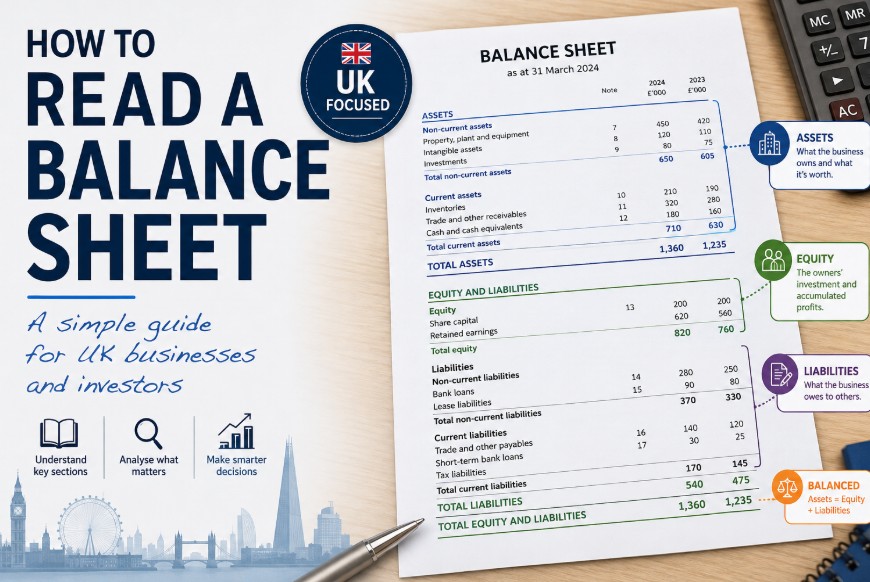
A balance sheet has three main sections assets, liabilities and equity, which must follow the basic accounting equation.
Under FRS 102, modern cloud accounting software can automatically bring together sales, supplier invoices and bank transactions to help keep records accurate.
How to Read a Balance Sheet as a Small Business Director?
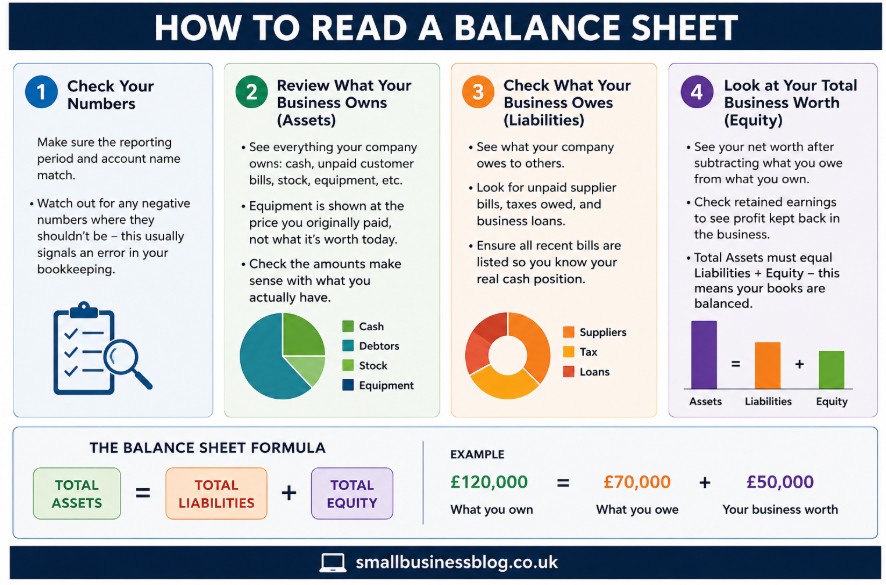
You can read a balance sheet in four simple steps. Check your cash balance, review your assets, check your debts and unpaid bills, and then look at your overall business worth and equity.
1. Check Your Bank Balance First
-
Start with a quick scan of the numbers to see if anything looks odd.
-
Look at your bank balance on the sheet and compare it with your actual bank account to ensure it matches.
-
Watch out for any negative numbers where they shouldn’t be, as this usually signals an error traced back to day-to-day bookkeeping for small business workflows.
2. Review What Your Business Owns (Assets)
-
Look at the asset section to see everything your company owns, such as cash, unpaid customer bills, and stock.
-
Remember that equipment and machinery are usually listed at their original purchase price, rather than what they are worth today.
-
Check if these amounts make sense based on the actual physical items and money your business currently has.
3. Check What Your Business Owes (Liabilities)
-
Move down to the liabilities section to see what your company owes to others.
-
Look for unpaid supplier bills, taxes owed, and any active business loans.
-
Make sure all recent bills are included so you do not end up thinking you have more spare cash than you really do.
4. Look at Your Total Business Worth (Equity)
-
Check the bottom section to see your business’s net worth after taking what you owe away from what you own.
-
Look at your retained earnings to see how much profit has been kept back to help the business grow.
-
Make sure your total assets equal your liabilities plus equity to confirm that the accounts balance.
How to Read Current and Non-Current Assets?
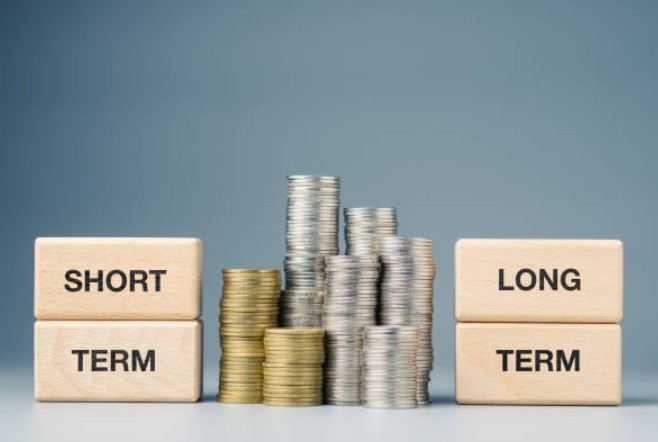
Assets are split into short-term items that can be turned into cash within 12 months and long-term assets used by the business over several years.
Current assets include cash and trade debtors, while non-current assets include machinery and equipment that are depreciated over time.
When reviewing assets, directors should make sure stock is valued realistically and is not overstated by old or unsold items.
-
Check the cash held in the business bank accounts to make sure there is enough available for upcoming payroll.
-
Check outstanding customer invoices to identify overdue payments and delays in collecting money.
-
Review stock inventory balances to ensure unsold goods are valued at cost or net realisable value.
-
Calculate total current assets by summing cash, debtors, and inventory figures.
-
List long-term assets such as computers, vehicles and office property at their original purchase cost.
-
Deduct accumulated depreciation from fixed assets to show their current value in the accounts.
-
Add current and non-current assets together to work out the total value of the business’s assets.
How to Read Short-Term and Long-Term Liabilities?
Liabilities are assessed by looking at the financial obligations owed to suppliers, lenders and tax authorities, and when they need to be paid.
Short-term liabilities are normally due within a year, while long-term liabilities are paid over a longer period.
-
Trade Creditors: Unpaid supplier bills due within standard trading terms, representing immediate short-term commercial obligations.
-
Taxation Reserves: Accrued corporation tax, employer National Insurance contributions, and quarterly VAT liabilities owed to HMRC.
-
Short-Term Borrowings: Overdraft facilities and commercial credit card balances falling due within twelve months.
-
Long-Term Debt: Bank loans, director loan balances and asset finance agreements that are due over several years.
How Do You Read Owner Equity and Retained Earnings?
Owner equity shows the net value of the company after all external liabilities have been taken into account.
Owner equity shows the net value of the company after all external liabilities have been taken into account.
When reviewing equity, rising retained earnings can indicate that the business is making profits and keeping some of them in the business.
-
Sum the total value of all current and non-current assets recorded on the ledger.
-
Aggregate total short-term and long-term liabilities owed to external creditors.
-
Subtract total liabilities from the total asset figure to isolate net asset value.
-
When reviewing equity, rising retained earnings can indicate that the business is making profits and keeping some of them in the business.
-
Inspect share capital accounts to confirm original founder equity injections remain correctly logged.
-
When reviewing equity, rising retained earnings can indicate that the business is making profits and keeping some of them in the business.
What Is the Golden Rule of the Balance Sheet?
The golden rule of a balance sheet is that total assets must always equal total liabilities plus equity.
This balance means that every pound held by the business is accounted for through either liabilities or the owners’ investment.
When transactions are entered, every credit entry must have a matching debit entry so the accounts remain balanced.
| Balance Sheet Section | Definition | Common UK Small Business Examples |
| Assets | Economic resources controlled by the business that generate future value. | Cash at bank, trade debtors, office equipment, stock inventory. |
| Liabilities | Financial obligations and debts owed to external parties. | Trade creditors, VAT payable, corporation tax, commercial loans. |
| Equity | Residual interest in assets after deducting liabilities (net worth). | Share capital, retained earnings, director loan accounts. |
What Are the Three Most Important Things on a Balance Sheet?
The three key areas to look at on a small business balance sheet are cash reserves, working capital and the debt-to-equity ratio.
Keeping track of these three areas can help prevent cash flow problems from disrupting day-to-day operations.
Looking at these three areas gives you a quick view of your company’s financial health.
-
Liquid Cash Reserves: This covers your ready cash and bank balances, representing the immediate funds available to pay daily expenses, staff salaries, and urgent bills without waiting on customer payments.
-
Working Capital Levels: This shows the difference between what you currently own and what you owe, helping you see whether the business has enough money to cover its short-term needs.
-
Total Debt-to-Equity Ratio: This compares your borrowings with your own investment in the business, showing how much debt the company has and the level of financial risk.
What Are the Red Flags in a Balance Sheet?
Key warning signs include negative working capital, rising unpaid customer debts and unusual director loan balances. Regular checks of cloud accounting records can help directors spot financial problems before statutory filing deadlines.
-
Negative Working Capital: Current liabilities exceeding current assets, pointing to immediate cash flow stress and potential insolvency.
-
Director Loan Deficits: Unauthorized or un-repaid withdrawals from a director loan account triggering heavy tax penalties under Section 455.
-
Stale Debtors: Growing trade debtors with no corresponding cash inflow, signaling broken credit control policies.
-
Inflated Inventory: Unmovable stock sitting on the ledger indefinitely without generating sales revenue.
Can AI Be Used to Analyze a Balance Sheet?
Yes, Artificial intelligence can be effectively used to analyze balance sheets by automating ratio calculations, flagging anomaly patterns, and forecasting cash flow trajectories from cloud ledger data.
Modern financial software uses machine learning models to analyze balance sheet metrics, comparing current performance against historical trends to assist small business owners in making rapid decisions.
While AI tools streamline data processing, final strategic decisions regarding solvency and risk management remain the responsibility of company directors.
Conclusion
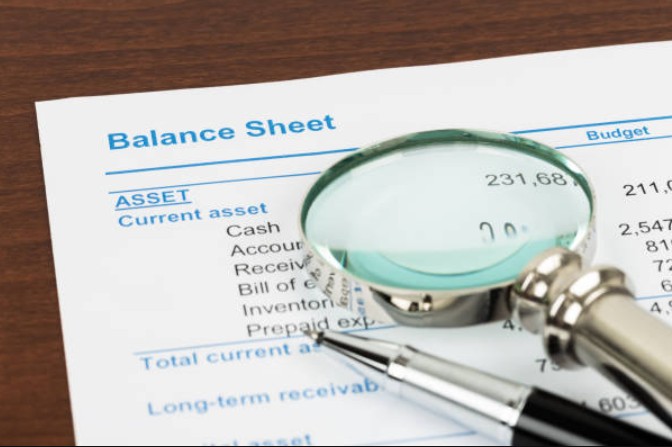
Reading a balance sheet effectively transforms raw accounting data into actionable insight for small business management. By regularly auditing assets, controlling liabilities, and protecting equity reserves, directors ensure long-term corporate survival.
Next steps involve syncing cloud accounting software with bank feeds to maintain real-time visibility over working capital and scheduling monthly balance sheet reviews with internal finance teams.
Disclaimer: This article is for informational purposes only and does not constitute professional financial, accounting, or legal advice.
FAQs
How to read a balance sheet for beginners?
Beginners can read a balance sheet by reviewing total assets at the top, checking total liabilities in the middle, and verifying that owner equity balances the equation at the bottom.
What are the red flags in a balance sheet?
Major red flags include negative working capital, mounting uncollected customer debts, and unserviced director loan account liabilities that threaten company solvency.
What is the golden rule of the balance sheet?
The golden rule states that total assets must always equal total liabilities plus owner equity, maintaining permanent mathematical equilibrium across the ledger.
What is the difference between an asset and a liability?
An asset is an economic resource owned by the business that generates future value, whereas a liability is a financial debt owed to an external creditor.
Why must a balance sheet always balance?
A balance sheet must always balance because every company asset is funded either by borrowing from creditors or by capital invested by company owners.
How often should a small business review its balance sheet?
Small businesses should review their balance sheet monthly alongside profit and loss statements to monitor working capital fluctuations and cash reserves.