
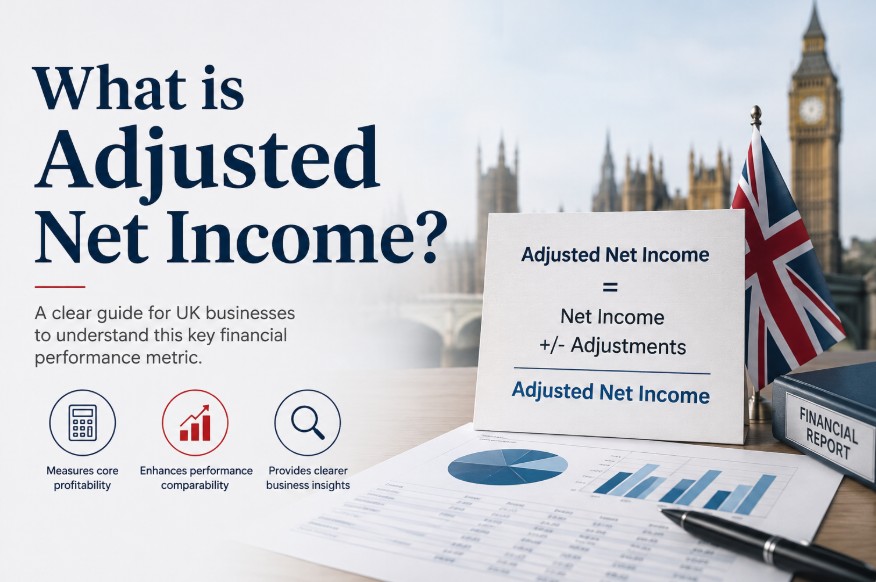
What is Adjusted Net Income? A Complete Guide for Small Business Owners
Adjusted net income is your total taxable income before Personal Allowances are applied, minus certain tax reliefs such as grossed-up Gift Aid donations, relief-at-source pension contributions, and trading losses.
HM Revenue and Customs (HMRC) uses this figure to work out whether you meet key tax thresholds, including the High Income Child Benefit Charge and the Personal Allowance taper.
Working out personal and business tax obligations means looking beyond your salary or annual take-home pay.
Understanding how this figure is worked out can help avoid unexpected tax charges and ensure eligible reliefs are claimed by unincorporated business owners, sole traders, and company directors.
Key Takeaways
- Adjusted net income represents total taxable income before Personal Allowances, minus specific reliefs like Gift Aid and pension contributions.
- HM Revenue and Customs uses the metric to enforce the High Income Child Benefit Charge and Personal Allowance tapering thresholds.
- Charitable donations and relief-at-source pension payments need to be grossed up by applying the correct tax factor to the amount paid.
- Going over the £60,000 threshold starts the gradual clawback of Child Benefit under current UK tax rules.
- Earning over £100,000 reduces the tax-free Personal Allowance by £1 for every £2 of income above that level.
What is adjusted net income?
Adjusted net income is the figure set out under the Income Tax Act 2007 and is used to assess an individual’s income for tax purposes.
In practice, HMRC does not use your take-home pay or business turnover when working out high-income tax charges. Instead, the calculation adds together all taxable income for the tax year before Personal Allowances are deducted, while also taking certain tax reliefs into account.

Why Does Adjusted Net Income Matter?
Adjusted net income is the figure used under the Income Tax Act 2007 to assess your income for tax purposes. In practice, when reviewing decisions regarding high-income tax charges, HMRC does not look at net take-home pay or raw turnover.
Instead, it adds together your taxable income for the tax year before taking off Personal Allowances and certain tax reliefs.
It helps determine whether a taxpayer faces the High Income Child Benefit Charge or falls into the 60% effective marginal tax rate caused by the Personal Allowance taper.
What Is Included in Adjusted Net Income?
The calculation starts with your total taxable income from personal and business sources before Personal Allowances are deducted.
To work out this figure, taxpayers need to add together the different sources of income received during the tax year.
-
Employment earnings: Salary, bonuses, and taxable benefits-in-kind such as company cars or private medical insurance form the primary layer. Business owners or high earners climbing into the top 5 percent income UK often find that these primary layers push them past critical statutory limits.
-
Self-employment and business profits: Sole trade profits, business partnership income, and rental income from property portfolios are also included in the calculation. This is particularly relevant when assessing what a good rental yield is.
-
Investments and savings: Savings interest and company share dividends count toward the baseline.
-
Pensions: Most pensions, including state and occupational schemes, are included.
Some items, however, are not included in the calculation. Tax-free investments such as Individual Savings Accounts (ISAs) do not form part of the calculation, nor do most means-tested state benefits.
| Income Category | Included in Adjusted Net Income Baseline? | Excluded from Calculation? |
| Employment Salary and Bonuses | Yes | No |
| Self-Employed Trading Profits | Yes | No |
| Property Rental Income | Yes | No |
| Savings Interest and Dividends | Yes | No |
| State and Occupational Pensions | Yes | No |
| Individual Savings Account Returns | No | Yes |
Is net income the same as taxable pay?
No. Net income and taxable pay are two different figures with separate definitions under the UK tax system.
Taxable pay refers to earnings that are subject to income tax before allowances, deductions or reliefs are applied. Net income represents taxable income minus specific direct reliefs such as allowable trading losses.
Adjusted net income goes a step further by including deductions such as grossed-up charitable donations and private pension contributions, so it can differ from both gross turnover and take-home pay.
What are the key differences between Net Income, Taxable Income, and Adjusted Net Income?
Net income, taxable pay and adjusted net income are different figures, each with its own definition under the UK tax system.
| Feature / Attribute | Taxable Pay (or Taxable Income) | Net Income | Adjusted Net Income |
| Statutory Definition | Earnings subject to income tax before any allowances, deductions, or reliefs are applied. | Taxable income adjusted strictly for primary direct reliefs. | Total taxable income before Personal Allowances, minus specific eligible statutory tax reliefs. |
| Key Inclusions | Employment salary, bonuses, benefits-in-kind, trading profits, property rental, savings interest, and dividends. | All primary taxable income streams included in taxable pay. | All net income sources (salary, profits, dividends, pensions, rental income). |
| Key Deductions and Adjustments | None applied at this initial calculation stage. | Allowable trading losses and specific direct deductions. | Grossed-up Gift Aid donations, relief-at-source pension contributions, and trade union/police organization relief payments. |
| Primary Tax Purpose | Serves as the raw starting pool of income before tax administration rules are applied. | Acts as an intermediate baseline before personal allowances and complex tax reliefs are factored in. | Used by HMRC to enforce high-threshold rules like the High Income Child Benefit Charge and Personal Allowance tapering. |
What is adjusted net income for child benefit?
The High Income Child Benefit Charge (HICBC) applies if an individual or their partner has an adjusted net income exceeding £60,000 within a given tax year.
Parents can face unexpected tax bills if they are unaware of the threshold and their business profits or other income push them above the limit.
The charge gradually claws back child benefit payments at a rate of 1% for every £200 earned above the £60,000 threshold, reaching a 100% repayment requirement once income hits £80,000.
How do I work out my adjusted net income step-by-step?
Working out the final figure involves following the steps set out under current tax rules. Business owners and self-employed individuals can work out their position by following these steps:
-
Calculate net income by adding all taxable income streams together and deducting specific eligible reliefs such as allowable trading losses or gross pension contributions paid without tax relief.
-
Deduct grossed-up Gift Aid donations by calculating the value of charitable gifts and adjusting them to account for basic rate tax relief.
-
Deduct relief-at-source pension contributions by taking personal contributions made to a relief-at-source pension scheme and scaling them to reflect basic rate tax relief.
-
Add back any tax relief claimed for qualifying payments made to trade unions or police organisations if they were deducted during the initial net income phase.
-
Check the final figure against the £60,000 and £100,000 HMRC thresholds.
-
Submit your Self Assessment details accurately and make sure the deductions match your records.
How does adjusted net income affect my personal allowance?
Once adjusted net income goes above £100,000, the standard tax-free Personal Allowance starts to reduce.
The allowance reduces by £1 for every £2 earned above the £100,000 mark, disappearing completely once income reaches £125,140.
| Income Bracket | Personal Allowance Status | Effective Marginal Tax Rate |
| Up to £100,000 | Full £12,570 Allowance Active | Standard Rates (20% / 40%) |
| £100,001 to £125,140 | Tapering (£1 reduction per £2 earned) | 60% Effective Tax Trap |
| Over £125,140 | Fully Withdrawn (£0 Allowance) | 45% Additional Rate |
This taper creates an effective marginal tax rate of 60% within this income range, which can make tax planning more difficult for growing small businesses and high-earning directors.

What can I do to lower my adjusted net income legally as a business owner?
Managing income close to key tax thresholds can help business owners protect valuable allowances and reduce their tax bill through legitimate planning.
-
Utilise workplace salary sacrifice arrangements to redirect a portion of gross employment salary directly into a workplace pension before it registers in the initial calculation.
- Founders considering different passive income ideas should also consider how extra income affects their overall tax position.
-
Increase relief-at-source private pension payments to allow for direct deductions from the overall net income total.
-
Use Gift Aid when making eligible charitable donations to reduce the final adjusted figure while supporting good causes.
-
Where business cash flow allows, consider spreading dividend payments across tax years to avoid a sudden increase in income.
Conclusion
Managing your tax obligations effectively means keeping clear records of taxable income, allowable business expenses and pension reliefs throughout the tax year.
Small business owners and directors should monitor their earnings regularly against key HMRC thresholds, particularly the £60,000 and £100,000 markers.
Getting advice from a qualified accountant, such as one registered with the Institute of Chartered Accountants in England and Wales, can help you stay compliant and avoid unexpected tax charges.
Disclaimer: This article is for informational purposes only and does not constitute formal financial, tax, or legal advice.
FAQs
How do I calculate my adjusted net income for child benefit?
Add all taxable earnings, subtract allowable trading losses, and then deduct grossed-up Gift Aid donations and relief-at-source pension contributions. If the resulting total exceeds £60,000, the High Income Child Benefit Charge applies.
Is adjusted net income before or after tax?
It is calculated from total taxable income before Personal Allowances are applied, while taking certain tax reliefs such as charitable donations and basic-rate pension adjustments into account. It is distinct from final take-home pay.
What’s the difference between net income and adjusted net income?
Net income is total taxable income minus certain reliefs such as trading losses. Adjusted net income then includes further deductions, such as grossed-up charitable donations and private pension contributions.
How does pension contribution affect adjusted net income?
Personal pension contributions made through relief-at-source schemes are deducted from net income after being grossed up at the basic rate, reducing the figure used to assess tax thresholds.
Does dividend income count toward adjusted net income?
Yes, dividend income from company shares is included as taxable income when calculating the figure used by HMRC.
What happens if my income exceeds £100,000?
Your standard tax-free Personal Allowance reduces by £1 for every £2 earned above £100,000, leading to a complete loss of the allowance at £125,140 and creating a 60% marginal tax rate.
Are business expenses deducted before calculating adjusted net income?
Allowable business expenses and trading losses are deducted when calculating net taxable business profits, which form the starting point for the calculation.
Can sole traders claim pension deductions against adjusted net income?
Yes, Sole traders can deduct eligible personal pension contributions from their net income calculation, provided they meet HMRC rules and limits for the relevant tax year.



One Comment