
How to Pay Yourself From a Limited Company: The Small Business Guide
Paying yourself from a small business limited company involves combining a tax-efficient director salary through an HMRC PAYE payroll scheme with post-tax dividend distributions from company profits, supported by strict bookkeeping practices and formal board documentation.
Balancing salary, dividends, and director loans minimizes overall Corporation Tax and personal Income Tax liability for small business owners.
Key Takeaways
-
A director salary set at the Lower Earnings Limit protects state pension entitlement while avoiding employee National Insurance.
-
Dividends can only be paid from legally distributable profits remaining after Corporation Tax liabilities are settled.
-
Operating a PAYE payroll scheme is a mandatory administrative step before drawing any regular director remuneration.
-
Overdrawn Director Loan Accounts must be settled within nine months of the accounting period end to avoid Section 455 tax.
How to Pay Yourself From a Limited Company?
Drawing remuneration from a limited company requires establishing a formal, compliant structure that balances corporate tax deductibility with personal tax optimization. Because a limited company is a distinct legal entity, you cannot simply transfer funds at will without proper categorization.
-
Establish a PAYE Payroll Scheme: Register as an employer with HMRC before your first payday to report salary figures in real time through RTI-compliant software.
-
Draw a Tax-Efficient Salary: Set your monthly salary up to statutory thresholds, such as the Lower Earnings Limit, to protect state pension entitlements while minimizing or eliminating employee and employer National Insurance contributions.
-
Distribute Post-Tax Profits as Dividends: Extract the remainder of your required income through dividend distributions, which bypass National Insurance entirely and attract lower tax rates than earned income.
-
Document Every Transaction: Maintain strict separation between business and personal bank accounts, recording all salaries, dividends, and director loans with proper ledgers and vouchers.

How Much Salary Should You Pay Yourself as a Director?
For 2026/27, most single-director companies choose a salary of £5,000, £6,708 or £12,570 a year. The right one depends on whether you want a qualifying year for your State Pension and how much employer National Insurance you are willing to pay.
The three figures behind those options are the £5,000 Secondary Threshold, the £6,708 Lower Earnings Limit (£559 a month) and the £12,570 Personal Allowance, which is also the Primary Threshold.
| Annual salary | Employer NI (15%) | Employee NI | Qualifying State Pension year? |
|---|---|---|---|
| £5,000 | £0 | £0 | No |
| £6,708 | £256.20 | £0 | Yes |
| £12,570 | £1,135.50 | £0 | Yes |
The employer NI figures assume your company cannot claim the Employment Allowance. The Lower Earnings Limit now sits above the Secondary Threshold.
That means a £6,708 salary is not completely free of National Insurance, as older guides suggest. Employer NI of 15% applies to the £1,708 between the two figures.
The £10,500 Employment Allowance can offset this cost only if someone other than the director is paid above the Secondary Threshold. A company whose only such employee is the director cannot claim it.
Salary is a deductible expense, so each option also reduces your Corporation Tax bill. Ask your accountant to model all three against your own profits before you choose.
How to Take Dividends From a Limited Company Legally?
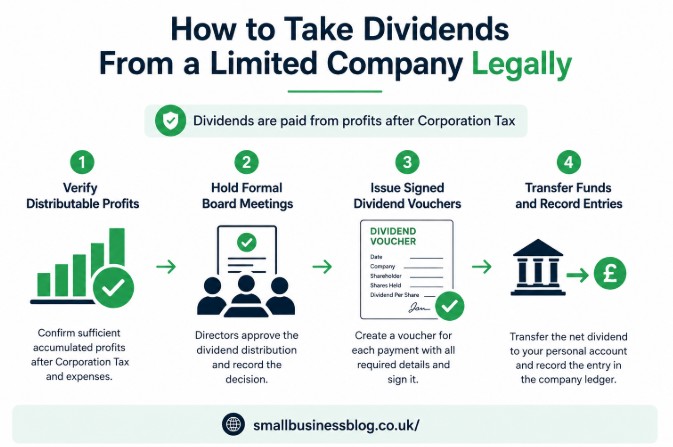
Dividends are appropriations of profit rather than business expenses, meaning they are distributed after Corporation Tax liabilities are settled.
To understand the mechanics of these payments better, founders should review how do dividends work in practice to remain fully legal and withstand an HMRC compliance check.
-
Verify Distributable Profits: Review up-to-date bookkeeping records and financial statements to confirm that the company holds sufficient accumulated, realized profits after accounting for Corporation Tax and operational expenses.
-
Hold Formal Board Meetings: Convene a meeting of the company directors to approve the dividend distribution, even if you are the sole director, and record the decision.
-
Issue Signed Dividend Vouchers: Generate a formal dividend voucher for every payment detailing the date, company name, shareholder name, number of shares held, and the exact dividend amount per share.
-
Transfer Funds and Record Entries: Transfer the net dividend amount from the business bank account to your personal account and log the transaction within the company’s official financial ledger.
Is it better to pay yourself a salary or dividends?
Salaries and dividends serve fundamentally different functions in small business finance. A salary is treated as a deductible business expense, meaning it reduces the company’s taxable profit before Corporation Tax is calculated.
Dividends, conversely, are appropriations of profit distributed after Corporation Tax has been paid and cannot be deducted as business expenses.
Despite the lack of corporation tax relief on dividends, their overall tax treatment makes them the preferred vehicle for profit extraction.
Dividends carry zero National Insurance liability and benefit from lower tax rates across basic, higher, and additional rate bands compared to earned income.
Balancing both mechanisms allows directors to capture the tax-deductible nature of a small salary while maximizing the tax efficiency of dividend distributions.
-
Salaries reduce corporate taxable profits, lowering overall Corporation Tax bills.
-
Dividends bypass National Insurance entirely, protecting net household income.
-
Salaries build qualifying years for the UK state pension without triggering tax bills.
-
Dividends require sufficient retained earnings and formal paperwork to remain legal.
How Much Tax Do You Pay on Dividends?
You pay no tax on the first £500 of dividend income in 2026/27. After that, the rate depends on which Income Tax band your dividends fall into:
| Band | Dividend tax rate 2026/27 | Rate in 2025/26 |
|---|---|---|
| Basic rate | 10.75% | 8.75% |
| Higher rate | 35.75% | 33.75% |
| Additional rate | 39.35% | 39.35% |
HMRC treats dividends as the top slice of your income, so your salary is counted first. Any unused Personal Allowance can cover dividends at 0%.
Example: A director takes a £12,570 salary and £30,000 in dividends. Their total income of £42,570 stays inside the basic-rate band, which runs up to £50,270. The taxable dividends are £29,500 (£30,000 less the £500 allowance). At 10.75%, the dividend tax is £3,171.25.
The company does not deduct this tax for you. You calculate and pay it yourself through Self Assessment. Setting money aside as you draw dividends avoids a shock in January.
How Much Can You Take Out After Corporation Tax?
You can only take dividends from profit left after Corporation Tax, so the tax rate decides how much is available. For 2026/27 the company pays:
- 19% on profits up to £50,000 (small profits rate)
- 25% on profits over £250,000 (main rate)
- Marginal relief on profits in between, which lifts the effective rate gradually from 19% to 25%
Above £50,000, work out the tax by charging 25% on the whole profit. Then subtract marginal relief, which is (£250,000 minus your profit) × 3/200.
| Taxable profit (after your salary) | Corporation Tax | Left to distribute |
|---|---|---|
| £30,000 | £5,700 | £24,300 |
| £80,000 | £17,450 | £62,550 |
For the £80,000 case, 25% gives £20,000. Marginal relief is £170,000 × 3/200 = £2,550. The tax is £17,450, an effective rate of about 21.8%.
Your salary and the employer NI on it come off profit before Corporation Tax is calculated. Dividends do not, because they are paid out of what remains. If your company has associated companies, the £50,000 and £250,000 limits are shared between them.
How much can you pay yourself without getting taxed?
Directors can earn up to the Personal Allowance threshold of £12,570 across total income before personal Income Tax applies. However, structuring the exact split requires balancing tax-free personal limits with National Insurance rules.
A common pattern among UK small business directors involves setting the annual salary at the Lower Earnings Limit (LEL), which stands at £6,396 per year (or £533 per month).
This specific figure ensures the director qualifies for a state pension year without incurring any employee or employer National Insurance liabilities.
Any income required above this threshold is then drawn as dividends, which benefit from the annual dividend allowance before standard dividend tax rates apply.
-
Audit company cash flow and calculate net profits remaining after operational expenses.
-
Register an official PAYE scheme with HM Revenue and Customs (HMRC).
-
Set up monthly payroll runs using approved payroll software to report figures via Real Time Information (RTI).
-
Draw the monthly director salary via bank transfer from the business account to the personal account.
-
Calculate available distributable profits after accounting for Corporation Tax.
-
Issue signed board meeting minutes and formal dividend vouchers.
-
Transfer dividend payments to personal accounts and record them in the company ledger.
Can you loan yourself money from your company?
Small business owners occasionally require short-term liquidity outside of regular salary and dividend schedules. Beyond personal drawings, some entrepreneurs also explore alternative asset structures such as buying property through a limited company to build long-term value.
Accessing company funds for personal use without declaring formal dividends or salary creates a Director’s Loan Account (DLA) balance.
When a DLA becomes overdrawn, meaning the director owes money to the company, strict statutory timelines apply.
If an overdrawn loan balance remains unsettled nine months and one day after the company’s accounting period end date, the business faces a penalty charge known as Section 455 tax.
Clearing the loan before this deadline or repaying it through subsequent dividend declarations prevents this punitive corporate tax charge from activating.
| DLA Status | Financial Threshold | Regulatory Consequence | Settlement Window |
| In Credit | Company owes money to director | No tax implications; funds can be withdrawn tax-free | Immediate withdrawal permitted |
| Overdrawn (Short-Term) | Director owes money to company | Nil penalty if cleared within 9 months | Within 9 months and 1 day of accounting year-end |
| Overdrawn (Long-Term) | Outstanding balance past deadline | Section 455 tax charge triggered at corporation tax rates | Ongoing until full repayment or write-off |
How do I set up a payroll scheme for my small business?
Operating an official payroll scheme is a legal prerequisite before any director or employee receives a regular salary. Small business owners must register as an employer with HMRC before the first payday occurs.
Digital registration generates official PAYE reference numbers required for reporting. Once established, every payroll run must be submitted to HMRC on or before the payday using Real Time Information (RTI) software.
This ensures that tax codes are applied correctly and employment records remain fully compliant with statutory reporting standards.
How Do You Declare Your Director Pay on a Self Assessment Return?
Company directors generally need to file a Self Assessment return, and dividend tax is settled through it.
Salary appears on the employment pages, using the figures from your payroll records. Dividends go in the dividend income section, using the amounts on your dividend vouchers.
The key dates for a 2026/27 return:
- 5 October 2027: register for Self Assessment if you have not filed before.
- 31 January 2028: file your online return and pay the balance.
- 31 January and 31 July: payments on account, if your bill exceeds £1,000.
Keep every dividend voucher and payslip. They are the evidence behind every figure you report.
Mistakes to Avoid When Paying Yourself From Your Company
- Using an out-of-date threshold, such as a Lower Earnings Limit from a previous year, in your payroll.
- Assuming a £6,708 salary has no National Insurance cost. Employer NI applies above £5,000.
- Declaring dividends without checking distributable reserves.
- Skipping board minutes or dividend vouchers because you are the only director.
- Taking cash “as you go” with no record, which builds an overdrawn director’s loan account.
- Forgetting that dividend tax is payable through Self Assessment, and spending the money before the bill arrives.
- Paying personal costs from the business account.
- Missing the RTI submission, which must reach HMRC on or before payday.
- Not reviewing your split after the April 2026 dividend rate rise.
Conclusion
Balancing remuneration requires careful coordination between corporate tax obligations and personal income thresholds.
Small business directors maintain compliance and protect net income by anchoring their regular withdrawals to a low PAYE salary, utilizing post-tax dividend distributions for primary profit extraction, and monitoring loan account balances closely.
Maintaining disciplined bookkeeping practices across every payroll run and dividend voucher secures long-term financial stability and prevents unexpected regulatory penalties.
Disclaimer: This guide is for informational purposes only and does not constitute formal financial, tax, or legal advice.
FAQs
What is the most tax-efficient way to pay yourself as a director?
Drawing a salary up to the National Insurance primary threshold combined with dividends up to the basic rate tax band threshold represents the standard tax-efficient structure for single-director companies.
Can you take cash out of a limited company without paying tax?
Cash can be withdrawn tax-free up to personal allowances and specific dividend or savings bands, while other withdrawals must be structured as allowable business expenses, legitimate salary, or short-term director loans.
How do I avoid tax with a limited company?
Tax liabilities are legally minimized by utilizing allowable business expenses, claiming capital allowances on equipment, structuring director remuneration through optimal salary and dividend splits, and utilizing pension contributions.
Do I need an accountant to pay myself?
While company directors can manage payroll and dividends independently using digital accounting software, professional accountancy guidance ensures compliance with changing HMRC thresholds and prevents costly filing mistakes.