
How Do Dividends Work: Complete UK Limited Company Rules, Tax Rates & Payout Steps
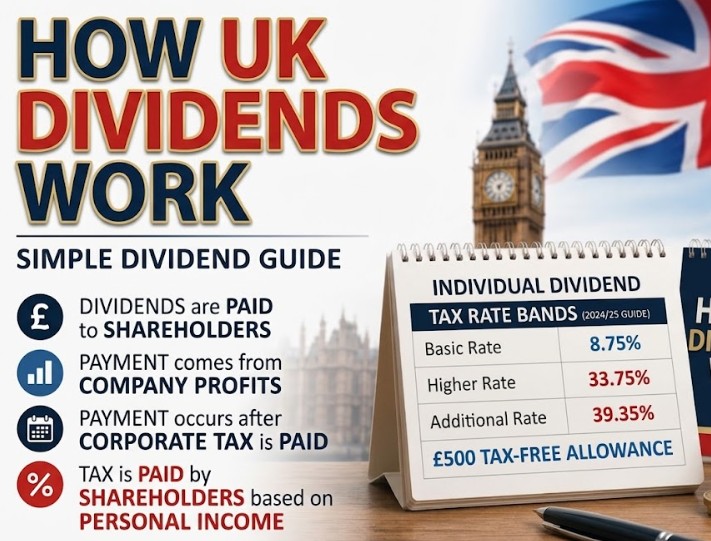
A dividend is a distribution of a company’s post-tax profits paid out to equity shareholders as an investment return.
Understanding how do dividends work is essential for UK company directors seeking tax-efficient director remuneration and retail investors building stock portfolios in 2026.
Key Takeaways
-
A dividend is a payout of accumulated post-tax corporate profits, distinct from standard employment wages.
-
UK limited companies can only distribute dividends if they hold sufficient distributable reserves and retained earnings.
-
The tax-free annual dividend allowance stands at £500, with tax rates set at 10.75%, 35.75%, and 39.35% for 2026/27.
-
Every distribution requires a formal board resolution and a written dividend voucher for HMRC and corporate compliance.
What Are Dividends UK?
In the UK, dividends are shares of corporate wealth distributed to equity holders after a company has settled its operating expenses, overheads, and Corporation Tax liabilities.
Under UK company law, the corporate entity acts as a separate legal person, meaning business funds do not automatically belong to company directors.
Understanding the distinction between corporate wealth and personal money is vital for legal compliance.
Legal Realities of Company Distributions
-
Separate Legal Identity: Corporate funds must remain distinct from personal finances until a formal distribution occurs.
-
Proportional Allocation: Dividends must match exact shareholdings unless distinct share classes (such as alphabet shares) are established.
-
Solvency Protection: Retained earnings must absorb all operational liabilities before any distribution can be calculated.
When reviewing decisions, company accountants emphasize that cash flow alone does not equal profit.
A business might show a healthy bank balance due to incoming advance payments, but if outstanding debts and tax liabilities exceed those funds, no distributable reserves exist.

How Do Dividends Work UK?
In the UK, dividends are shares of corporate wealth distributed to equity holders after a company has settled its operating expenses, overheads, and Corporation Tax liabilities.
Under UK company law, establishing a private limited company means the corporate entity acts as a separate legal person, meaning business funds do not automatically belong to company directors.
Understanding the distinction between corporate wealth and personal money is vital for legal compliance.
In practice, a common pattern among owner-managed small businesses involves combining a modest PAYE salary with periodic dividend distributions.
This blend optimizes personal taxation because dividends attract zero National Insurance contributions, unlike standard employment income, which triggers both employer and employee Class 1 deductions.
For equity holders operating within a public limited company, the process operates automatically through a brokerage or investment platform, though the underlying requirement for corporate profitability remains identical.
What are the rules for paying dividends in the UK?
UK rules dictate that limited companies can only pay dividends if they possess sufficient distributable reserves from accumulated, realized profits.
Directors must verify accounts, review articles of association, pass a formal board resolution, and issue written dividend vouchers.
-
Verify Distributable Reserves: Review current management accounts and balance sheets to confirm the company holds accumulated, realized profits after all taxes and expenses.
-
Review Articles of Association: Check the company’s governing constitutional documents for any specific internal restrictions or procedural rules regarding shareholder payouts.
-
Convene a Board Meeting: Gather directors to formally propose and evaluate the dividend amount based on verified financial health.
-
Approve a Board Resolution: Pass a formal resolution agreeing to the distribution and document the decision in written board meeting minutes.
-
Transfer Funds: Move the approved cash amount from the corporate bank account to the personal bank accounts of eligible shareholders.
-
Generate Dividend Vouchers: Issue a formal, written dividend voucher to every participating recipient detailing the exact payment metrics.
-
Archive Compliance Records: Store all board minutes, management accounts, and voucher copies securely for a minimum of six years to satisfy potential HMRC inquiries.
Do all companies pay dividend tax UK?
No, UK companies themselves do not pay tax on the dividend distributions they issue because dividends are paid out of post-tax corporate profits and are non-deductible business expenses.
Regarding recipients, whether tax is due depends entirely on individual income and allowances.
Dividends are paid out of post-tax corporate profits (retained earnings), meaning they cannot be used to lower a company’s Corporation Tax bill.
For individual recipients, tax liability depends on overall income:
-
If an individual’s total dividend income falls within the £500 annual Dividend Allowance, or is completely absorbed by their unused Personal Allowance (£12,570), they pay 0% tax.
-
Shares held inside tax-sheltered wrappers like an Individual Savings Account (ISA) are entirely exempt from UK dividend tax, regardless of the payout size.
What are the changes made in paying dividends in 2026 UK?
The UK tax landscape for 2026/27 introduced critical adjustments, including a 2 percentage point hike on basic and higher dividend tax rates, alongside a frozen £500 tax-free annual allowance.
The UK tax adjustments impacting how much net income shareholders retain include:
-
Dividend Tax Rate Hikes: The UK government increased dividend tax rates across both the basic and higher rate bands by 2 percentage points. The basic dividend tax rate increased from 8.75% to 10.75%, and the higher rate increased from 33.75% to 35.75%.
-
Frozen Allowances: The annual tax-free Dividend Allowance remains frozen at £500, maintaining the tighter threshold established in previous years.
-
Additional Rate Stability: The additional rate for top earners remains unchanged at 39.35%.
What are the UK dividend tax rates and thresholds?
Once total dividends cross the £500 allowance, they are taxed according to current UK dividend tax rates aligned with the recipient’s overall income tax band:
| Tax Band | Taxable Income Threshold | 2026/27 Dividend Tax Rate |
| Personal Allowance | Up to £12,570 | 0% (Within allowance/personal limit) |
| Basic Rate Band | £12,571 to £50,270 | 10.75% |
| Higher Rate Band | £50,271 to £125,140 | 35.75% |
| Additional Rate Band | Over £125,140 | 39.35% |
How is dividend tax declared on companies in the UK?
While companies do not pay or declare dividend tax on their Company Tax Return (CT600), they must maintain internal corporate records. Individual shareholders must report earnings exceeding the £500 allowance via an annual Self Assessment tax return.
The reporting mechanism is split into two distinct tiers:
-
At the Corporate Level: Companies must properly document internal records (board minutes and dividend vouchers) to prove that the distributions were legally backed by distributable reserves. While the total dividend amount is recorded in the company’s annual accounts submitted to Companies House and HMRC, it is not an allowable expense to lower Corporation Tax.
-
At the Individual Level (Self Assessment): If a shareholder’s total dividend income exceeds the £500 annual allowance, they must individually register for and file an annual Self Assessment tax return. Shareholders must report their exact dividend earnings on the supplementary dividend pages so HMRC can calculate and collect the correct personal tax liability.

How to Pay Yourself Dividends from Your Limited Company?
For owner-managed limited companies, executing a dividend requires a structured administrative workflow to satisfy HM Revenue and Customs (HMRC) and Companies House standards.
-
Verify Distributable Reserves: Review current management accounts and balance sheets to confirm the company holds accumulated, realized profits after all taxes and expenses.
-
Review Articles of Association: Check the company’s governing constitutional documents for any specific internal restrictions or procedural rules regarding shareholder payouts.
-
Convene a Board Meeting: Gather directors to formally propose and evaluate the dividend amount based on verified financial health.
-
Approve a Board Resolution: Pass a formal resolution agreeing to the distribution and document the decision in written board meeting minutes.
-
Transfer Funds: Move the approved cash amount from the corporate bank account to the personal bank accounts of eligible shareholders.
-
Generate Dividend Vouchers: Issue a formal, written dividend voucher to every participating recipient detailing the exact payment metrics.
-
Archive Compliance Records: Store all board minutes, management accounts, and voucher copies securely for a minimum of six years to satisfy potential HMRC inquiries.
How Much Dividend Can I Pay Myself Tax-Free in the UK?
Every UK resident benefits from a tax-free Dividend Allowance of £500 for the 2026/27 tax year, incurring 0% tax. Additional earnings stack on top of personal income allowances and are taxed according to individual tax bands.
Tax planning around distributions depends heavily on annual government allowances. For the 2026/27 tax year, every individual resident in the UK benefits from a tax-free Dividend Allowance of £500.
HMRC treats dividend income as the “top slice” of an individual’s total taxable income. For example, if a director earns a modest salary utilizing their personal allowance (£12,570), subsequent dividends stack directly on top. Once total dividends cross the £500 allowance, they face:
-
Basic Rate Band: Taxed at 10.75%
-
Higher Rate Band: Taxed at 35.75%
-
Additional Rate Band: Taxed at 39.35%

Essential Comparison of Remuneration Structures
Business profit extraction methods can be compared across corporation tax treatment, National Insurance impact, and income tax classification to balance company liabilities against personal income.
Evaluating how business profits are extracted requires balancing corporation tax liabilities against personal income taxes and national insurance:
| Remuneration Type | Corporation Tax Treatment | National Insurance Impact | Income Tax Classification |
| Director Salary | Deductible business expense reducing corporate profit | Subject to Class 1 Employer and Employee contributions | Subject to standard PAYE Income Tax bands |
| Dividend Payout | Paid from post-tax retained earnings (non-deductible) | Completely exempt from all National Insurance charges | Subject to specialized Dividend Tax rates |
| Director’s Loan | Temporary advance requiring formal repayment within specific timelines | Exempt if repaid within nine months of accounting year-end | Treated as income if written off permanently |
Understanding Shareholder Payout Timelines and Market Rules
Public equity dividend distributions follow a strict four-stage calendar sequence: Declaration Date, Ex-Dividend Date, Record Date, and Payment Date, managed by brokers and registrars.
For individuals investing in publicly traded equities on markets like the London Stock Exchange, dividend distribution follows a strict sequence of calendar milestones:
-
Declaration Date: The board of directors publicly announces the upcoming dividend amount and distribution schedule.
-
Ex-Dividend Date: The vital cut-off point; investors must purchase and own the stock before this date to qualify for the payment.
-
Record Date: The day the company inspects its shareholder registry to formalize exactly who is entitled to the funds.
-
Payment Date: The operational day when cash is deposited into the investor’s brokerage or bank account.
What Does This Mean for Small and Medium Enterprises and Business Owners?
For SMEs and owner-managed companies, dividends offer a tax-efficient way to extract profits and bypass National Insurance costs, though improper handling carries severe risks.
-
Cash Flow vs. Profit: Directors must confirm actual distributable reserves from realized profits rather than relying on misleading bank balances.
-
Rigid Compliance: Every payout requires formal board resolutions, written dividend vouchers, and records stored for six years.
-
Tax Management: With the £500 allowance frozen and higher tax rates (10.75% and 35.75%), directors must balance PAYE salaries with dividends to minimize liabilities.
-
Legal Penalties: Unlawful payouts without sufficient reserves can force directors to make personal repayments and trigger HMRC reclassifications.
Conclusion
How do dividends work means securing tax-efficient remuneration for limited company directors and retail investors in 2026/27.
For company directors, maintaining formal meeting records and issuing accurate dividend vouchers ensures complete regulatory compliance. For investors, monitoring ex-dividend dates and utilizing tax-sheltered accounts optimizes long-term returns.
Business owners exploring asset growth or buying property through a limited company should consult a certified chartered accountant to tailor these principles safely to individual financial circumstances.
Disclaimer: This guide is for informational purposes only and does not constitute formal financial, legal, or tax advice; consult a certified chartered accountant before making business remuneration decisions.
FAQ
Do I pay National Insurance contributions on dividends?
No. Dividend distributions are entirely exempt from both employee and employer National Insurance contributions, separating them from PAYE wages.
How do I report dividend income to HMRC?
If total dividend income exceeds the £500 annual allowance, individuals must register for Self Assessment and report the figures using supplementary dividend pages on their annual tax return.
Can dividends be paid unequally among shareholders?
Only if the corporate structure incorporates separate classes of shares (such as alphabet shares). Identical ordinary shares require payouts distributed strictly in proportion to ownership percentages.
What happens if a company pays an unlawful dividend?
Distributing funds without sufficient retained earnings creates an unlawful dividend. Directors can be forced to repay the money personally, and HMRC may reclassify the payments as taxable earnings.
How often can a company distribute dividends?
Directors can declare dividends as frequently as business cash flow and distributable reserves allow, with many owner-managed firms opting for monthly, quarterly, or annual schedules.
Do dividends reduce a company’s Corporation Tax bill?
No. Unlike staff salaries or director wages, dividends are distributed from post-tax profits and do not count as a deductible business expense.
Can retail investors receive dividends inside an ISA?
Yes. Stocks and shares held within an Individual Savings Account (ISA) are entirely exempt from UK dividend tax and do not count toward the £500 allowance.