Complete Guide to Companies House Identity Verification Deadlines, ACSP Routes, and Rules
House identity verification is a mandatory legal process introduced under the Economic Crime and Corporate Transparency Act 2023 (ECCTA).
It requires all UK company directors, Persons with Significant Control (PSCs), and LLP members to authenticate their identity using GOV.UK One Login or an Authorised Corporate Service Provider (ACSP) to receive a unique 11-character personal code.
Key Takeaways
-
Companies House identity verification is a mandatory statutory requirement under the Economic Crime and Corporate Transparency Act 2023.
-
The mandatory transition window for existing officers and persons with significant control culminates in a hard legal deadline ending on 18 November 2026.
-
Successful verification yields a unique 11-character personal code that must be linked to all corporate appointments and annual confirmation statement filings.
-
Non-compliance results in criminal prosecution, rejection of Section 853A confirmation statements, and immediate administrative company strike-off risks.
What Is Companies House Identity Verification?
Companies House identity verification is the statutory process of confirming the identity of individuals who own or control UK corporate entities.
Introduced under ECCTA 2023, it replaces self-certification with biometric digital checks via GOV.UK One Login or Authorised Corporate Service Providers to eliminate anonymous ownership across the registry.
Companies House identity verification marks a fundamental shift in UK corporate law. Every director, Person with Significant Control (PSC), and LLP member must verify their identity once with the UK Registrar of Companies to prove they are who they claim to be.
Core Legal Purpose and Registry Transformation
The legal purpose of Companies House identity verification is to transform the UK register from a passive document repository into an active anti-money laundering gatekeeper.
Part of a broader Companies House company crackdown, it prevents bad actors from using fake names or stolen identities to form shell companies and conceal illicit financial activities.
Historically, public records on Companies House Beta operated as an unverified registry where filings were accepted at face value. This vulnerability allowed criminal networks to register shell corporations using fraudulent director details.
Under the Economic Crime and Corporate Transparency Act 2023 (ECCTA), Companies House holds legal authority to query, verify, and reject information. The verification framework binds every corporate officer to a verified government record, ensuring complete transparency across the UK business environment.
Statutory Applicability Scope
Companies House identity verification applies to all individuals holding management or beneficial ownership positions in UK corporate entities.
This includes directors of LTDs and PLCs, PSCs holding over 25% control, LLP designated members, general partners, and authorised filing presenters.
The scope of the law covers both domestic and international individuals involved in UK entities:
-
Limited Companies (LTD / PLC): All active, executive, non-executive, and shadow directors.
-
Limited Liability Partnerships (LLPs): All designated and individual LLP members.
-
Persons with Significant Control (PSCs): Individuals who directly or indirectly hold more than 25% of shares or voting rights.
-
Filing Presenters & Third-Party Agents: Company secretaries, accountants, and formation agents submitting official registry documents.
Who Needs to Verify?
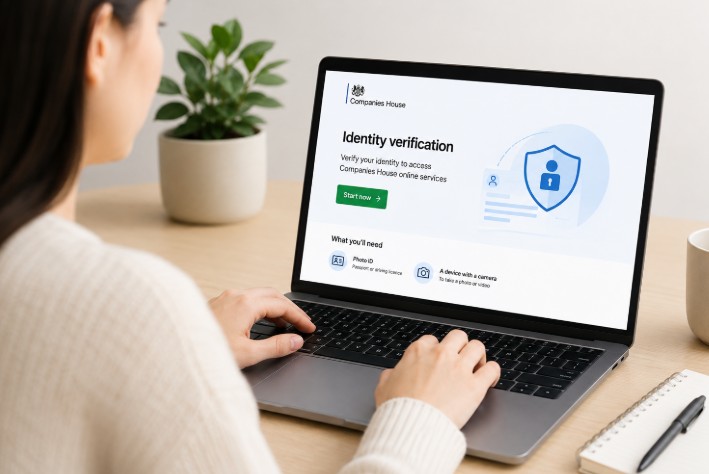
Anyone who directs, owns a controlling interest in, or files official documents for a UK-registered business must complete Companies House identity verification.
Nationality and residency do not grant exemption; overseas directors and non-UK PSCs must satisfy the same statutory verification requirements.
Identity verification applies universally across all UK business structures. Regardless of whether a business is active or dormant, the individuals behind the corporate entity must undergo authentication.
Detailed Entity and Role Mapping
Specific roles requiring mandatory verification include company directors, individual PSCs, corporate PSC representatives (Relevant Legal Entities), LLP members, general partners in Limited Partnerships, and direct filing agents delivering information under Companies House regulations.
| Target Group / Role | Entity Type | Verification Requirement |
| Company Directors | Private Limited (LTD), Public Limited (PLC), Overseas UK Branches | Mandatory prior to appointment or via next Confirmation Statement. |
| Persons with Significant Control (PSCs) | All corporate entities with >25% shareholding/voting rights | Mandatory within statutory timeframe linked to birth month or filing. |
| LLP Designated Members | Limited Liability Partnerships (LLPs) | Mandatory for all individual designated members. |
| General Partners | Limited Partnerships (LPs) | Mandatory for individual general partners or corporate officers. |
| Filing Presenters | Corporate Secretaries, In-house Accountants, Directors | Mandatory for anyone delivering direct filings to Companies House. |
| Authorised Corporate Service Providers (ACSPs) | External Accountants, Solicitors, Formation Agents | Must obtain registered ACSP status to verify third parties. |
When Is Verification Necessary?
Verification is triggered by specific corporate milestones: before forming a new company, upon appointment as a new officer, or alongside the first annual Confirmation Statement (CS01) filing for existing officers. New appointments must verify before or within 14 days of taking office.
The exact timing of when you must verify depends on whether you are launching a new enterprise or managing an existing company role.
-
Before New Incorporation: Anyone planning to form a new company or LLP must be fully verified before submission.
-
Upon New Appointment: New directors, LLP members, or PSCs must complete verification before or within 14 days of taking up their appointment.
-
During the Transitional Window (Existing Officers): Existing directors and PSCs must verify before the submission of the company’s first annual confirmation statement due after 18 November 2025 (extending through 18 November 2026).
-
When Filing Documents: Anyone submitting information on behalf of a company must be verified before the filing will be accepted.
What Are the Key Deadlines and Compliance Timelines?
Mandatory Companies House identity verification applies to new directors and PSCs from 18 November 2025.
Existing company officers have a 12-month transitional window ending on 18 November 2026, requiring identity verification to be completed alongside or before submitting their annual Confirmation Statement (CS01).
To avoid system congestion and ensure smooth processing across millions of UK business directors, Companies House phased the compliance rollout over 12 months
Transition Deadlines and Confirmation Statement Alignment
Under Section 853A of the Companies Act 2006, Companies House enforces identity verification through the annual Confirmation Statement (CS01).
An unverified director or PSC invalidates the CS01 submission, exposing the company to immediate statutory default.
Relevant Compliance Timeline
-
18 November 2025: Mandatory rules start for new appointments
-
CS01 Filing Date (2025–2026): Practical deadline for existing officers
-
18 November 2026: Hard legal transition window closes
Failing to plan for your company’s specific Confirmation Statement review period creates operational bottlenecks. Companies House will refuse unverified filings, leaving businesses vulnerable to automated enforcement penalties.
How Can You Access the GOV.UK One Login Portal?
You can access the official verification service by logging into GOV.UK One Login via the official GOV.UK verification portal. The system connects your central government identity credentials directly to the Companies House database using secure single sign-on technology.
GOV.UK One Login provides a single, secure gateway to access government services online, replacing disjointed legacy accounts with a unified digital identity framework.
Portal Access Procedures
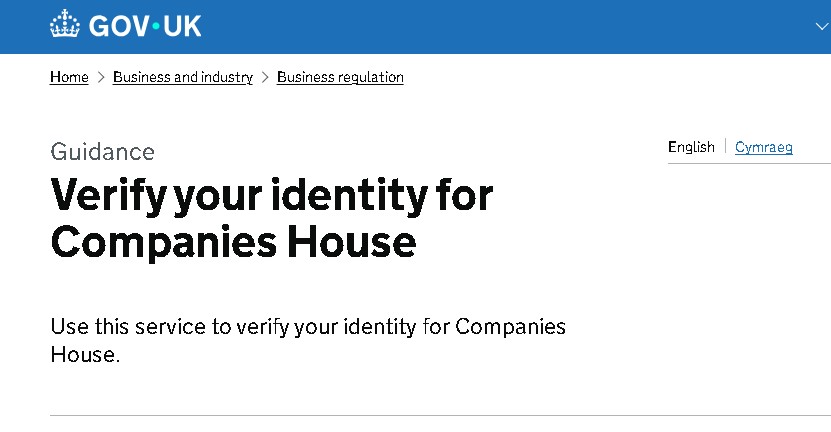
To access the Companies House verification portal, visit GOV.UK, navigate to the identity verification service, and log in with your GOV.UK One Login credentials. If you do not have an account, you can create one using a valid email address and smartphone.
Follow these foundational steps to navigate the official system:
-
Navigate to Official Channels: Access the verified GOV.UK online portal service.
-
Authenticate GOV.UK One Login: Sign in with your existing credentials or set up a new account using multi-factor authentication (MFA).
-
Link Your Companies House Profile: Confirm your personal details (full name, date of birth, residential address) to link your account to Companies House records.
How to Verify Your Identity Step-by-Step Online?
Verifying identity online requires downloading the free GOV.UK ID Check app onto a compatible smartphone.
Users scan a valid biometric passport or photocard driving licence, read its embedded NFC chip, and complete a 3D facial liveness check. Verification takes around 15 minutes and generates an 11-character personal code.
The GOV.UK One Login smartphone route is the fastest, free method for UK residents holding biometric identification documents.
Required Identity Documentation for Companies House Identity Verification
To complete digital verification, you need a smartphone with NFC functionality alongside an accepted biometric identity document, such as a UK or international biometric passport, UK photocard driving licence, or Biometric Residence Permit (BRP).
Accepted identity documents include:
-
Biometric Passport: UK or approved international biometric passport with an active NFC chip.
-
Photocard Driving Licence: UK, Isle of Man, or Channel Islands photocard driving licence.
-
Biometric Residence Permit (BRP) / Settled Status: UK digital immigration status or physical biometric residence card.
Step-by-Step Digital Verification Procedure
-
Download the official GOV.UK verification application onto a compatible smartphone.
-
Scan the machine-readable zone and embedded NFC chip of your biometric passport or driving licence.
-
Position your face in front of the front-facing camera to execute the live biometric liveness scan.
-
Complete the automated database matching check against HM Passport Office or DVLA records.
-
Receive your confirmation notification and unique personal authentication code.
-
Store your credentials securely for future corporate filings and registry updates.
What Are the Alternative Routes Using an Authorised Corporate Service Provider?
Individuals without biometric passports, compatible smartphones, or UK credit records can verify through an Authorised Corporate Service Provider (ACSP) or in person at participating Post Offices.
Regulated accountants and solicitors act as official intermediaries to complete identity checks.
Automated digital identity checks do not suit every individual’s circumstances. Alternative routes ensure non-digital or international users remain fully compliant.
Professional Intermediary Verification
ACSP verification allows regulated professionals (accountants, solicitors, formation agents) to authenticate directorship identities using enhanced anti-money laundering (AML) Customer Due Diligence (CDD) procedures.
The ACSP then submits a confirmation statement directly to Companies House. If you are an overseas director lacking a UK biometric passport, or if the digital app fails to match your details, an ACSP provides a legally binding verification path:
-
Document Inspection: ACSPs examine original identity documents in person or via verified video link.
-
Enhanced Due Diligence: Professionals run anti-money laundering and sanction list database matches.
-
Direct Registry Notification: The ACSP transmits an official verification notification to Companies House, which then issues your personal code.
Verification Channel Comparison
Choosing between GOV.UK One Login, an ACSP, or the Post Office depends on your documentation, residency, and smartphone technology. GOV.UK is free and instant, while ACSPs cater to complex overseas setups for a commercial fee.
| Feature / Criteria | GOV.UK Digital App | ACSP Professional Route | Post Office Counter Route |
| Primary Audience | UK residents with biometric ID | Overseas directors, complex cases | Users without NFC smartphones |
| Cost | Free of charge | Commercial fee set by provider | Standard counter/postage fee |
| Required ID | Biometric Passport / Driving Licence | Broad AML-compliant KYC documents | Physical ID & government barcoded letter |
| Processing Speed | Instant to 15 minutes | 1 to 5 business days | Instant upon counter scan |
| Result | 11-character personal code | 11-character personal code | 11-character personal code |
How Do You Manage and Use Your Companies House Verification Code?
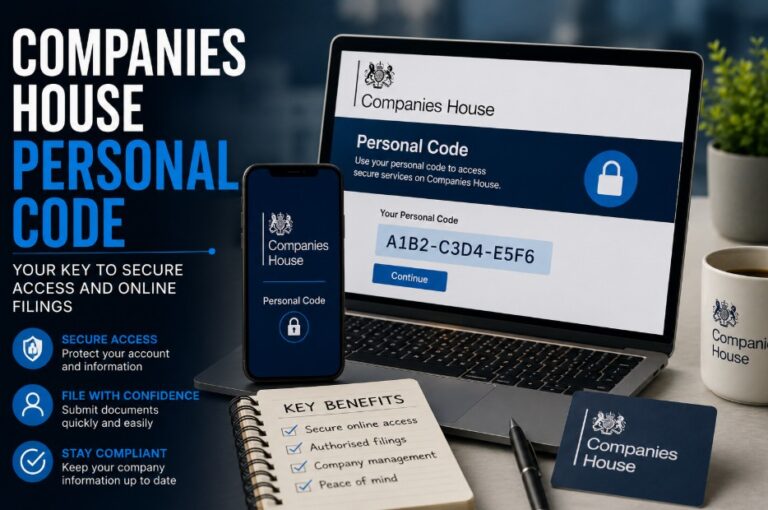
Once verified, you receive a unique 11-character personal code formatted with dashes (e.g., FT5-15ED-7JY5). This code is assigned to you for life and must be linked to every directorship or PSC role you hold across all UK companies.
Your personal code functions as your private digital identity key for Companies House. You must protect it and provide it whenever performing official filings.
Managing Your 11-Character Personal Code
Manage your 11-character personal code by storing it securely in your GOV.UK One Login account dashboard. Provide this code to your accountant or company secretary so they can link your verified status to annual confirmation statements and appointment filings.
Key operational guidelines for code management include:
-
Lifetime Assignment: You receive only one personal code. Even if you direct twenty different companies, you use the exact same code for all roles.
-
Privacy & Security: Personal codes are not visible on the public register. Treat your code securely, similar to a government PIN.
-
Linking to Filings: Supply your personal code whenever incorporating a company, accepting a directorship, or filing Form CS01.
Personal Code vs. Company Authentication Code
Do not confuse your 11-character Personal Code with a 6-character Company Authentication Code. A Personal Code verifies an individual officer for life, whereas a Company Authentication Code acts as a password to access a specific company’s online file.
| Code Type | Format & Lifetime | Scope |
| Personal Code | 11 Characters (e.g., FT5-15ED-7JY5) | Tied to an INDIVIDUAL for life |
| Company Authentication Code | 6 Characters (e.g., A2W45R) | Tied to a SPECIFIC COMPANY |
What Are the Risks and Penalties of Non-Compliance?
Non-compliance results in the rejection of annual confirmation statements under Section 853A, civil penalties up to £5,000, director disqualification, criminal prosecution, immediate company strike-off risks, and bank account freezes due to failed AML audits.
Ignoring identity verification obligations carries direct personal and corporate consequences.
Legal and Operational Consequences
Unverified officers face multi-tiered legal actions. Under Section 1112 of the Companies Act 2006, making false statements or acting as an unverified director constitutes a criminal offence carrying fines and potential imprisonment up to two years.
-
Rejection of annual confirmation statements under Section 853A.
-
Criminal prosecution and financial penalties for defaulting officers.
-
Administrative strike-off proceedings initiated by the Registrar of Companies.
-
Commercial freezing of business bank accounts due to failed bank AML compliance audits.
| Compliance Infraction | Legal Penalty | Operational Impact |
| Acting while Unverified | Criminal prosecution & fines up to £5,000 | Invalidation of officer status on public register. |
| CS01 Filing Default | Rejection under Section 853A | Corporate default, loss of good standing, strike-off notice. |
| False Identity Submission | Unlimited fines & up to 2 years imprisonment | Immediate company dissolution and fraud investigation. |
| Failed Bank Due Diligence | Financial Conduct Authority compliance alert | Immediate freezing of business bank accounts and credit lines. |
Verification Methods and Compliance Standards
Verification routes comply with statutory anti-money laundering standards set by HM Treasury and Companies House. Methods vary by cost, supervisory authority, and proof requirements, but all generate the same legally valid 11-character personal code.
| Feature | GOV.UK Digital App | ACSP Professional Route | Postal Verification Network |
| Cost | Free of charge | Commercial service fees apply | Standard postal or counter fees |
| Supervision | Cabinet Office / GOV.UK | FCA, ICAEW, or Legal Sector Regulators | Post Office Counters Ltd |
| Output | 11-character personal code | 11-character personal code or direct filing | Verification certificate and code |
Conclusion
Companies House identity verification means fulfilling mandatory director authentication for UK business leaders to avoid administrative strike-off and legal penalties in 2026.
To maintain seamless operations, audit your current board and PSC registry, identify unverified officers, and complete authentication well before statutory enforcement deadlines take effect.
Disclaimer: This article is for informational purposes only and does not constitute formal legal or financial advice.
FAQ
Do I need to verify my identity more than once?
No. Once completed successfully, your verified status remains tied to your unique personal code across all current and future UK corporate appointments without requiring periodic repetition.
Can a company file documents with unverified directors?
No. Automated registry validations reject any confirmation statement or appointment filing containing unverified officers once their respective transition windows expire.
What are the latest identity verification methods available?
Methods include smartphone biometric NFC app scans, Post Office counter identity checks, and supervised remote checks via regulated Authorised Corporate Service Providers.
How do I find my personal code if I misplaced it?
You can retrieve your unique identifier by logging securely into your official GOV.UK account dashboard or contacting the professional ACSP agent who processed your verification.
Is identity verification expensive?
No. Verifying directly through the official GOV.UK One Login app or website is completely free. Commercial fees only apply if you choose to use a third-party Authorised Corporate Service Provider (ACSP).
What happens if GOV.UK cannot confirm my identity automatically?
If automated database checks fail due to name mismatches or limited credit histories, you must retry with alternative documents or use an authorised professional accountant.
Who qualifies as a Person with Significant Control?
Anyone holding more than 25 percent of shares or voting rights, or exercising equivalent control over a UK company, must complete mandatory identity verification.