
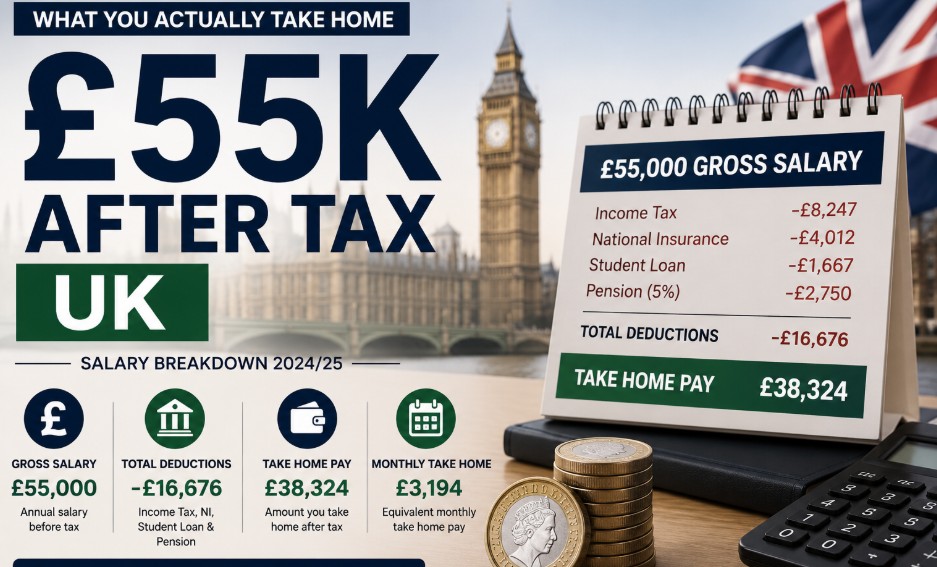
55k After Tax UK: Complete Annual & Monthly Take-Home Pay Breakdown and Tax Guide
When looking at 55k After Tax UK, gross salary across England, Wales, and Northern Ireland leaves you with an estimated annual take-home pay of £42,457.40, or roughly £3,538.11 monthly on a standard tax code.
This breakdown accounts for £9,432 in Income Tax and £3,110.60 in Employee National Insurance before factoring in workplace pensions or student loans.
Key Takeaways
-
An annual gross salary of £55,000 results in an estimated net take-home pay of £42,457 per year across England, Wales, and Northern Ireland.
-
Earnings above the £50,270 higher-rate threshold face a 40% income tax rate, meaning £4,730 of the total salary is taxed at the higher tier.
-
Standard Class 1 employee National Insurance deductions shave an additional £3,110.60 off your yearly payroll earnings.
-
Workplace pension auto-enrolment and student loan deductions reduce monthly take-home funds further depending on individual plan thresholds.
What Is 55k After Tax UK in Annual and Monthly?
Taking home a £55,000 gross wage leaves you with £3,538.11 each month after standard PAYE deductions. Based on a typical five-day work schedule, your weekly net amount lands at £816.49 while daily earnings sit near £163.30.
For earners in England, Wales, and Northern Ireland operating under a standard tax code, the calculation begins with the tax-free Personal Allowance of £12,570.
Income between £12,571 and £50,270 is taxed at the basic rate of 20%, while any amount exceeding £50,270 enters the higher-rate band at 40%. For a £55,000 salary, exactly £4,730 falls into this higher tier.
| Pay Period | Gross Income | Income Tax | National Insurance | Net Take-Home Pay |
| Annual | £55,000.00 | £9,432.00 | £3,110.60 | £42,457.40 |
| Monthly | £4,583.33 | £786.00 | £259.22 | £3,538.11 |
| Weekly | £1,057.69 | £181.38 | £59.82 | £816.49 |
| Daily | £211.54 | £36.28 | £11.96 | £163.30 |

What Is the Breakdown of 55k After Tax UK?
Shifting from a £55,000 gross wage down to your actual take-home money, making adjacent wage brackets helps you see how raises or performance bonuses actually affect your marginal tax burden.
It comes down to two major PAYE payroll deductions: £9,432.00 for Income Tax and £3,110.60 for National Insurance.
| Deduction Component | Annual Amount | Monthly Amount | Calculation Logic |
| Gross Salary | £55,000.00 | £4,583.33 | Baseline contracted annual remuneration before tax. |
| Income Tax | £9,432.00 | £786.00 | £0 on first £12,570; 20% on basic band (£37,700); 40% on higher band (£4,730). |
| National Insurance | £3,110.60 | £259.22 | 8% levied on earnings between £12,571 and £50,270, plus 2% on earnings above £50,270. |
| Net Take-Home Pay | £42,457.40 | £3,538.11 | Total cash remaining for personal budgeting and living expenses |
How Do Adjacent Salaries Compare to a 55k After Tax UK?
Checking adjacent wage brackets helps you see how raises or performance bonuses actually affect your marginal tax burden. Pushing past certain financial boundaries shifts how much of your gross pay makes it into your pocket.
Official Office for National Statistics earnings data indicates that a £55,000 salary sits comfortably within the upper quartile of full-time employment remuneration across the UK, bridging the gap between standard £50k After Tax UK benchmarks and higher-tier 80k After Tax UK managerial earnings.
-
£53,000 Gross: Yields an annual net income of approximately £41,317, translating to a monthly take-home of about £3,443 after standard deductions.
-
£55,000 Gross: Yields an annual net income of approximately £42,457, leaving about £3,538 per month.
-
£57,000 Gross: Yields an annual net income of approximately £43,457, resulting in a monthly take-home near £3,621 due to the heavier 40% tax weighting on earnings above £50,270.
-
£60,000 Gross: Yields an annual net income of approximately £44,957, providing roughly £3,746 per month.
How Do Workplace Pensions and Student Loans Affect 55k After Tax UK and Pension Totals?
Workplace pension auto-enrolment typically deducts 5% of qualifying earnings (reducing take-home pay by £145 to £180 monthly), while a Plan 2 student loan triggers a 9% deduction above £28,470 (trimming about £200 monthly).
Government taxes only tell part of the story when looking at your monthly payslip. Most workers see additional reductions through automatic workplace pension enrollment and university loan repayments handled via PAYE.
| Deduction Type | Typical Rate / Basis | Estimated Monthly Impact | Purpose |
| Workplace Pension | 5% of qualifying earnings | £145 – £180 | Long-term retirement savings |
| Plan 2 Student Loan | 9% above £28,470 | Approx. £200 | Repayment of higher education debt |
| National Insurance | Sliding scale across bands | £259.22 | Funding state benefits and NHS |
How Is Income Tax Calculated?
Income tax uses progressive tax brackets applied to specific slices of your earnings, beginning with a tax-free Personal Allowance up to £12,570, moving to a 20% basic rate up to £50,270, and hitting a 40% higher bracket beyond that.
Your geographical location dictates which tax framework applies to your non-savings income.
England, Northern Ireland, and Wales Income Tax Bands
| Tax Band | Taxable Income Threshold | Tax Rate |
| Personal Allowance | Up to £12,570 | 0% |
| Basic Rate | £12,571 to £50,270 | 20% |
| Higher Rate | £50,271 to £125,140 | 40% |
| Additional Rate | Over £125,140 | 45% |
Scottish Income Tax Bands
| Tax Band | Income Threshold | Tax Rate |
| Personal Allowance | Up to £12,570 | 0% |
| Starter Rate | £12,571 to £16,537 | 19% |
| Basic Rate | £16,538 to £29,526 | 20% |
| Intermediate Rate | £29,527 to £43,662 | 21% |
| Higher Rate | £43,663 to £75,000 | 42% |
| Advanced Rate | £75,001 to £125,140 | 45% |
| Top Rate | Over £125,140 | 48% |
Employee National Insurance (NI) Rates and Thresholds
| Earnings Band / Threshold Type | Annual Earnings Range | Employee NI Rate |
| Below Lower Earnings Limit | Up to £6,708 (£559/month) | 0% (No NI or credits) |
| Lower Earnings Limit to Primary Threshold | £6,709 to £12,570 (£1,048/month) | 0% (Earns NI credits) |
| Primary Threshold to Upper Earnings Limit | £12,570 to £50,270 (£4,189/month) | 8% |
| Above Upper Earnings Limit | Balance above £50,270 | 2% |

How Does Scottish Income Tax Alter a 55k Salary After Tax UK?
Because the Scottish higher-rate threshold begins at a lower point (£43,662), a larger slice of a £55,000 salary is subject to higher taxation, resulting in a net annual take-home pay of approximately £40,776 (£3,398 monthly).
Living north of the border places your earnings under the Scottish Parliament’s tax rules, which feature a separate multi-tier system distinct from the rest of the country.
-
Scottish Income Tax liability sits higher due to progressive regional bands.
-
National Insurance calculations remain uniform across all UK jurisdictions.
-
Regional tax code differences require explicit verification via HMRC personal tax accounts.
What Is the Tax Code for a £55k Salary?
For a standard single-employment situation with no secondary jobs or company benefits, the correct tax code for a 55k salary is 1257L, which grants the standard tax-free Personal Allowance of £12,570.
How Is the Tax Code Decided on a Salary Amount?
For a standard single-employment situation with no secondary jobs or company benefits, the correct tax code is 1257L, which grants a standard tax-free Personal Allowance of £12,570.
Tax authorities issue a specific tax code to tell your employer or pension provider how much tax-free income you can earn before they start taking PAYE money out of your pay packet.
- The Numeric Value (1257): Represents your total tax-free Personal Allowance divided by 10. The salary amount itself does not change this baseline number unless your total income exceeds £100,000 (where the Personal Allowance gradually tapers away).
- The Suffix Letter (L): Denotes standard entitlement indicating you are under 65 and eligible for the standard tax-free Personal Allowance.

Is 55k a Good Salary in the UK?
Official Office for National Statistics earnings data indicates that a £55,000 salary sits comfortably within the upper quartile of full-time employment remuneration across the UK.
Your actual purchasing power with this money changes dramatically depending on local living costs. Outside pricey hotspots like London and the South East, £55,000 gives you plenty of breathing room for mortgages, family expenses, and savings.
In major cities, though, steep rent, council tax variations, and travel expenses turn this wage into a respectable professional baseline rather than luxury spending money.
How to Calculate and Optimise 55k After Tax UK Earnings?
Maximising net take-home efficiency requires understanding legal remuneration strategies and auditing payroll records for accuracy.
-
Review your current HMRC tax code through your digital personal tax account to ensure allowances are assigned correctly.
-
Evaluate employer salary sacrifice options for pension contributions or green vehicle schemes to reduce taxable gross pay.
-
Factor in student loan thresholds to anticipate exact PAYE adjustments before accepting a new role or promotion.
-
Utilise tax-free allowances such as Individual Savings Accounts to protect investment returns and savings interest from tax liability.
-
Account for regional variations if relocating between Scotland and England, as tax bands alter net monthly cash flow.
-
Check professional subscription reliefs or uniform tax rebates if eligible under HMRC guidelines.
-
Monitor annual budget updates from HM Treasury for shifts in National Insurance thresholds or income tax brackets.
Conclusion
Navigating a £55,000 salary requires looking past headline gross figures to understand how income tax bands, National Insurance, pensions, and student loans interact with monthly cash flow.
By mapping these statutory variables correctly, earners can build accurate budgets and optimise their long-term financial position.
Disclaimer: This guide is for informational purposes only and does not constitute formal financial or tax advice.
FAQ
How much is £55,000 a month after tax?
In England, Wales, and Northern Ireland, a £55,000 gross annual salary results in approximately £3,538 per month in net take-home pay after standard income tax and National Insurance deductions.
What tax code should I apply to a £55k salary?
Standard single-employment situations without secondary income sources or taxable company benefits typically operate under the 1257L tax code, granting a £12,570 tax-free allowance.
How much is 60k after tax in the UK compared to 55k?
A £60,000 gross salary yields roughly £44,957 annually (£3,746 monthly), providing an additional net gain of approximately £2,500 per year over a £55,000 salary due to higher-rate tax band scaling.
Does a workplace pension reduce my £55k take-home pay?
Yes. Standard auto-enrolment workplace pension schemes deduct an employee contribution percentage, typically lowering monthly cash take-home pay while building long-term retirement capital.
Can you live in London on a £55k salary?
Yes, a £55,000 income allows an individual to live independently in London, though high rental and transport costs require disciplined budgeting compared to living in regional UK towns.
What UK salary is considered middle class?
Current socioeconomic definitions place middle-class earnings across a broad spectrum, with a £55,000 salary sitting above the national median and representing established professional standing.
How much can I earn before paying 40% tax in the UK?
For the current tax year across England, Wales, and Northern Ireland, the higher-rate 40% income tax threshold begins on taxable earnings exceeding £50,270.
What is a top 5% salary in the UK?
Official earnings distributions indicate that entering the top 5% of UK full-time earners requires a gross annual income significantly higher than £55,000, typically starting above £80,000.