
I have never paid National Insurance will I get a pension? (2026/27 Guide)
Last Updated on
I have never paid National Insurance will I get a pension? No, you cannot claim the standard UK State Pension with zero National Insurance years; a minimum of 10 qualifying years is required.
However, if you have a low income, you can claim Pension Credit instead, which guarantees a minimum weekly income of £238.00 (single) or £363.25 (couple) in 2026/27, regardless of your National Insurance record.
Key takeaways
- You need at least 10 qualifying National Insurance years to get any State Pension, and 35 years for the full £241.30 weekly rate in 2026/27.
- Pension Credit guarantees a minimum weekly income of £238.00 for single people and £363.25 for couples in 2026/27, even with zero NI years.
- Automatic National Insurance credits for Child Benefit, Carer’s Credit or Specified Adult Childcare Credits can fill gaps without any direct payment needed.
- Buying a missing Class 3 National Insurance year costs £956.80 in 2026/27 and can add roughly £6.89 a week to your pension for life.
The Rule of 10: I have never paid National Insurance will I get a pension?
To receive any New State Pension in the UK, you must have a minimum of 10 qualifying years on your National Insurance record. If you have zero years, you will not receive a State Pension payment.
Fortunately, you are not left with nothing. If you live in the UK and have a low income, you can claim Pension Credit instead.
According to official Department for Work and Pensions (DWP) guidelines for the 2026/27 tax year, this safety net tops up your weekly income to a minimum of £238.00 (for single people) or £363.25 (for couples), effectively providing a pension-level income regardless of your NI history.
Gaining a clear understanding of your eligibility requires you to distinguish between paying National Insurance out-of-pocket and accruing qualifying years through credits.
-
The Minimum Threshold: You need 10 years for a partial pension.
-
The Full Pension: You need 35 years for the full New State Pension of £241.30 per week.
-
Qualifying via Credits: Many people who never paid NI actually have qualifying years through automatic credits (e.g., raising children, being a carer, or claiming certain benefits).
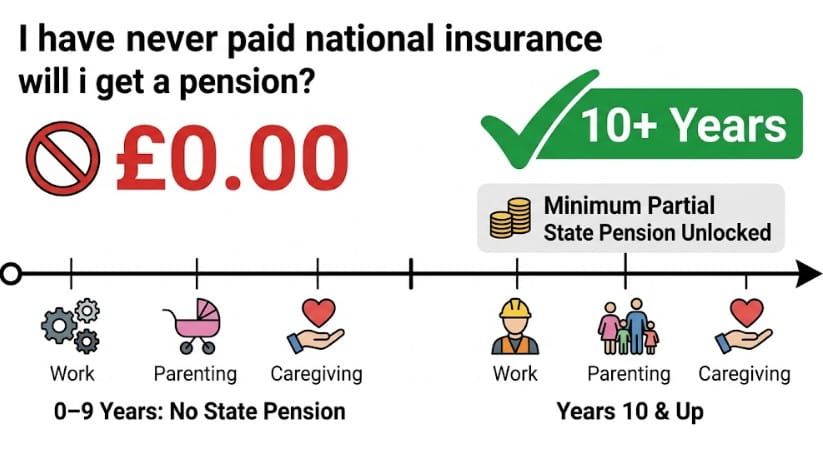
The threshold for receiving a retirement income
Under the current system, having fewer than 10 years results in a zero-value State Pension. However, it is a common pattern for people to assume they have no record when, in fact, they have accrued years through the benefit system.
For example, a parent who stayed home to raise a child under the age of 12 and claimed Child Benefit will have automatically received National Insurance credits that count toward this 10-year minimum. Figures released by the DWP confirm that these small credits fully establish baseline pension metrics.
| NI Qualifying Years | State Pension Payout Estimates for 2026/27 | Status |
| 0 to 9 Years | £0.00 | No State Pension entitlement |
| 10 Years | £68.94 | Minimum partial State Pension |
| 20 Years | £137.89 | Partial State Pension |
| 35 Years | £241.30 | Full New State Pension |
How many NI years do I need for a full pension in 2026?
To claim the full New State Pension, you generally need 35 qualifying years of National Insurance contributions or credits. For the 2026/27 tax year, the full rate is set by the DWP at £241.30 per week, with lesser records paying out on a proportional, pro-rata basis.
Key Fact: The DWP requires a minimum of 10 qualifying years on your record to receive any portion of the standard State Pension. Anything less results in a £0.00 baseline award, making alternate safety nets like Pension Credit necessary.
If your record has gaps, your weekly payment is reduced proportionally, provided you have met the initial 10-year threshold mentioned above.
If you are unsure where you stand, you can follow these practical steps to identify and fill any gaps in your record:
-
Request a State Pension Forecast: Access the Check your State Pension service on GOV.UK to see your current year count.
-
Identify Gaps: Review your National Insurance record to find years that are not full.
-
Check for Missing Credits: Ensure you claimed credits for periods of caregiving or unemployment.
-
Verify Eligibility to Buy: Confirm if you are eligible to pay Class 3 voluntary contributions for the missing years.
-
Calculate the Cost: Determine if the cost of the voluntary payment (approx. £956.80 for a full year in 2026) outweighs the pension increase.
-
Make Payment: Use the HMRC online service or pay via bank transfer to fill the selected gaps.
-
Confirm Update: Check your record after 8 weeks to ensure the years are now marked as full.

How do I know if I am entitled to a UK pension?
Entitlement is determined by your National Insurance record and your age. As of 2026, the State Pension age is 66, but it is being phased up to 67 between May 2026 and March 2028 under the Pensions Act 2014, the exact date depends on your date of birth, so it’s worth checking your own State Pension age on GOV.UK rather than assuming.
Those in the public sector might have different rules to consider, such as the NHS pension after 20 years, which operates independently of the basic State Pension requirements.
You can verify your status by viewing your National Insurance record online through the Personal Tax Account. This digital statement lists every year since you turned 16 and specifies whether that year counts toward your pension.
Identifying your qualifying status
A common mistake occurs when individuals confuse working years with qualifying years. It is a frequent oversight to equate employment with pension eligibility.
Many people who have never held a traditional job, such as registered foster carers or those on Carer’s Allowance, are surprised to find they have already built a substantial National Insurance record through automatic credits.
-
Child Benefit: Credits for parents/guardians of children under 12.
-
Carer’s Credits: For those spending 20+ hours a week looking after someone with a disability.
-
Specified Adult Childcare Credits: For grandparents moving credits from a working parent.
-
Statutory Sick Pay: Periods where you were unable to work due to health issues.
What happens if I have less than 35 years of National Insurance?
If you reach State Pension age with between 10 and 34 qualifying years, the DWP awards you a reduced pro-rata pension. This payment scales linearly based on your exact year count; for example, holding 25 qualifying years secures you exactly 25/35ths of the full weekly entitlement.
To help separate misunderstandings from legal reality regarding thin NI contribution profiles, consider this breakdown:
| Myth regarding zero NI records | Reality under official DWP frameworks |
| Never working means you get zero income at age 66. | False. Pension Credit guarantees low-income individuals a baseline weekly income regardless of work history. |
| You can only get NI years if you pay tax on a salary. | False. Free National Insurance credits are granted for childcare, caregiving, and health conditions. |
| Missing the 10-year mark means your retirement options are gone. | False. You can often buy back missing gap years via voluntary Class 3 HMRC payments to unlock the pension. |
One caveat applies even to those who do reach 35 qualifying years: if you have any National Insurance record from before 6 April 2016 and were contracted out of the additional State Pension, commonly through a workplace defined-benefit scheme, a Contracted-Out Pension Equivalent (COPE) deduction may apply to your starting amount.
This can mean 35 years still doesn’t produce the full £241.30 a week. If your forecast looks lower than expected despite a long NI record, this is usually why, and it’s worth checking your State Pension forecast on GOV.UK for the exact figure rather than assuming the standard 35-year rule applies in full.
This calculation is performed automatically by the Department for Work and Pensions (DWP) when you reach the eligible age and make a claim.
Hidden Ways You Might Have Earned Credits Without Knowing
Many people who believe they have never paid National Insurance actually have qualifying years on their record.
This happens through National Insurance Credits, years that the government gives you for free because of your life circumstances.
-
Time Spent Raising Children: If you claimed Child Benefit for a child under 12, you likely earned automatic credits.
-
Caring for Family or Friends: If you spent 20 hours or more a week looking after someone with a disability, you may have earned Carer’s Credits.
-
Grandparents Providing Childcare: You can actually transfer credits from a working parent to a grandparent who is helping with the kids.
-
Illness and Disability: If you were unable to work due to a long-term health condition, you may have been awarded credits during that time.
Could You Be Missing Home Responsibilities Protection?
Before 2010, caring credits worked differently. If you spent time between 1978 and 2010 raising children or looking after someone who was sick or disabled, you may have been entitled to Home Responsibilities Protection (HRP), the forerunner to today’s automatic NI credits.
The DWP has confirmed that HRP was not correctly recorded for a significant number of people, mostly women now in their sixties and seventies. This means an empty or thin NI record from that period may not reflect what you were actually entitled to.
- Who’s affected: primarily people who claimed Child Benefit before May 2000, when NI numbers weren’t always required on the claim form, so HRP wasn’t automatically linked to their NI record.
- What it’s worth: DWP estimates the average underpayment at around £5,000 per person, though this varies by individual record.
- What to do: use the HRP checker tool on GOV.UK to see if you’re likely to be affected, then apply to have your record corrected if so.
If you’re approaching retirement with a thinner NI record than you expected, checking for missing HRP is worth doing before assuming you have no entitlement at all.
Should You Spend Money to Buy Back Missing Years?
Buying voluntary Class 3 National Insurance contributions allows individuals to fill gaps in a thin record. According to HMRC, purchasing a full missing year costs roughly £956.80 in 2026, a move that can successfully lift you past the mandatory 10-year state pension threshold.
Checking your record to discover you hold 8 or 9 years places you in a structural danger zone. Missing that 10-year mark by just one single year means you get nothing from the standard State Pension fund.
Buying Voluntary Contributions: It currently costs about £956.80 to buy one full year of National Insurance via HMRC frameworks.
Is it worth it? Usually, yes. Reaching that 10-year milestone can turn a £0 pension into thousands of pounds over the course of your retirement.
A Word of Caution: If you are already eligible for the full Pension Credit top-up, buying NI years might not actually increase your total income. It is always best to speak to a specialist before spending your savings on buy-backs.
For individuals who sit just a few years short of the 10-year threshold, making these specific payments can unlock a lifetime of structural State Pension payouts that would otherwise equal zero.
To evaluate whether your retirement nest egg can comfortably cover these voluntary contributions or other lifestyle adjustments, it helps to understand How Much Savings Can a Pensioner Have in the Bank without impacting means-tested benefits.
As you plan your retirement income, you should also look at ways to avoid tax on your pension to ensure you keep more of the money you’ve secured.
However, if you are eligible for Pension Credit, buying years might be unnecessary as the credit would simply top up your income to the same level.

Can I pay voluntary NI contributions if I live abroad?
Yes, UK citizens or former residents living overseas can often pay voluntary contributions to maintain their record.
Depending on your employment status abroad, you may qualify for Class 2 contributions, which are significantly cheaper than the standard Class 3 rates.
This is a vital strategy for expats who intend to return to the UK or wish to claim their UK pension while residing in another country.
How much is Pension Credit for those with no NI?
Pension Credit acts as a critical safety net for UK residents with no National Insurance history. In 2026, this means-tested benefit tops up your weekly income to a guaranteed minimum of £238.00 for singles or £363.25 for couples, ensuring financial security even with zero years of contributions.
It is a means-tested benefit that tops up your weekly income to a guaranteed level; however, many individuals are unsure of their eligibility for the Guaranteed Pension Credit or whether they meet the specific income thresholds.
One eligibility rule catches people out: since 15 May 2019, if you live with a partner, you generally both need to have reached State Pension age before you can make a new joint Pension Credit claim.
If only one of you has reached State Pension age, the couple usually needs to claim Universal Credit instead until the younger partner also qualifies.
- Passported Benefits: Claiming Pension Credit often unlocks extra help, including Housing Benefit, Council Tax reduction, and the free TV license for those over 75.
Pro Tip: Even if you are only entitled to £1 of Pension Credit, you should claim it. It is the gateway to thousands of pounds in additional cost-of-living support.
| Feature | State Pension | Pension Credit |
|---|---|---|
| Basis | Contributions (NI Years) | Financial Need (Means-tested) |
| Minimum Years | 10 Years | 0 Years |
| 2026/27 Rate (Single) | Up to £241.30 | Up to £238.00 (Guarantee) |
| 2026/27 Rate (Couple) | — | Up to £363.25 (Guarantee) |
| Extra Benefits | None automatically | Includes Housing Benefit & Council Tax help |
How to Claim Pension Credit with No National Insurance?
You can secure your income even with a zero-year record by following a few simple steps. Because this is based on need, the DWP focuses on your savings and current income rather than your work history.
What do you need to apply?
-
Your National Insurance Number: Even with zero contributions, you still have this unique ID.
-
Financial Details: Have information ready regarding any savings, investments (over £10,000), or other benefits you receive.
-
Bank Details: Where you want your weekly support to be paid.
The Easiest Ways to Apply
-
Online: Visit GOV.UK, if you have already reached the qualifying age.
-
By Phone: Call the Pension Credit claim line on 0800 99 1234. This is often the best route if you need a staff member to walk you through the questions.
-
By Post: You can request form PC1 be sent to your home address.
Pro Tip: You can apply up to four months before you reach State Pension age. If you apply late, you can ask for the claim to be backdated by three months.

How Does National Insurance and Pension Status Impact SMEs, Micro-Businesses, and Commercial Operations?
Understanding National Insurance (NI) pension thresholds directly affects business operations, payroll administration, and workforce management across SMEs and micro-enterprises. Gaps in employee NI records influence workplace pension obligations, salary sacrifice strategies, and PAYE compliance, directly shaping commercial liabilities and recruitment dynamics.
-
Operational Changes (Payroll & Onboarding): HR teams must configure PAYE systems to track primary (£12,570) and secondary (£5,000) NI thresholds. Validating NI statuses during onboarding ensures accurate auto-enrolment and smooth workplace pension integration.
-
Cost & Financial Implications: Managing the 15% employer Class 1 NIC rate makes leveraging the £10,500 Employment Allowance critical. Employers can also utilize salary sacrifice pension schemes to trim NIC liabilities while enhancing staff retirement benefits.
-
Compliance & Risk Mitigation: Misclassifying self-employed contractors or improperly claiming Employment Allowance, such as single-director firms without qualifying staff, triggers HMRC penalties and payroll errors.
-
Productivity & Workforce Dynamics: Employees facing State Pension shortfalls often seek extended careers or voluntary contribution options. Offering financial wellness guidance and flexible retirement paths supports morale and retention.
-
Market Competitiveness: Providing employer pension matches above statutory minimums offers SMEs and digital firms a distinct hiring advantage, appealing to candidates aiming to offset thin state contribution records.
Conclusion
If you’re unsure where you stand, the practical order of operations is: check your State Pension forecast on GOV.UK first, then check your NI record for gaps, then check whether you’re missing HRP or other automatic credits before spending anything.
Only consider buying voluntary Class 3 years once you know your real starting point, and if you’re already likely to qualify for full Pension Credit, get advice before paying, since it may not increase your total income.
If you have zero or very few years, apply for Pension Credit regardless of how small the award looks on paper; even a £1 award unlocks Housing Benefit, Council Tax reduction and other passported support.
Disclaimer: This article is for informational purposes only and does not constitute financial or legal advice; please consult GOV.UK or a certified financial advisor before making major retirement decisions.
FAQ
Do you still get a pension if you haven’t paid National Insurance?
No standard State Pension is paid with zero qualifying years, 10 years minimum are required. However, low-income households can still claim Pension Credit, which guarantees £238.00 a week (single) regardless of National Insurance history.
Can I still receive the UK State Pension if I have never worked?
Yes, if you’ve built qualifying years through National Insurance credits rather than paid contributions, for example, Child Benefit, Carer’s Credit, or Specified Adult Childcare Credits, which count the same as paid years toward your 10-year minimum.
What is the lowest State Pension you can get in the UK?
The lowest possible State Pension payment is £0.00, awarded to anyone with fewer than 10 qualifying years. Reaching exactly 10 years secures the minimum partial payment of £68.94 a week in 2026/27.
How many years NI to get the full State Pension in the UK?
You need 35 qualifying National Insurance years for the full new State Pension of £241.30 a week in 2026/27. Fewer years reduce your payment pro-rata, down to a 10-year minimum floor.
What is Home Responsibilities Protection and could I be owed money?
Home Responsibilities Protection (HRP) was the pre-2010 forerunner to today’s NI credits for parents and carers. DWP estimates thousands of people, mostly women in their sixties and seventies, are missing HRP and may be owed backdated State Pension.
Will being contracted out before 2016 reduce my State Pension even with 35 years?
Potentially, yes. If you were contracted out of the additional State Pension before April 2016, a Contracted-Out Pension Equivalent (COPE) deduction can mean 35 qualifying years still doesn’t produce the full £241.30 weekly rate.
Do both partners need to reach State Pension age before claiming Pension Credit as a couple?
Generally, yes, since May 2019, both partners in a couple must have reached State Pension age to make a new joint Pension Credit claim. Mixed-age couples usually need to claim Universal Credit instead.