
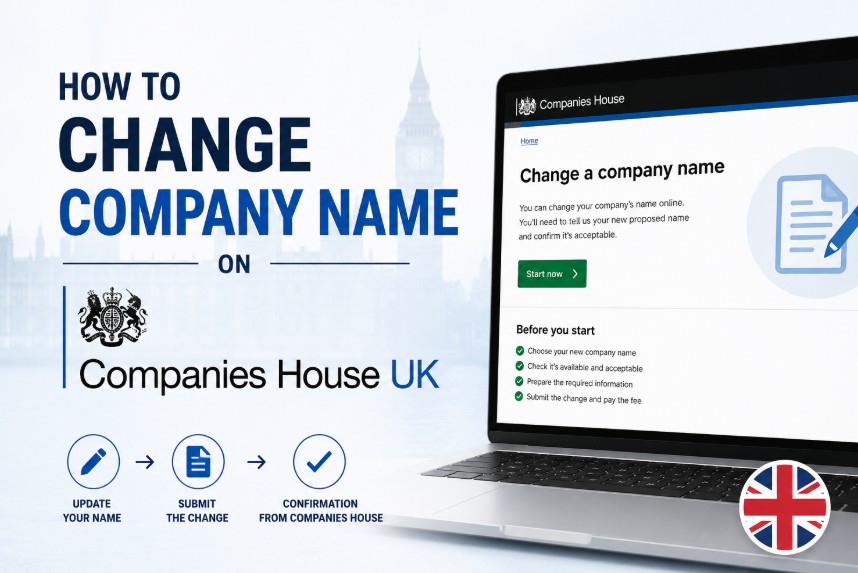
How to Change Company Name on Companies House: Step-by-Step UK Guide
Changing a registered company name with Companies House requires passing a formal corporate resolution, ensuring name availability, and submitting the correct statutory application alongside the required fee.
Whether updating a corporate identity due to a rebrand, a pivot in market focus, or a structural reorganization, UK limited companies must follow a precise legal framework governed by the Companies Act 2006.
Changing a company name on Companies House is the official statutory process by which a UK limited company amends its registered corporate identity with the Registrar of Companies under the Companies Act 2006, requiring member approval, name availability clearance, and the submission of a digital filing or paper Form NM01.
-
Changing a company name on Companies House requires passing a special resolution or board resolution under the Companies Act 2006.
-
Standard online filings cost £20 while postal submissions via Form NM01 cost £30, with processing times varying from 24 hours to 10 days.
-
A corporate name change only takes formal legal effect when the Registrar issues the Certificate of Incorporation on Change of Name.
-
Companies must update internal statutory registers, notify HMRC, and inform financial institutions immediately after approval.
-
The unique company registration number remains unchanged throughout the corporate name alteration procedure.
How to Change Company Name on Companies House?
Executing a registered corporate name change requires strict adherence to a four-step statutory workflow governed by the Companies Act 2006. Each phase must be completed meticulously to avoid application rejections or administrative delays.
Step 1: Check Name Availability and Sensitive Word Restrictions
Before submitting any resolution, verify that the proposed corporate title is completely unique and compliant with regulatory standards.
-
Search the official Companies House register to ensure no identical or confusingly similar entity already exists.
-
Review the Intellectual Property Office (IPO) database to cross-reference registered trademarks and avoid potential passing-off claims.
-
Check whether the proposed title contains regulated or sensitive words (such as Chartered, Institute, or Group) that require prior written clearance from government departments or professional bodies.
Step 2: Pass a Special Resolution or Board Resolution
Formal authorization must be executed and recorded in the company’s internal books.
-
Convene a general meeting or circulate a written resolution to secure the mandatory 75% shareholder approval for a special resolution.
-
Alternatively, draft a formal board resolution signed by directors if the Articles of Association explicitly permit management-level changes.
-
Ensure a physical or digital copy of the special resolution is prepared for submission, keeping in mind that it must reach Companies House within 15 days of being passed.
Step 3: File Form NM01 via Companies House WebFiling or Post
Submit the official notification to the Registrar of Companies using the correct statutory channel.
-
File online through the Companies House WebFiling portal for fast digital processing using your Companies House personal code alongside your corporate authentication code.
-
Alternatively, complete and sign paper Form NM01 (or Form LL NM01 for Limited Liability Partnerships) and mail it to the central registrar office.
-
Ensure all sections, including the original company number, old name, and exact new name with its correct limited suffix, are error-free, keeping in mind that directors must also comply with broader transparency rules such as Companies House identity verification when managing filings.
Step 4: Receive Your Official Certificate of Incorporation
Monitor the application status until the regulatory body finalizes the administrative review.
-
Companies House reviews the submission to ensure compliance with statutory naming rules and sensitive word guidelines.
-
Upon approval, the Registrar issues the official Certificate of Incorporation on Change of Name.
-
Download or file the digital certificate safely, as this document serves as legal proof of the corporate title modification.
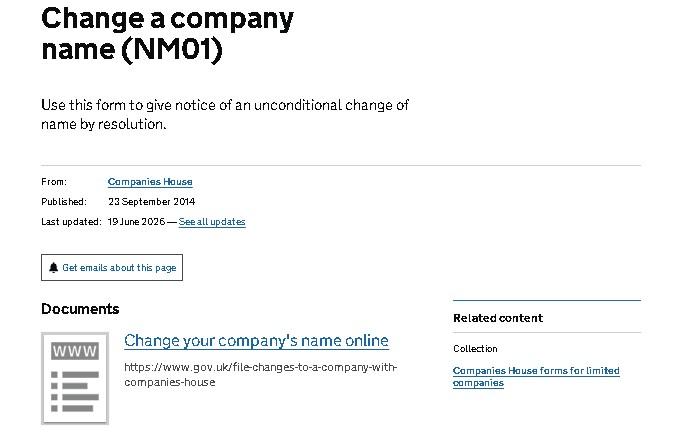
Do Your Articles of Association Permit Board Approval or Require a Shareholder Vote?
Before filing any paperwork, directors must inspect the company’s Articles of Association to determine who holds the authority to approve a corporate title change.
By default, under the Companies Act 2006, private limited companies require a special resolution passed by a 75% majority of shareholder votes.
However, some corporate constitutions contain bespoke clauses granting the board of directors direct power to pass a board resolution without member voting. Verifying this internal constitutional rule prevents costly procedural errors and ensures compliance from the outset.
Why Do Small Businesses Change Their Company Name?
Small business owners decide to alter their registered corporate identity for several strategic and operational reasons. A comprehensive rebrand often necessitates a fresh corporate title that better aligns with expanded product lines or new target markets.
In other instances, founders must rectify historical naming errors, resolve intellectual property or trademark conflicts, or accommodate corporate mergers and acquisitions.
Outgrowing an initial trading name that felt too narrow or localized is another frequent catalyst for undertaking a formal corporate update.
-
Strategic Rebranding: Aligning the corporate title with expanded product lines, new target markets, or evolved business models.
-
Resolving IP Conflicts: Avoiding trademark infringement lawsuits or passing-off claims with established competitors.
-
Scaling Beyond Local Roots: Removing geographic or hyper-niche restrictions as the business expands nationally or diversifies services.
-
Correcting Historical Errors: Rectifying early-stage typos or clumsy placeholders to project a professional image to investors.
-
Corporate Restructuring: Reflecting mergers, acquisitions, or new ownership structures following strategic buyouts.

How Much Does It Cost and How Long Does It Take?
Filing fees and processing turnaround times depend entirely on the chosen submission method. Digital applications submitted through the online gateway cost £20 and are typically processed within 24 hours.
In contrast, paper submissions handled via postal services cost £30 and generally require between 8 to 10 working days for administrative clearance. Expedited same-day priority services may be available for higher fees through authorized corporate secretarial providers.
| Filing Method | Statutory Form | Standard Fee | Average Processing Time | Signature Requirement |
| Online WebFiling | Digital Portal | £20 | Within 24 hours | Authentication Code |
| Standard Postal | Form NM01 | £30 | 8 to 10 working days | Wet Ink Signature |
| Same-Day Priority | Priority Digital / Post | Variable (£83+) | Same day (if submitted early) | Digital or Authorized Agent |
What Is the Difference Between a Registered Company Name and a Trading Name?
A registered company name is the official legal title recorded with Companies House, whereas a trading name is an alternative moniker used solely for marketing and branding purposes without altering the underlying corporate registration.
| Feature | Registered Company Name | Trading Name (DBA) |
| Definition | The official legal title recorded on the public register at Companies House. | An alternative moniker used for marketing, retail storefronts, or website branding. |
| Legal Status | Creates a distinct, independent legal entity across the entire UK. | Does not create a separate legal entity; it is simply an alias used by the underlying business. |
| Mandatory Usage | Must legally appear on all official corporate stationery, legal contracts, invoices, and web footers. | Optional for branding purposes; underlying company details must still be clearly displayed. |
| Intellectual Property Protection | Grants exclusive statutory rights, preventing other businesses from registering an identical corporate entity. | Provides no independent legal protection against others registering the same name as a formal company. |
What Must You Update After Your Company Name Changes?
Executing a corporate name change triggers an extensive administrative checklist across multiple regulatory, financial, and operational touchpoints.
Failing to notify key stakeholders can result in banking disruptions, compliance penalties, or contractual ambiguities, and may even cause administrative oversight on your upcoming Companies House confirmation statement.
-
HM Revenue and Customs (HMRC): Update Corporation Tax, PAYE, and VAT registration profiles promptly via the government gateway.
-
Financial Institutions: Amend corporate bank account details, merchant processing accounts, and direct debit mandates with commercial lenders.
-
Statutory Registers: Update internal company books, including the Register of Members, Register of Directors, and the Register of People with Significant Control (PSC).
-
Digital Assets and Branding: Revise website headers, domain settings, email signatures, invoicing templates, and social media channels.
-
Commercial Contracts: Notify key suppliers, corporate clients, insurers, and landlords while updating active vendor agreements, ensuring that all post-rebrand corporate filings are submitted on time to avoid strict Companies House late filing penalties.
What are the Common Mistakes and Rejections to Avoid?
Administrative oversight during the preparation stage frequently leads to application rejections by the Registrar. Avoiding these pitfalls ensures smooth processing without costly delays.
-
Failing to file the special resolution within 15 days: The statutory shareholder resolution must be delivered to Companies House within the mandatory 15-day window, separate from the primary application form.
-
Using unapproved sensitive words: Submitting names containing restricted terms without attaching official written justification letters will trigger an immediate administrative rejection.
-
Premature commercial trading: Signing contracts, issuing tax invoices, or printing marketing materials under the new title before the official Certificate of Incorporation is issued creates legal liability.
-
Overlooking minor typographical discrepancies: Discrepancies between the name stated on the special resolution and the name typed onto Form NM01 will stall processing.

Conclusion
Executing a successful corporate name change involves a structured progression from preliminary availability checks and internal governance approvals to statutory filings with Companies House.
Business owners must verify their Articles of Association, secure proper shareholder consent via special resolution, submit Form NM01 or use the WebFiling portal, and methodically update HMRC and commercial partners once the certificate is issued.
Ensuring strict adherence to these procedural safeguards protects the continuity and legal standing of the business.
Disclaimer: This guide is for informational purposes only and does not constitute formal legal or financial advice; consult a qualified professional for specific corporate queries.
FAQs
Does my company registration number change?
No, the unique company registration number assigned at initial incorporation remains permanently unchanged, preserving the continuous legal identity of the corporate entity.
What happens to my existing logo and domain name?
Existing logos, website domains, and email addresses must be manually updated by the business owner, as Companies House only regulates the official text-based corporate register and holds no jurisdiction over branding assets.
Do I need a solicitor to change a company name?
No, legal representation is not legally required; directors can independently prepare resolutions, complete Form NM01, and file online or via post directly with Companies House.
Can a company change its name multiple times?
Yes, a UK limited company can update its registered title as frequently as required, provided each alteration follows the correct governance rules and settles the statutory filing fees.
What happens to existing contracts after a name change?
Existing commercial agreements remain fully valid and enforceable because a name change alters only the corporate title rather than the underlying legal entity or its contractual obligations.
Is a special resolution always required?
A special resolution requiring 75% shareholder approval is the default statutory requirement under the Companies Act 2006, unless the company articles explicitly grant the board authority to change the name independently.