
Decoding Chief Business Officer Meaning: Roles, UK Salaries & C-Suite Differences
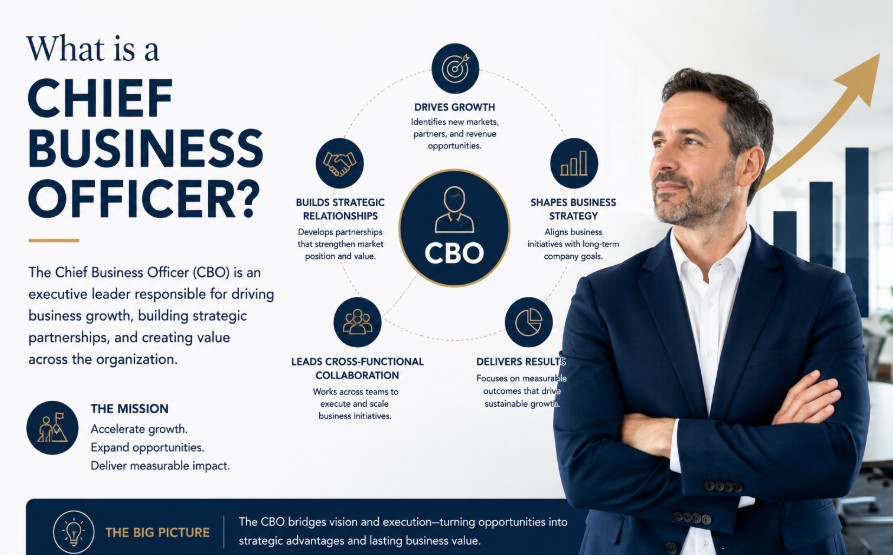
Chief business officer meaning is defined as a senior executive position focused on driving commercial growth, strategic partnerships, and operational execution across corporate enterprises.
The role of a chief business officer encompasses managing core revenue streams, aligning cross-functional teams, and executing long-term corporate strategies within regulatory frameworks.
Key Takeaways
-
Chief business officers manage commercial growth, strategic partnerships, and revenue execution across modern UK corporate and institutional structures.
-
Average UK base salaries for this executive rank typically range from £110,000 to over £180,000 annually, excluding performance bonuses and equity.
-
Unlike a chief executive officer who governs the entire enterprise vision, this commercial leader reports directly to the CEO to execute operational targets.
-
Public sector bodies and higher education institutions across Britain increasingly adopt this commercial role to streamline administrative and financial assets.
What Is Chief Business Officer Meaning?
A Chief Business Officer (CBO) is a high-ranking corporate executive responsible for spearheading commercial growth, building strategic partnerships, and scaling revenue operations across modern British enterprise networks.
In the UK corporate landscape, the title defines a senior leader who bridges the gap between high-level board vision and daily commercial execution.

What Does a Chief Business Officer Do?
A Chief Business Officer drives commercial growth by identifying new market segments, structuring high-value enterprise contracts, executing joint ventures, and aligning product, marketing, and financial divisions toward unified business goals.
The role centers on transforming corporate strategy into tangible market expansion. Responsibilities include negotiating high-value enterprise contracts, driving cross-functional collaboration, and overseeing business development across domestic and international markets.
-
Identifying and capturing new market segments and revenue streams.
-
Structuring joint ventures, mergers, and high-level corporate partnerships.
-
Aligning product, marketing, and financial divisions toward unified commercial goals.
What is the Senior Chief Business Officer Meaning UK?
A senior chief business officer meaning applies to expansive corporate matrices and multinational groups where the executive manages multi-regional divisions, international trade corridors, large asset portfolios, and rigorous UK governance standards.
As of 2026, corporate governance standards across Britain require greater accountability in executive oversight. A senior leader at this level collaborates closely with the chief financial officer and chief operating officer to ensure that capital allocation aligns with long-term enterprise goals.
Key Duties of a Senior Commercial Leader
-
Directing multi-channel revenue expansion across domestic and international markets.
-
Overseeing large commercial teams and regional business heads.
-
Advising the board on regulatory compliance and corporate restructuring.
-
Spearheading major mergers, acquisitions, and joint ventures.
What Are the Key Responsibilities of a Chief Business Officer?
The core responsibilities of a CBO span revenue operations, strategic partnerships, executive advisory for corporate restructuring, and cross-functional team leadership across regional divisions.
Executive duties span multiple pillars of enterprise development, ensuring that capital allocation and commercial activities drive long-term profitability.
-
Revenue Operations: Managing and expanding core revenue streams across existing and emerging markets.
-
Strategic Partnerships: Establishing alliances with key industry stakeholders, suppliers, and regional business networks.
-
Executive Advisory: Advising the CEO and board of directors on corporate restructuring, market risks, and regulatory compliance.
-
Team Leadership: Directing regional business heads and large commercial divisions to maintain high performance standards.

What Is the Salary of a Chief Business Officer?
According to UK executive recruitment benchmarks, Chief Business Officer salaries vary by enterprise scale, with mid-market roles starting from £110,000 up to £350,000+ for global senior tiers, plus performance bonuses, equity stakes, and London location premiums.
Compensation packages for UK commercial executives vary based on company size, sector, and geographic location, typically combining base salaries with performance bonuses and equity.
Note: Roles based in London typically command a 20% to 35% premium over regional hubs like Manchester or Birmingham.

What Are the Essential Skills for a Chief Business Officer?
Essential CBO skills comprise advanced financial literacy, high-stakes negotiation and deal-making, cross-functional leadership, and deep navigation of UK corporate governance and regulatory compliance frameworks.
Succeeding in this senior executive role requires a robust blend of commercial acumen, strategic vision, and interpersonal leadership capabilities.
-
Advanced Financial Literacy: Ability to interpret complex financial models, P&L statements, and capital allocation metrics.
-
Negotiation & Deal-Making: Proven expertise in securing multi-million-pound enterprise contracts and strategic joint ventures.
-
Cross-Functional Leadership: Skill in uniting disparate departments, such as sales, marketing, and legal, under a single commercial strategy.
-
Regulatory Navigation: Deep understanding of UK corporate governance standards, market regulations, and compliance frameworks.
Chief Business Officer vs Other Roles
While a CBO drives external commercial growth and partnerships, a COO manages internal operations and supply chains, and a Chief Brand Officer focuses exclusively on brand equity and corporate marketing.
Navigating executive titles requires clear differentiation between commercial, operational, and brand-focused leadership roles within the C-suite.
| Executive Title | Primary Focus Area | Key Reporting Line |
| Chief Business Officer (CBO) | External commercial growth, revenue strategy, and partnerships. | Reports directly to the Chief Executive Officer. |
| Chief Operating Officer (COO) | Internal business operations, supply chains, and workflow execution. | Reports directly to the Chief Executive Officer. |
| Chief Brand Officer (CBO) | Brand equity, corporate identity, public relations, and marketing. | Reports to the CEO or Chief Marketing Officer. |
Chief Business Officer vs Chief Brand Officer
A Chief Business Officer focuses on overall business growth and revenue streams, whereas a Chief Brand Officer concentrates strictly on public relations, brand equity, advertising, and consumer perception.
A frequent point of confusion in corporate titling involves distinguishing between a commercial executive and a marketing specialist. While both share the abbreviation CBO, their strategic functions are fundamentally different.
-
Chief Business Officer (CBO): Focuses on overall business growth, commercial strategy, revenue streams, partnerships, and operational execution.
-
Chief Brand Officer (CBO in Marketing): Focuses specifically on brand equity, corporate identity, public relations, advertising strategy, and consumer perception.
Conflating these two titles can lead to misaligned recruitment strategies. Companies seeking revenue growth require commercial leadership, whereas firms undergoing brand transformation prioritize marketing specialists.
Chief Business Officer vs CEO and C-Suite Comparison
C-suite rankings place the CEO at the helm of enterprise strategy, followed by specialized executive officers like the CBO for commercial expansion, COO for operations, and CFO for financial structure.
Understanding where the commercial leader sits within the corporate ladder requires a clear mapping of executive responsibilities.
How to Navigate C-Suite Rankings?
-
Chief Executive Officer (CEO): Holds ultimate responsibility for overall enterprise strategy, board relations, and company vision.
-
Chief Operating Officer (COO): Focuses on internal business operations, supply chains, and day-to-day execution.
-
Chief Business Officer (CBO): Drives external commercial growth, strategic partnerships, and revenue expansion.
-
Chief Financial Officer (CFO): Manages financial planning, risk management, and capital structure.
-
Vice President (VP): Manages specific functional departments and reports directly to C-suite executives.
Conclusion
Navigating executive structures requires a precise understanding of titles, compensation benchmarks, and operational duties. Whether operating within private enterprise or public sector frameworks, commercial leadership remains central to scalable growth.
-
Review existing corporate structures to determine whether commercial growth requires dedicated executive oversight.
-
Benchmark executive compensation against current UK market rates to attract top-tier leadership talent.
-
Ensure clear reporting lines between the commercial executive, the CEO, and the board of directors.
Disclaimer: The information provided in this article is for general informational and educational purposes only and does not constitute formal legal, financial, or professional executive recruitment advice.
FAQ
Is a Chief Business Officer higher than a CEO?
No, the chief business officer is not higher than a chief executive officer. The CBO reports directly to the CEO and the board of directors, focusing specifically on commercial growth and revenue strategy rather than overall corporate governance.
Who is more powerful, CEO or COO?
The chief executive officer holds ultimate power and authority within an organization. The chief operating officer manages internal operations and reports to the CEO, making the CEO the primary decision-maker for the enterprise.
Is a CCO or CPO higher than a CEO?
Neither a chief commercial officer nor a chief product officer ranks higher than a chief executive officer. Both executive roles report directly to the CEO, managing specific departmental functions within the corporate structure.
Who is higher, CFO or CCO?
A chief financial officer and a chief commercial officer typically hold equal rank within the C-suite hierarchy. Both executives report directly to the chief executive officer and manage distinct pillars of the enterprise.
Is a COO higher than a VP?
Yes, a chief operating officer holds a higher executive rank than a vice president. Vice presidents usually report to C-suite executives, including the COO, depending on the organizational structure of the enterprise.
Can a CIO or CSO become a CEO?
Yes, a chief information officer or chief security officer can transition into a chief executive officer role. Executive leadership potential depends on broader business acumen, strategic vision, and board approval.
Who makes more, CEO or CIO?
Chief executive officers consistently earn higher compensation packages than chief information officers. The CEO bears ultimate enterprise accountability, commanding larger base salaries, performance bonuses, and equity allocations.





One Comment