Without Prejudice Meaning: A Guide for UK Small Businesses
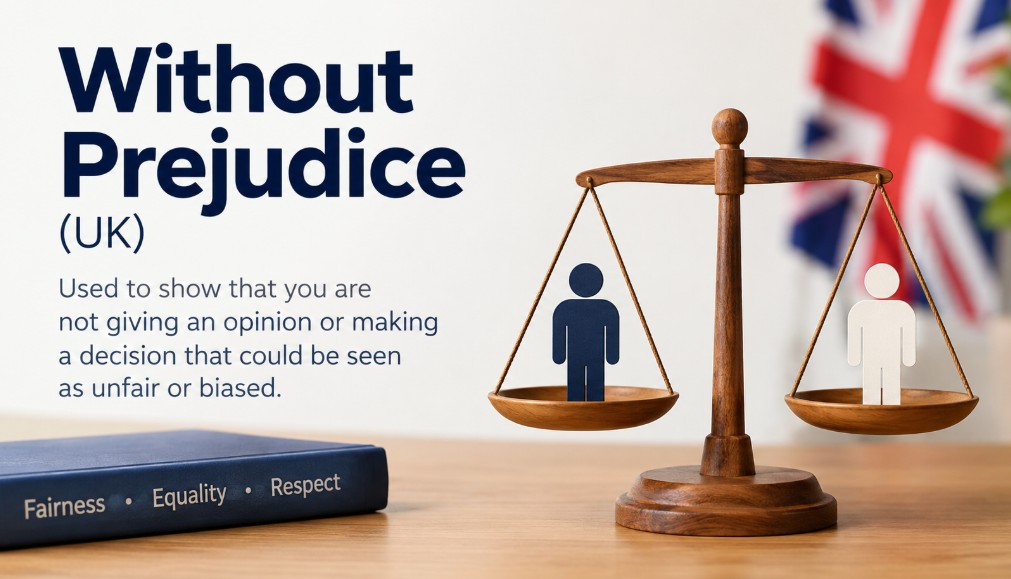
Without prejudice is a legal privilege under English law that keeps genuine settlement negotiations confidential, meaning neither party can submit those offers or discussions as evidence in court to prove liability if negotiations fail.
For the privilege to apply, an active dispute must exist, and the communication must represent a genuine attempt to compromise.
Placing the label on everyday commercial emails does not grant confidentiality. This guide breaks down exactly when the rule applies, how to mark correspondence correctly, and the critical cost exceptions under the Civil Procedure Rules.
Key Takeaways
-
Without prejudice privilege protects genuine settlement negotiations from being admitted as evidence in court to prove liability.
-
An active dispute must exist, and a compromise must be offered; labelling routine emails without a dispute provides zero legal protection.
-
Opening correspondence remains fully admissible in court, while properly marked settlement offers remain strictly confidential.
-
The save as to costs exception allows settlement offers to be shown to a judge solely for determining legal cost liabilities after a trial.
What is the Without Prejudice Meaning?
Without prejudice is a vital legal privilege derived from English common law. It acts as a protective shield for parties involved in a dispute, allowing them to speak freely, make concessions, and explore compromise solutions without the fear that their words will later be used against them in court if negotiations fail.
To fully understand the meaning and mechanics of this rule, it can be broken down into four key pillars:
1. The Public Policy Purpose: Encouraging Out-of-Court Settlements
The courts strongly favor the private resolution of disputes to avoid unnecessary litigation and reduce court congestion. Under English law, public policy dictates that businesses and individuals should feel entirely safe when attempting to compromise.
Without this rule, parties would be terrified to offer concessions or lower settlement figures, knowing that any display of flexibility could be weaponized by the opposition during a summary judgment or trial if talks broke down.
2. Total Inadmissibility on Liability
When a communication is genuinely without prejudice, it is strictly confidential and inadmissible as evidence in court to prove liability or weakness.
If Party A offers to pay 50% of a disputed debt just to make the matter go away, and Party B rejects it, Party B cannot later walk into court and tell the judge, Look, Your Honor, they practically admitted they owed the money because they offered to pay half! The court will completely block that evidence from being introduced.
3. Freedom to Negotiate Candidly
In practice, this rule creates a safe space (often thought of as the legal equivalent of being off the record). During commercial negotiations, parties can openly discuss:
-
Reduced settlement figures and lump-sum payouts
-
Flexible payment schedules and installment plans
-
Contractual compromises or trade-offs
This transparency allows both sides to realistically evaluate their positions and reach a mutually beneficial agreement much faster.
4. The Golden Rule: Substance Over Label
Crucially, the meaning of without prejudice is defined by substance, not just a label. Simply typing the phrase at the bottom of an email or across the top of a standard debt-collection letter does not automatically grant legal protection. For the phrase to carry true legal weight, two strict conditions must be met:
-
There must be an active, genuine dispute already underway.
-
The communication must contain a bona fide attempt to compromise (i.e., an offer to give up something in exchange for a resolution).
If these elements are missing, such as when a business merely demands an overdue invoice while threatening legal action, the label is legally meaningless, and the correspondence remains fully open and admissible in court.

When Can Small Businesses Use Without Prejudice?
Privilege only attaches if specific legal criteria are met. Business owners, along with executive leadership teams like a Chief Business Officer, frequently assume that writing the phrase at the top of a document automatically shields it from disclosure.
However, English courts apply a strict two-part test to determine whether the label holds any legal weight.
To ensure the label is applied correctly, follow these sequential steps:
-
Confirm that an active dispute exists, meaning an unresolved claim, unpaid invoice, or formal disagreement is already on foot.
-
Formulate a genuine settlement proposal or compromise rather than merely demanding payment or restating contractual obligations.
-
Ensure both parties understand that the dialogue is off-the-record settlement outreach aimed at resolving the outstanding disagreement.
-
Verify that the communication contains an explicit concession or offer to give up something in exchange for a resolution.
-
Check that the correspondence is clearly marked at the very top before sending it via email or post.
-
Retain a separate file for open correspondence to keep everyday operational discussions distinct from closed settlement talks.
Where these criteria are satisfied, the communication enjoys protection from disclosure in court, safeguarding the business against litigation risk during ongoing negotiations.
Open Correspondence vs. Without Prejudice: Key Differences
Understanding the structural boundary between standard business correspondence and confidential settlement outreach prevents critical disclosure errors.
Open correspondence can be freely submitted to a judge to prove liability or breach of contract, whereas without prejudice communications remain strictly confidential and inadmissible in court.
| Feature | Open Correspondence | Without Prejudice Correspondence |
| Court Admissibility | Fully admissible to prove facts and liability | Strictly inadmissible to prove liability |
| Primary Purpose | Normal commercial operations, invoicing, demands | Bona fide out-of-court settlement negotiations |
| Legal Label Required | None (default status for all business emails) | Must be explicitly marked or clearly contextualised |
| Cost Implications | Standard cost rules apply based on judgment outcome | Can trigger protective cost orders (save as to costs) |
How to Use Without Prejudice in Emails and Letters Correctly?
Implementing the label correctly requires a disciplined approach to day-to-day administration. When drafting an email or letter proposing a compromise during an active dispute, place the phrase clearly at the very top of the text.
-
Do not label routine invoices, payment reminders, or chasing emails without prejudice in an attempt to hide standard payment demands.
-
Do not rely on the label alone if no genuine dispute or compromise offer exists within the body of the message.
-
Do not mix open factual statements and unlabelled commercial threats with settlement offers within the same paragraph.
A common pattern is observed when small business owners attempt to shield ordinary debt-chasing emails by appending the phrase to the signature block. Courts regularly disregard the label in such scenarios, treating the email as open correspondence because no mutual compromise was ever proposed.

What Happens If You Use It Incorrectly?
Misapplying the phrase creates a false sense of security that can expose sensitive commercial concessions to the opposing side.
If a business owner labels an ordinary operational email without prejudice while merely threatening legal action over an unpaid invoice, the opposing party’s solicitor can freely submit that email as evidence.
When reviewing decisions where parties mislabelled routine correspondence, judges routinely rule that the privilege never attached because no bona fide dispute or reciprocal concession was present.
Consequently, admissions of fact or apologies made within those improperly labelled emails become fully admissible, potentially undermining the business’s position during a subsequent trial.
What Does Without Prejudice Save as to Costs Mean?
During formal litigation governed by the Civil Procedure Rules (CPR), parties occasionally mark correspondence as without prejudice save as to costs.
This specific formula means the communication remains entirely confidential regarding liability while the trial is underway, but can be revealed to the presiding judge after judgment has been handed down.
The primary mechanism for this is a Calderbank offer or a formal Part 36 offer.
If a claimant rejects a reasonable settlement offer made under this rule and subsequently wins a lower amount at trial, the judge exercises court discretion on cost allocation to penalise the claimant, ordering them to pay the defendant’s legal expenses from the date of the offer onward.
When Does Without Prejudice Privilege Not Apply?
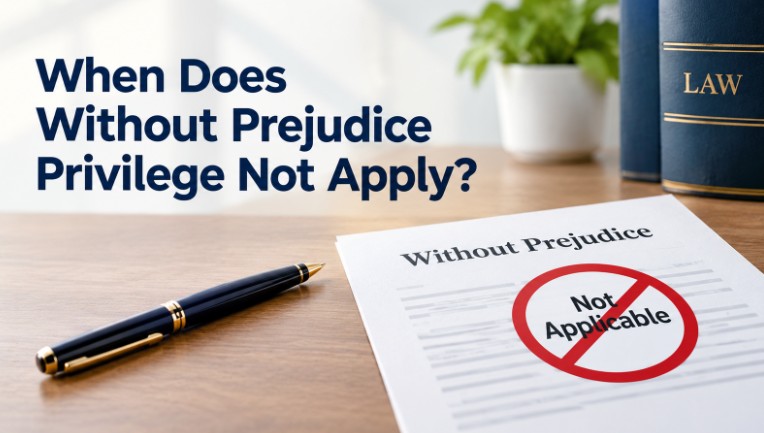
Privilege is not absolute. The Supreme Court and the Court of Appeal have established clear exceptions where public policy demands that the confidentiality shield be set aside.
-
Cases involving fraud, blackmail, extortion, or criminal intent executed under the guise of settlement negotiations.
-
Instances of undue influence, misrepresentation, or economic duress that vitiate the fairness of the compromise.
-
Situations where an unambiguous threat or clear impropriety is made, transforming the discussion into a weapon rather than an honest attempt to settle.
Where these exceptions occur, the court permits a waiver of privilege, allowing the otherwise confidential correspondence to be read and evaluated during proceedings.
Conclusion
Properly leveraging settlement privilege requires maintaining a strict separation between open operational correspondence and closed compromise discussions.
Utilising the label exclusively during genuine disputes involving mutual concessions ensures that commercial negotiations remain protected.
Disclaimer: This article is for informational purposes only and does not constitute formal legal advice.
FAQs
Can you use without prejudice in an open letter?
No. Mixing open factual demands and closed settlement offers in the same unlabelled letter compromises confidentiality and forfeits protection.
Does without prejudice mean off the record?
Yes, within civil law proceedings, it functions similarly to an off-the-record agreement, shielding compromise discussions from being disclosed during a trial.
What is a without prejudice offer?
It is a formal settlement proposal made during a dispute that allows parties to negotiate compromise terms without admitting liability for the underlying claim.
How does this apply to ACAS employment conciliation?
ACAS conciliation discussions and settlement agreements operate under comparable confidentiality principles, alongside specific statutory frameworks governing pre-termination negotiations.
Can the label be used in verbal negotiations?
Yes, stating verbally at the start of a telephone call or meeting that the discussion is conducted without prejudice establishes the same protective confidentiality.
Does the label protect communications sent to third parties?
Generally no, because the privilege only exists between the disputing parties, though limited exceptions apply in multi-party commercial litigation.