
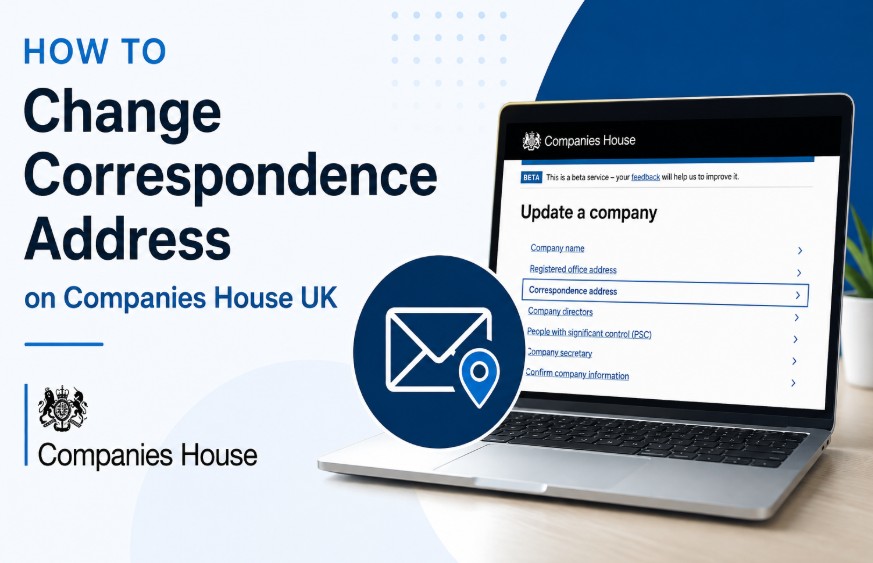
How to Change Correspondence Address on Companies House: Step-by-Step Guide
Changing your correspondence address on Companies House involves updating either your company’s registered office address or an individual officer’s service address via the official online WebFiling portal or statutory paper forms, ensuring public records remain fully compliant with the Companies Act 2006.
A correspondence address on Companies House represents the official public-facing location where directors, secretaries, and people with significant control receive statutory notices and formal communications, distinct from private residential properties.
-
Correspondence updates for directors, secretaries, and PSCs must be reported to Companies House within 14 days of the change.
-
Submitting updates online via the Companies House WebFiling portal using an authentication code is free and processed within 24 hours.
-
A registered office address and a director’s correspondence service address are legally distinct and require separate update workflows.
-
Officers can use a dedicated service address or virtual office provider to keep private residential home addresses off public registers.
-
Failing to update statutory addresses on time leads to compliance penalties, rejected filings, and legal notices sent astray.
How to Change Correspondence Address on Companies House?
To change a correspondence address on Companies House, you can choose between a fast digital submission or a manual postal filing. Both methods are completely free of charge, though online updates are processed significantly faster.
Method 1: Update Online via Companies House WebFiling
Submitting updates through the digital portal is the fastest way to ensure your records are accurately reflected on the public register within 24 to 48 hours.
-
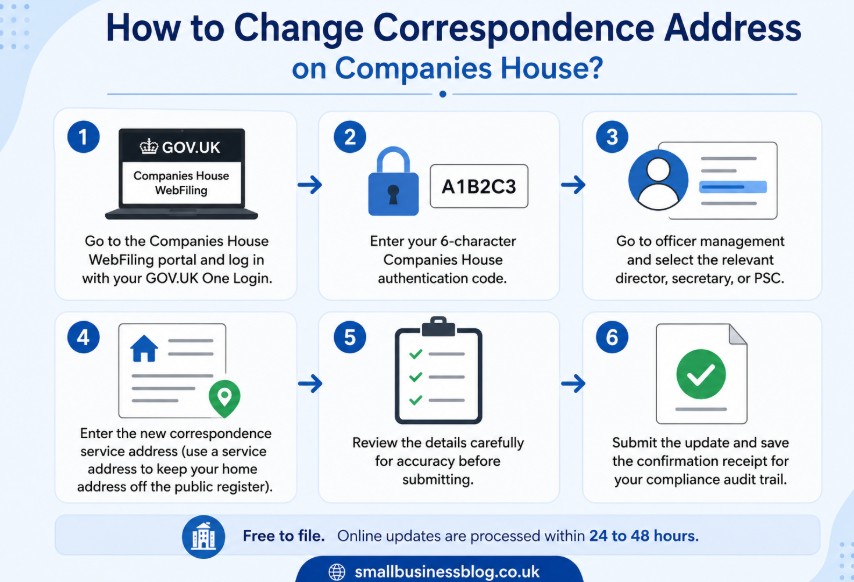
Step 1: Navigate to the official GOV.UK Companies House WebFiling portal and log into your authorized account using your active GOV.UK One Login credentials.
-
Step 2: Enter the unique 6-character Companies House authentication code assigned to your company to unlock management access for the enterprise.
-
Step 3: Go to the officer management dashboard and select the specific director, secretary, or PSC profile that requires modification.
-
Step 4: Input the new correspondence service address, ensuring all postal details comply with Royal Mail addressing standards. (Note: You can use a dedicated service address, accountant’s office, or virtual business provider here to keep your private home address off the public register).
-
Step 5: Carefully review the entered data for typographical accuracy before submitting the digital filing.
-
Step 6: Submit the electronic update and save the confirmation receipt issued by the portal for your compliance audit trail.
Method 2: Update by Post
If digital systems or authentication tokens are temporarily unavailable, or if you are managing a complex corporate restructuring, you can submit statutory paper forms.
-
Step 1: Complete the required paper form, such as Form CH01 for individual directors.
-
Step 2: Ensure manual authorization via a signature from a company director or authorized signatory, as this is mandatory for postal filings.
-
Step 3: Mail the completed form to the appropriate UK Registrar of Companies office depending on your enterprise’s jurisdiction (England and Wales, Scotland, or Northern Ireland).
Keep in mind: Postal processing requires manual handling queues and takes 5 to 10 working days, so submit early to stay within the strict 14-day statutory notification window.
What Is a Correspondence Address on Companies House?
A correspondence address, officially designated as a service address, is the official public contact location where individual company officers (such as directors, secretaries, and People with Significant Control or PSCs) receive statutory notices, legal documents, and formal communications.
Under the Companies Act 2006, the Registrar of Companies maintains public registers where this information must be displayed transparently.
To prevent common administrative errors, it is vital to understand the legal and structural distinctions between an officer’s individual service address and the company’s registered office address.
Key Differences at a Glance
| Feature | Correspondence / Service Address | Registered Office Address |
| Applies To | Individual officers (Directors, Secretaries, PSCs) | The corporate entity itself (the company as a whole) |
| Primary Purpose | To receive personal statutory mail and formal notices while keeping private homes off public databases | To serve as the official legal headquarters of the company for official government and legal correspondence |
| Location Requirements | Can be anywhere postal mail is reliably received and acknowledged | Must be a physical address located in the correct UK jurisdiction (e.g., England and Wales, Scotland, or Northern Ireland) |
| PO Box Usage | Permitted, provided documents can be successfully delivered and acknowledged | Generally restricted; must be a physical location capable of accepting physical legal service |
| Public Visibility | Fully visible on the public Companies House register | Fully visible on the public Companies House register |
The primary operational advantage of utilizing a dedicated service address is residential privacy. Because service addresses are fully visible on public databases accessible via data scraping and commercial mining, using a home address exposes private households to unwanted solicitations and public exposure.
Many officers opt to use a professional virtual office provider, accountant’s office, or third-party registered office address service to maintain a strict boundary between their personal lives and corporate responsibilities.
What are the required documents to Change Your Correspondence Address?
Completing a correspondence address update smoothly requires specific digital credentials, authentication tokens, and precise location data before accessing the submission portal.
-
Active GOV.UK One Login credentials linked to the corporate filing account.
-
The unique 6-character Companies House authentication code assigned to the company.
-
A fully verified postal address capable of receiving legal and statutory mail promptly.
-
Exact officer details, including full legal names and dates of birth for identity verification.

Who Needs to Keep Their Correspondence Address Updated?
Active company directors, corporate secretaries, and People with Significant Control (PSCs) are legally mandated to maintain accurate correspondence details with regulatory authorities.
Initial subscribers who formed the company are excluded from ongoing correspondence updates once incorporation is finalized unless they concurrently serve as active directors or PSCs.
Corporate governance frameworks rely heavily on transparent officer data to ensure accountability across UK enterprises. When officers change their primary mailing locations or transition to professional secretarial providers, updating the data preserves institutional integrity.
A common pattern in corporate administration involves neglecting PSC updates while successfully modifying director records, which creates compliance discrepancies during annual confirmation statement filings.
Why Business Owners Might Want to Change It?
Directors frequently update their correspondence details to maintain residential privacy, transition to professional virtual office providers, or reflect relocations without exposing home addresses on public databases.
Public data scraping and commercial directory mining make private residential addresses vulnerable when used as official officer contacts.
Utilizing a dedicated corporate correspondence address or virtual business space shields private households from unwanted commercial solicitations and public exposure.
When reviewing director onboarding decisions, corporate advisers routinely recommend establishing a secure service address before corporate registration to safeguard personal boundaries from day one.
How Long Does It Take to Update?
Online updates submitted through the WebFiling portal typically process and appear on the public register within 24 to 48 hours, whereas postal forms take significantly longer due to manual handling queues.
| Filing Method | Statutory Form | Typical Processing Time | Filing Fee |
| Online WebFiling | Digital Portal Entry | 24 to 48 Hours | Free |
| Postal Submission | Form CH01 / Form AD01 | 5 to 10 Working Days | Free |
Is There a Fee to Change Correspondence Address on Companies House?
No, Companies House charges zero fees for updating corporate registered offices or individual officer correspondence addresses, regardless of whether submissions are processed online or via paper forms.
Regulatory policy ensures that basic statutory compliance updates remain accessible and free of financial friction for small business owners.
What Happens If You Don’t Update It in Time?
Failing to notify Companies House within the statutory 14-day legal window can result in compliance breaches, returned legal notices, and potential criminal prosecution of company officers under the Companies Act 2006.
When official notices fail to reach a director because an outdated address remains on the register, missed legal deadlines can lead to default judgments, administrative restoration issues, or unexpected company strike-off actions, though legitimate delays can sometimes be mitigated via a formal Companies House filing extension.
Can You Use a Different Address to Protect Your Privacy?
Yes, officers can use third-party service address providers, accountant offices, or virtual business addresses as their official correspondence location to keep private homes off public databases.
Professional service providers specialize in receiving statutory mail and forwarding correspondence securely to directors.
When reviewing privacy options, ensuring that the chosen alternative address meets all legal standards set by the Registrar of Companies is critical.
The location must be capable of accepting formal legal documents and ensuring prompt delivery to the intended recipient.

What are the Common Mistakes to Avoid?
Avoiding common Companies House filing errors protects your business from statutory penalties, rejected paperwork, and misrouted legal notices.
-
Conflating Addresses: Mixing up the company’s registered office with an individual officer’s service address.
-
Missing the 14-Day Deadline: Failing to report address changes within the strict statutory notification window.
-
Forgetting HMRC Updates: Assuming Companies House changes automatically update tax, PAYE, and corporate records with HM Revenue and Customs.
-
Using Invalid Postal Formats: Submitting unverified locations or non-compliant setups that fail formal statutory delivery requirements.
Conclusion
Maintaining accurate records on the public register is a foundational requirement for UK company directors and business proprietors.
By utilizing the digital WebFiling portal and adhering to the strict 14-day statutory window, administrators can successfully update correspondence locations while protecting personal privacy through dedicated service addresses.
Review internal records today and execute any required updates promptly to ensure complete corporate compliance.
Disclaimer: This article is for informational purposes only and does not constitute formal legal or financial advice; consult a qualified professional or the official GOV.UK guidance for specific corporate compliance matters.
FAQs
Is my correspondence address public?
Yes, a director’s correspondence or service address is fully visible on the public Companies House register, which is why many officers use a separate business or virtual address to protect home privacy.
Can I use my home address as a correspondence address?
Yes, officers can legally use their residential home address as a correspondence address, though it will be publicly accessible on the register for anyone to view.
Do I need to update HMRC separately when changing my address?
Yes, updating Companies House does not automatically update HM Revenue and Customs (HMRC); corporate tax and PAYE records must be updated independently.
Can corporate secretaries use a correspondence address?
Yes, company secretaries are required to maintain an accurate correspondence address on the public register, which can be updated through digital or postal filing channels.
What happens if mail sent to my service address is returned?
If statutory mail is repeatedly returned undelivered, Companies House may launch an inquiry into the validity of the address, potentially leading to compliance enforcement actions.
Are PO boxes permitted for director service addresses?
Yes, unlike registered office addresses, individual director service addresses may utilize a PO Box provided that documents can be successfully delivered and acknowledged.