

Companies House Filing Extension Guide: Rules, Deadlines & Penalties
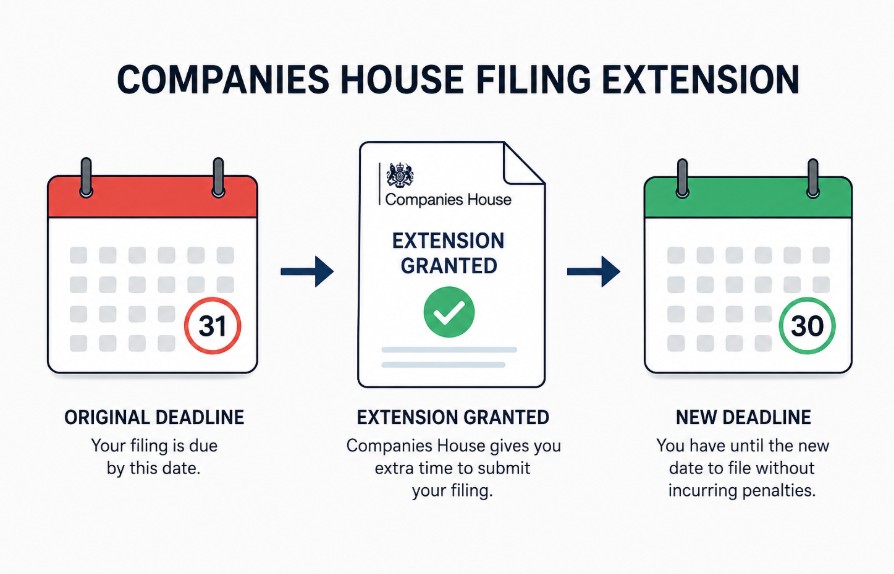
A Companies House filing extension is a discretionary grace period issued by the Registrar of Companies, giving qualifying UK businesses an extra 3 months to submit their annual accounts.
These extensions are never automatic and demand proof of unforeseen emergencies, such as severe illness or critical disaster, submitted before your statutory deadline passes.
Key Takeaways
-
Companies House does not grant automatic extensions for annual accounts, requiring proof of exceptional circumstances outside your control.
-
An approved discretionary extension typically provides an additional 3 months on top of your original statutory filing deadline window.
-
Private limited companies face escalating late filing penalties ranging from 150 pounds up to 1,500 pounds if deadlines are missed entirely.
-
Submitting Form AA01 allows businesses to alter their accounting reference date to permanently shift future filing schedules.
What Does a Companies House Filing Extension Mean?
A Companies House filing extension is a discretionary adjustment granted by the UK Registrar of Companies that pushes back a company’s statutory annual accounts submission deadline, typically offering an extra 3 months of compliance time.
Under the Companies Act 2006, private limited companies must submit their annual accounts within 9 months of their accounting reference date, while public firms get a tighter 6-month window.
Amid a broader regulatory Companies House company crackdown, when major operational disruptions block timely preparation, directors can apply for extra breathing room.
However, Companies House applies a strict threshold: your application must prove that exceptional events directly caused the delay, rather than routine bookkeeping backlogs, busy seasons, or everyday staff shortages.
What Is the Rule for Companies House Filing Extension?
The golden rule for a Companies House filing extension is simple: you must apply before your current deadline lapses, backed by proof of extraordinary circumstances well outside your control.
Companies House has zero patience for standard commercial hiccups. Key compliance rules involve:
-
High Threshold of Proof: The application must prove that exceptional circumstances fell strictly outside the company’s reasonable control.
-
Standard Time Extension: An approved discretionary extension typically provides an additional 3 months on top of your original statutory filing deadline window.
-
Timely Submission: Requests must be submitted well before your current statutory filing deadline expires. Applying post-deadline drastically reduces approval odds and results in actively compounding late penalties.
-
Monitoring of Repeat Requests: Businesses cannot use emergency extensions indefinitely as a substitute for ongoing financial management; systematic delays invite rigorous compliance scrutiny.
What is the Baseline UK Company Accounts Filing Deadline?
Newly incorporated private limited companies have 21 months from incorporation to file their first accounts, while established private companies must file within 9 months of their financial year-end.
Calculating your exact compliance window accurately prevents accidental breaches and late-stage administrative panics:
-
First Accounts Window: Newly incorporated private limited companies have 21 months from their date of incorporation to deliver their initial set of accounts to the Registrar.
-
Subsequent Annual Windows: Established private companies must submit their financial statements within 9 months of the financial year-end.
-
Public Company Timelines: Public limited companies operate under a compressed 6-month deadline following their accounting reference date.
What Are Acceptable vs. Unacceptable Extension Reasons?
Valid grounds for an extension are limited to severe director illness or major disasters like a fire or flood, whereas accountant delays, holiday cover, and poor organization are chucked out straight away.
Knowing what the Registrar greenlights versus what gets flatly refused saves precious time when you are up against it:
Acceptable Exceptional Circumstances
-
Severe Incapacitation: Sudden, severe illness or hospitalization of the sole director or person responsible for preparing accounts.
-
Catastrophic Physical Disasters: Fire, flood, or major natural disasters that completely destroy physical company financial records right before filing.
-
Critical IT Failures: Severe, unforeseen technological infrastructure breakdowns or system crashes that block access to digital accounting software immediately before the deadline.

Unacceptable Reasons
-
Routine staff shortages, staff holidays, or general employee turnover.
-
Accountant errors, heavy workloads, external accountant illness, or delayed bookkeeping backlogs.
-
Cash flow problems or inability to pay accountancy fees.
-
Assuming a company is dormant without checking official compliance registers (dormant accounts still require filing).
How Long Can You Extend Your Deadline By?
When approved, Companies House typically extends your filing deadline by an additional 3 months, creating an absolute maximum filing window of 12 months from the accounting reference date for private companies.
When Companies House evaluates and approves a formal application, the length of extra time granted is standardized to give you a realistic buffer to recover from the disruption. Businesses must note that emergency extensions cannot be used continuously.
Companies House monitors repeat requests closely, and systematic reliance on extensions will trigger compliance investigations.
How to File a Companies House Extension?
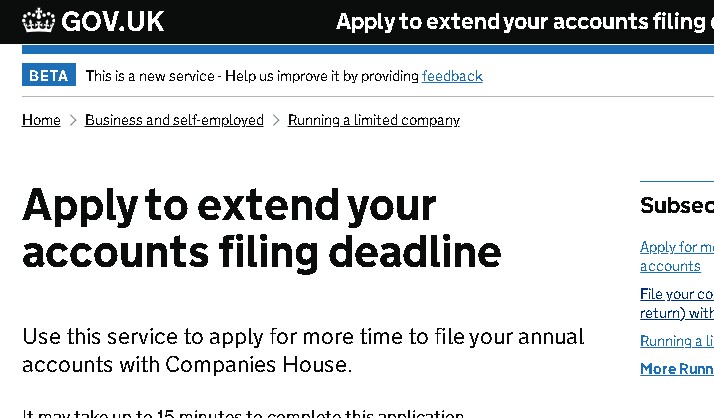
To request a Companies House filing extension, sign into the official GOV.UK WebFiling platform using your secure credentials, keeping in mind new identity verification requirements, head to the extension portal, write a clear explanation, and send it off before time runs out.
Getting a formal request right takes a bit of prep and a steady run-through of the online steps:
-
Review Internal Capacity: Identify the direct cause of the reporting delay and verify that the disruptive event falls strictly outside your reasonable control.
-
Gather Documentary Evidence: Collect official documentation, such as medical certificates, incident reports, or proof of catastrophic events.
-
Access the Portal: Sign straight into the official GOV.UK WebFiling system, or test features via the Companies House beta interface where available, with your company login details.
-
Complete the Digital Form: Navigate to the accounts extension section and fill out the digital application form, providing a detailed, transparent explanation outlining the exceptional circumstances.
-
Submit Before Deadline: Send the formal request to the Registrar before your current filing deadline expires.
-
Monitor Status: Check your registered account dashboard for the official evaluation decision from the Registrar.
Financial Impact of Companies House Late Filing Penalties
Failing to secure a valid extension triggers non-negotiable private company late filing penalties ranging from £150 for accounts up to a month late, scaling up to £1,500 for delays exceeding six months.
| How Late Are the Accounts? | Penalty Amount (Private Company) | Penalty Status |
| Up to 1 month late | 150 pounds | Standard First Tier |
| 1 month to 3 months late | 375 pounds | Escalated Tier |
| 3 months to 6 months late | 750 pounds | Severe Tier |
| More than 6 months late | 1,500 pounds | Maximum Statutory Fine |
Warning: If you file your accounts late two financial years in a row, these penalty amounts are automatically doubled. Extended delays can also lead to company strike-off and director prosecution.
Changing Your Accounting Reference Date
If your business requires a structural adjustment to its financial calendar rather than an emergency extension due to a crisis, changing your Accounting Reference Date is often a cleaner, more proactive strategy.
By submitting Form AA01 either online via WebFiling or via paper, companies can choose to lengthen or shorten their current or immediately preceding financial year.
Comparison of Filing Adjustments
| Feature | Discretionary Filing Extension | Changing Accounting Reference Date (Form AA01) |
| Primary Purpose | Securing extra time due to unexpected, exceptional events | Permanently or temporarily altering the financial year-end |
| Approval Requirement | Requires explicit discretionary approval from Companies House | Automatically processed if submitted correctly and on time |
| Time Granted | Usually adds an extra 3 months to the existing deadline | Alters the accounting period length, shifting future filing dates |
How Does a Companies House Filing Extension Impact Small and Medium Enterprises?
For small and medium enterprises, a Companies House filing extension provides critical operational breathing room during severe crises, preventing compounding late penalties and corporate strike-offs while preserving cash flow and director bandwidth.
-
Cash Flow Protection: Shields lean budgets from statutory penalties ranging from £150 up to £1,500, which double if missed for two consecutive years.
-
Operational Focus: Relieves pressure during emergencies, allowing leadership to prioritize crisis management and business continuity over compliance panic.
-
Commercial Standing: Avoids administrative default flags on public registers, protecting the business’s credit rating, supplier trust, and market reputation.
-
Strategic Transition: Encourages a clear shift from emergency extensions to proactive solutions like Form AA01 for ongoing financial calendar adjustments.
Conclusion
Securing compliance requires proactive timeline management and careful documentation of any unforeseen operational disruptions.
Business directors facing genuine administrative crises should immediately assemble supporting evidence and submit formal requests via the official GOV.UK portal before statutory windows close.
Disclaimer: This article is for informational purposes only and does not constitute formal legal or financial advice. Company directors should verify specific regulatory compliance requirements directly through the official GOV.UK portal.
FAQ
Can I get an automatic filing extension?
Companies House does not offer automatic extensions for standard corporate accounts. Every application undergoes manual review against strict criteria governing exceptional, unforeseen circumstances.
What is the maximum extension period allowed?
When an extension is granted due to exceptional circumstances, Companies House typically extends the filing deadline by an additional 3 months to facilitate compliance.
Can I apply for an extension after my filing deadline has passed?
While digital submission remains technically open, applying post-deadline drastically reduces approval odds, and statutory late penalties will already be actively compounding.
Is there an extension for filing confirmation statements?
Confirmation statement extensions are rarely granted because the filing process involves verifying existing administrative data rather than preparing complex financial accounts.
Can I submit amended accounts to Companies House?
Yes, corrected financial statements can be submitted post-filing, though doing so does not cancel out late penalties incurred if original deadlines were missed.
What qualifies as an exceptional circumstance?
Qualifying events are restricted to catastrophic, unforeseen disruptions outside management control, such as severe director incapacitation or total physical destruction of records.
How early should a request be submitted?
Applications must be submitted well before the statutory filing deadline expires to allow the Registrar sufficient time to evaluate the evidence provided.
Are public companies subject to the same extension rules?
Public companies must meet the same high threshold of exceptional circumstances, though their baseline statutory filing window is limited to 6 months post-year-end.



One Comment