70k After Tax UK Guide: Net Pay Breakdown, Tax Bands, Pension, and Student Loans
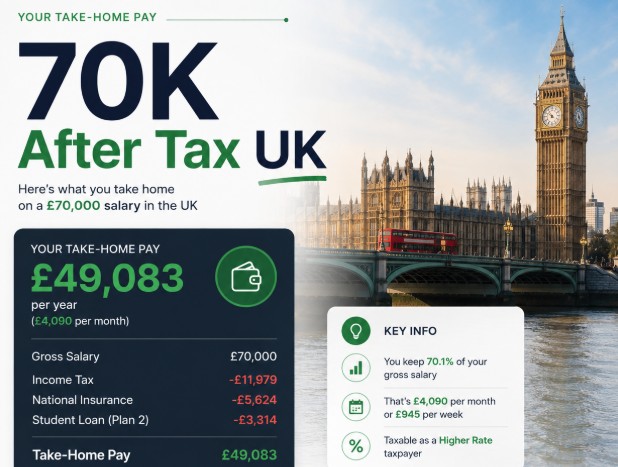
Earning £70,000 per year leaves you with a net annual take-home pay of £51,157 after statutory deductions across England, Wales, and Northern Ireland.
Understanding your 70k after tax UK salary means accounting for roughly £4,263 per month on a standard 1257L tax code before any pension or student loan adjustments.
Key Takeaways
-
An individual on a standard 1257L tax code taking home a gross salary of £70,000 pays £15,486 in Income Tax and £3,357 in National Insurance.
-
Earning £70,000 per annum produces an effective tax rate of approximately 26.92% and places an employee in the UK top 10% income bracket.
-
Monthly net income drops from £4,263 to approximately £3,933 if repaying a Plan 2 Student Loan alongside a standard 5% auto-enrolment pension.
-
Scottish residents earning £70,000 pay an additional £1,500 annually in Scottish Income Tax due to higher regional rate thresholds.
What Is 70k After Tax UK Take-Home Salary?
A 70k after tax UK take-home salary gives you an annual net income of £51,157 on a standard 1257L tax code after HMRC deducts Income Tax and Class 1 National Insurance. This equals £4,263 monthly, retaining roughly 73% of your gross £70,000 salary across England, Wales, and Northern Ireland.
Statutory Deductions Explained
Statutory deductions on a £70,000 salary consist of Income Tax (20% basic rate on earnings from £12,571 to £50,270 and 40% higher rate on earnings from £50,271 to £70,000) and Class 1 National Insurance (8% main rate up to £50,270 and 2% upper rate on the remainder).
-
Personal Allowance (£12,570): The first £12,570 you earn is completely tax-free under standard tax code 1257L.
-
Basic Rate Income Tax (20%): Earnings between £12,571 and £50,270 (£37,700 slice) are taxed at 20%, totaling £7,540.00.
-
Higher Rate Income Tax (40%): Earnings between £50,271 and £70,000 (£19,730 slice) are taxed at 40%, totaling £7,892.00.
-
Class 1 National Insurance (8% & 2%): Earnings between £12,571 and £50,270 incur 8% NI (£3,016.00), while earnings above £50,270 incur 2% NI (£394.58), totaling £3,410.58.

Pay Frequency Take-Home Salary Breakdown
Calculated assuming a standard 37.5-hour work week (5 days/week, 260 working days per year).
| Pay Frequency | Gross Salary | Income Tax | National Insurance | Total Deductions | Net Take-Home Pay |
| Yearly | £70,000.00 | £15,432.00 | £3,410.58 | £18,842.58 | £51,157.42 |
| Monthly | £5,833.33 | £1,286.00 | £284.22 | £1,570.22 | £4,263.12 |
| Weekly | £1,346.15 | £296.77 | £65.59 | £362.36 | £983.80 |
| Daily (5 days/wk) | £269.23 | £59.35 | £13.12 | £72.47 | £196.76 |
| Hourly (37.5 hrs/wk) | £35.90 | £7.91 | £1.75 | £9.66 | £26.24 |
How Is Income Tax Calculated?
Income Tax calculation depends directly on your location in the UK. While statutory National Insurance rates remain uniform across the UK, tax rates differ between England, Wales, & Northern Ireland and Scotland due to devolved Scottish tax powers.
England, Wales & Northern Ireland Tax Bands
| Tax Band | Tax Rate | Annual Taxable Threshold |
| Personal Allowance | 0% | Up to £12,570 |
| Basic Rate | 20% | £12,571 – £50,270 |
| Higher Rate | 40% | £50,271 – £125,140 |
| Additional Rate | 45% | Above £125,140 |
National Insurance Contributions (Primary Class 1)
| Threshold / Band | Annual Range | Employee Rate | Annual Charge on £70,000 |
| Primary Threshold | Up to £12,570 | 0% | £0.00 |
| Main Rate Band | £12,571 – £50,270 | 8% | £3,016.00 (£37,700 × 8%) |
| Upper Earnings Limit (UEL) | £50,271 – £70,000 | 2% | £394.60 (£19,730 × 2%) |
| Total Annual NI | — | — | £3,410.60 |
Scotland Tax Band
| Tax Band | Tax Rate | Annual Taxable Threshold |
| Personal Allowance | 0% | Up to £12,570 |
| Starter Rate | 19% | £12,571 – £15,397 |
| Basic Rate | 20% | £15,398 – £27,491 |
| Intermediate Rate | 21% | £27,492 – £43,662 |
| Higher Rate | 42% | £43,663 – £75,000 |
| Advanced Rate | 45% | £75,001 – £125,140 |
| Top Rate | 48% | Above £125,140 |
Regional Comparison Summary (£70,000 Gross Salary)
| Metric | England, Wales & NI | Scotland | Regional Variance |
| Total Annual Income Tax | £15,432.00 | £17,413.80 | Scotland pays +£1,981.80 |
| Total Annual NI | £3,410.60 | £3,410.60 | Identical (£0.00) |
| Total Statutory Deductions | £18,842.60 | £20,824.40 | Scotland pays +£1,981.80 |
| Annual Net Take-Home Pay | £51,157.40 | £49,175.60 | Scotland receives -£1,981.80 |
| Monthly Net Take-Home Pay | £4,263.12 | £4,097.97 | Scotland receives -£165.15/mo |

How Does Living in Scotland Impact Your 70k Take-Home After Tax UK?
Scottish taxpayers are subject to devolved tax rates set by the Scottish Parliament. Income Tax bands in Scotland differ significantly from the rest of the UK for higher earners.
Scottish Tax Bands vs Rest of UK Table
| Region | Personal Allowance | Intermediate/Basic Rates | Higher Rate Threshold & Rate | Total Net Pay on £70k |
| England, Wales & NI | £12,570 (0%) | £12,571 – £50,270 (20%) | £50,271 – £70,000 (40%) | £51,211 |
| Scotland | £12,570 (0%) | Mixed rates (19% – 21%) | £31,093 – £62,430 (42%) / £62,431+ (45%) | £49,711 |
In practice, a senior project manager relocating from Manchester to Edinburgh on a 70k per annum after tax UK contract would see their net monthly take-home pay fall by roughly £125 per month due to Scotland’s 42% and 45% regional tax brackets.
How Does a 70k Salary After Tax UK Compare Across Income Tiers?
Comparing a £70,000 salary to nearby pay bands reveals that every £5,000 gross raise above £50,270 delivers approximately £2,900 in net take-home pay (~£241/month), with HMRC retaining roughly £2,100 (42%) through higher-rate Income Tax and National Insurance.
Moving higher into the 40% tax bracket changes how much of a salary increase you keep. The marginal retention rate above £50,270 is 58% (you keep 58p of every extra £1 earned).
Take-Home Pay Across Salary Tiers Table
| Gross Salary | Annual Income Tax | Annual National Insurance | Net Take-Home Pay (Annual) | 70k Salary Per Month After Tax UK Equivalent |
| 65k after tax UK | £13,432 | £3,257 | £48,311 | £4,025.92 |
| 70k after tax UK | £15,432 | £3,357 | £51,211 | £4,267.61 |
| 75k after tax UK | £17,432 | £3,457 | £54,111 | £4,509.28 |
| 80k after tax UK | £19,432 | £3,557 | £57,111 | £4,750.95 |
Every £5,000 increase in gross salary above £50,270 yields approximately £2,900 in extra net income per year, with £2,100 retained by HMRC through higher-rate taxation and National Insurance.
What Is the Tax Code for a 70k Salary?
For most UK employees earning a £70,000 salary, the standard tax code is 1257L (or S1257L if resident in Scotland, C1257L if in Wales):
- 1257: Represents your annual tax-free Personal Allowance (£12,570 divided by 10).
- L: Entitles you to the basic, standard tax-free personal allowance.
- S Prefix: Tells your employer to apply Scottish Income Tax rates.
- C Prefix: Applies Welsh Income Tax rates (currently aligned with England).
If you do not have employer-provided benefits or outstanding unpaid taxes from previous years, 1257L is the code applied by default via PAYE.
What Factors Change Your Tax Code on a £70k Salary?
Factors that alter your tax code from 1257L include employer-provided benefits in kind (company cars, medical insurance), unpaid tax from previous years, taxable state benefits, secondary jobs (BR or D0 codes), or residing in Scotland or Wales.
-
Personal Allowance Eligibility: The base standard allowance is set at £12,570. Earnings over £100,000 reduce this allowance, but a £70,000 salary keeps your standard £12,570 entitlement intact.
-
Taxable Company Benefits (Benefits in Kind): Company cars, private medical insurance, or gym memberships provided by your employer reduce your tax-free allowance, altering the numbers in your tax code (e.g., dropping to1100L ).
-
State Benefits & Pensions: Receiving state benefits or taxable state pensions adjusts your allowance downward.
-
Unpaid Tax or HMRC Adjustments: Outstanding tax debt from prior tax years is collected by reducing your current tax allowance through an adjusted tax code (e.g., K codes).
-
Employment Type & Multiple Jobs: If £70,000 is your primary job, you receive the full allowance. If it is a secondary income stream, HMRC assigns a BR (Basic Rate) or D0 (Higher Rate 40%) code where no personal allowance is applied.
-
Residency / Region: Living in Scotland signals HMRC to add an S prefix (S1257L) so payroll calculates tax using devolved Scottish tax bands.
How Do Student Loans and Pensions Impact Your 70k Take-Home Pay?
Automatic workplace pension contributions (standard 5% auto-enrolment) and student loan repayments significantly alter your net monthly income.
Combining a 5% pension contribution (£291.67/mo) and a Plan 2 student loan repayment (£320.28/mo) reduces net monthly pay on £70,000 from £4,263.12 to approximately £3,651.17.
Most professionals earning £70,000 contribute to an occupational pension and may carry higher education loan obligations.
How Student Loans Reduce Take-Home Pay?
Repaying a Plan 2 student loan alongside a 5% workplace pension reduces a £70,000 salary take-home pay to approximately £3,651 per month. Combined deductions take £320 for student loans and £292 for pension contributions from your standard £4,263 net monthly income.
-
Plan 1: 9% above £26,065. On £70,000, annual repayment = £3,954 (£329.50/month).
-
Plan 2: 9% above £27,295. On £70,000, annual repayment = £3,843 (£320.25/month).
-
Plan 4 (Scotland): 9% above £32,745. On £70,000, annual repayment = £3,352 (£279.33/month).
-
Plan 5: 9% above £25,000. On £70,000, annual repayment = £4,050 (£337.50/month).
-
Postgraduate Loan: 6% above £21,000. On £70,000, annual repayment = £2,940 (£245.00/month).

How to Calculate Your Adjusted Net Pay?
To calculate exact net earnings on a 70k after tax UK and pension package, follow these sequential steps:
-
Determine your total gross annual salary (£70,000).
-
Deduct salary sacrifice items, such as a 5% pension contribution (£3,500), bringing gross taxable pay down to £66,500.
-
Subtract the tax-free Personal Allowance (£12,570) from taxable pay to find total taxable earnings (£53,930).
-
Calculate 20% Income Tax on the first £37,700 of taxable earnings (£7,540).
-
Calculate 40% Income Tax on the remaining £16,230 of taxable earnings (£6,492).
-
Calculate National Insurance contributions based on the adjusted gross pay of £66,500 (£3,340.60).
-
Subtract total tax, National Insurance, and student loan obligations from gross pay to establish final net take-home pay.
Is 70k a Good Salary in the UK?
Yes, £70,000 is considered an exceptionally strong salary in the UK. According to Office for National Statistics (ONS) data, the UK median full-time annual wage sits around £39,100. A gross income of £70,000 places you comfortably in the top 10% of national earners.
Earning £70,000 provides high purchasing power, though real-world lifestyle comfort depends heavily on geographic location and household composition.
Percentiles and Lifestyle Expectations Table
The table below compares a £70,000 salary against national benchmarks, income percentiles, mortgage borrowing limits, and real-world financial capability.
| Financial Metric | Official UK Benchmark | Real-World Context for £70,000 Earners |
| National Income Percentile | Top 10% Nationwide | Higher earning power than ~90% of working adults |
| Top 1% Income Benchmark | ~£180,000+ Gross | Well above middle-class; below ultra-high earners |
| Mortgage Borrowing Limit | ~4.5x Gross Income | Loan capability of up to £315,000 |
| Regional Purchasing Power | High outside London | Exceptional living standard in North/Midlands; comfortable in London |
High Income Child Benefit Charge (HICBC) on £70,000
Earning £70,000 triggers the High Income Child Benefit Charge (HICBC). Under HMRC rules, Child Benefit is clawed back at a rate of 1% for every £200 earned above £60,000, reaching a 100% clawback at £80,000.
On a £70,000 salary, you must repay 50% of all Child Benefit received via Self Assessment.
If you or your partner receive Child Benefit, earning £70,000 creates an additional tax obligation that reduces net household gain unless managed strategically.
-
Clawback Rate: 1% of total Child Benefit per £200 of adjusted net income over £60,000.
-
Impact on £70,000: Exactly 50% of your household Child Benefit entitlement is clawed back.
-
Mitigation Strategy: Reducing your adjusted net income to £60,000 via pension salary sacrifice completely eliminates the HICBC tax charge, preserving 100% of Child Benefit payments.
How Can You Optimize a £70k Income After Tax UK to Keep More Money?
Because earnings between £50,270 and £70,000 face a 40% marginal Income Tax rate and 2% National Insurance, every additional pound earned in this range yields 58p in net pay. Utilizing tax-efficient structures helps retain more of this income.
-
Maximize Pension Salary Sacrifice: Directing £19,730 of earnings above £50,270 into an occupational pension scheme via salary sacrifice completely eliminates Higher Rate Income Tax on that slice. A £100 pension contribution costs only £58 in net take-home pay.
-
Electric Vehicle (EV) Schemes: Leasing an electric car via company salary sacrifice lowers gross taxable pay before Income Tax and NI are applied, subject to a low Benefit-in-Kind (BiK) rate.
-
Cycle to Work & Childcare Vouchers: Subscribing to employer schemes reduces taxable income, allowing equipment purchases using pre-tax income.
-
Manage the High Income Child Benefit Charge (HICBC): For parents receiving Child Benefit, gross income above adjusted thresholds triggers a partial clawback. Salary sacrifice reduces adjusted net income below critical boundaries, protecting child benefit payments.
A common pattern among senior managers is increasing pension contributions from 5% to 15% via salary sacrifice. This strategy reclaims thousands of pounds annually from the 40% tax bracket, channeling those funds directly into retirement growth.
Small business owners and limited company directors taking £70,000 out of their business typically extract a low salary up to the National Insurance threshold (£12,570) and take the remaining £57,430 as company dividends to optimize tax liabilities.
Conclusion
A £70,000 salary places you among the top earners in the UK, but high marginal tax rates mean nearly half of any earnings above £50,270 goes to HMRC and National Insurance.
To maximize your earnings, review your personal tax coding notice via your HMRC Personal Tax Account.
Consider adjusting pension contributions through salary sacrifice to shield earnings from the 40% tax bracket, and review student loan obligations to track your true monthly take-home pay.
Disclaimer: This article is for informational purposes only and does not constitute formal financial or tax advice; verify specific tax codes and personal allowances directly with HMRC.
FAQ
What’s 70k after tax UK per month?
An employee earning £70,000 on a standard 1257L tax code takes home approximately £4,263 per month after standard Income Tax and National Insurance deductions.
How much is 80k after tax in the UK compared to 70k?
A gross salary of £80,000 yields an annual net take-home pay of approximately £57,111 (£4,751/month), which provides around £483 more per month than a £70,000 salary.
What is the marginal tax rate on a £70k salary?
The marginal tax rate on earnings between £50,270 and £70,000 is 42%, consisting of 40% Higher Rate Income Tax plus 2% Primary Class 1 National Insurance.
How do student loan repayments alter 70k after tax uk monthly pay?
A Plan 2 student loan deduction reduces net pay by approximately £320 per month, bringing the net monthly salary on £70,000 down to around £3,943.
Is 70k considered a middle-class salary in the UK?
Yes, £70,000 is comfortably within the upper-middle income bracket in the UK, placing the earner in the top 10% of national wage distribution.
How much tax do I pay on a £70,000 salary in Scotland?
In Scotland, higher regional tax rates mean an employee pays approximately £16,932 in Income Tax on a £70,000 salary, resulting in roughly £1,500 less take-home pay per year than in England.
Can I get a mortgage over £300,000 on a £70,000 salary?
Yes, most UK lenders offer between 4 and 4.5 times your gross annual salary, allowing a single applicant earning £70,000 to borrow between £280,000 and £315,000, subject to credit checks.