Guide to the VAT Flat Rate Scheme: Eligibility, Rates, Rules for Small UK Businesses
Last Updated on
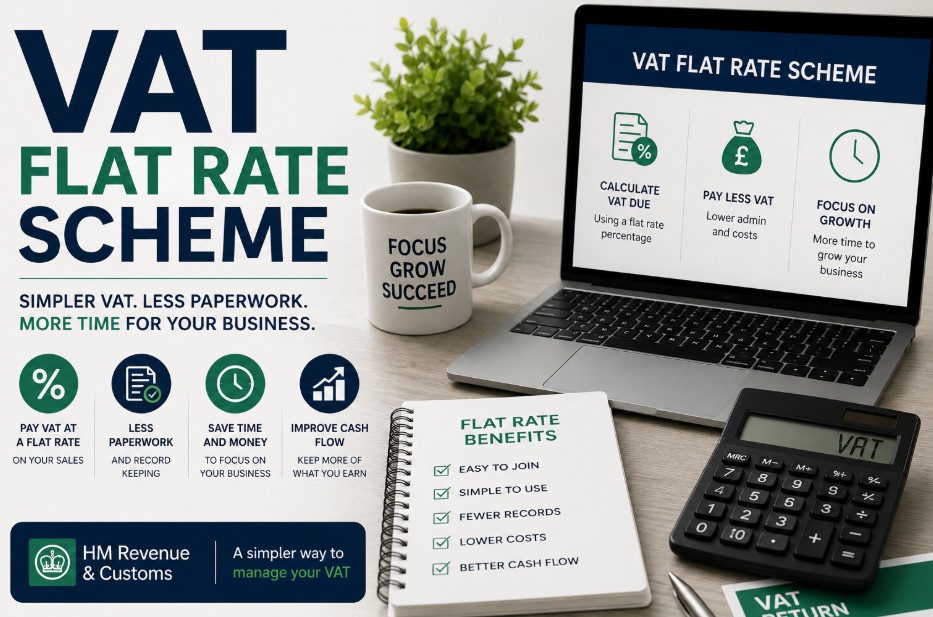
The VAT flat rate scheme is an optional incentive introduced by HM Revenue and Customs (HMRC) to simplify tax compliance for small enterprises. Instead of recording and offsetting every individual item of input tax on purchases, businesses pay a fixed, industry-specific percentage of their gross, VAT-inclusive turnover directly to HMRC while continuing to charge clients the standard 20% VAT rate.
According to HMRC guidelines, businesses using the Flat Rate Scheme are legally barred from reclaiming VAT on day-to-day operational costs, but they receive an automatic 1% discount on their sector rate during their first 12 months of VAT registration.
Key Takeaways
-
The entry threshold to register for the program requires your expected taxable turnover to be 150000 pounds or less over the next twelve months.
-
Businesses must legally leave the scheme if their total gross turnover including VAT exceeds the maximum statutory exit limit of 230000 pounds.
-
Service businesses spending under two percent of turnover on relevant goods are classified as limited cost traders and face a steep sixteen point five percent rate.
-
An introductory one percent discount applies automatically to your chosen industry sector rate during the first twelve months of your VAT registration.
What is the VAT Flat Rate Scheme?
The VAT Flat Rate Scheme is an optional HMRC scheme that simplifies tax accounting for small UK businesses. Instead of calculating the difference between sales VAT and purchase VAT, you pay a fixed, industry-specific percentage directly on your gross, VAT-inclusive turnover.
The UK VAT Flat Rate Scheme completely flips the traditional accounting framework on its head by decoupling your tax liabilities from actual supplier invoices.
Under standard VAT setups, you have to constantly crunch the difference between the tax you collect from clients (output tax) and the tax you pay to your suppliers (input tax), sending the remaining net balance to HMRC.
The core philosophy here is pure administrative simplicity. However, you need to weigh up the obvious trade-off: you are trading the pinpoint accuracy of line-by-line expense tracking for a swift, flat tax calculation based entirely on your gross income.
How Does the Flat Rate VAT Scheme Work?
The Flat Rate Scheme works by allowing a business to invoice clients using standard VAT rates (usually 20%), while paying HMRC back using a lower, fixed industry percentage. This percentage is applied directly to total gross, VAT-inclusive sales per quarter.
When utilizing this method, a company continues to issue invoices to customers showing the normal 20% standard rate.
However, when completing the quarterly return, the business does not calculate the actual input tax. Instead, it applies a single fixed percentage, determined by the specific business category, to the total gross sales figure.
A Practical Worked Example:
To see how the VAT system works under this methodology, consider a business that invoices a client for £1,000 plus £200 VAT, totaling a gross payment of £1,200.
If the assigned sector rate is 10%, the business pays £120 (10% of £1,200) to HMRC, legally retaining the remaining £80 as miscellaneous business income.
In practice, this process drastically cuts down on the operational hours required to track receipts, but it requires a business to forfeit its right to reclaim VAT on routine purchases.
The rules differ significantly from the standard regime, so if you are operating as an unincorporated business, it is worth exploring how to claim VAT back as a sole trader before committing to this simplification method.
What Are the VAT Flat Rate Scheme Eligibility and Turnover Limits?
To be eligible for the VAT Flat Rate Scheme, your projected VAT-taxable turnover must be £150,000 or less (excluding VAT) in the next 12 months. Once enrolled, you can remain in the scheme until your gross, VAT-inclusive turnover exceeds £230,000.
A business cannot simply adopt this method without verifying strict statutory boundaries. The fundamental criteria for VAT flat rate scheme eligibility rely entirely on your projected annual revenue.
The Threshold Landscape
According to the strict statutory criteria laid out by HMRC, the operational boundaries of the scheme hinge entirely on your projected annual revenue. The rules defining this threshold landscape remain firmly anchored to two key limits:
- The Entry Threshold (£150,000): This cap is calculated using your net taxable sales. Keep in mind that the mandatory UK VAT registration threshold itself sits at £90,000.
- The Exit Threshold (£230,000): This ceiling is calculated on your total gross revenue, which includes the VAT you collect from customers.
If your business experiences a sudden spike in sales that pushes your gross receipts over this £230,000 boundary, you must notify HMRC and prepare to transition back to standard reporting.
How long can you stay on flat rate VAT?
You can remain indefinitely, provided your annual gross sales stay below the upper limit, and you don’t operate associated or linked corporate entities.
What Are the Current HMRC VAT Flat Rate Scheme Percentages and Categories?
HMRC assigns specific VAT flat rate percentages based on commercial industry categories. These individual sector rates range from 4% up to 14.5% (excluding the 16.5% limited cost trader rate), reflecting the typical input tax expenses an industry sector would normally incur.
Statutory Rates by Industry Sector
The following structural table outlines common industry sectors and their official HMRC VAT flat rate scheme percentages:
| Business Sector Category | Flat Rate Percentage | First Year Discount Rate (1%) |
| Accountancy or Legal Services | 14.5% | 13.5% |
| Architectural, Engineering or Technical Committee | 14.5% | 13.5% |
| Computer and IT Consultancy | 14.5% | 13.5% |
| Estate Agency or Property Management | 12.0% | 11.0% |
| General Building or Construction Services | 9.5% | 8.5% |
| Hairdressing or Beauty Treatments | 13.0% | 12.0% |
| Management Consultancy | 14.0% | 13.0% |
| Retailing Food, Confectionery, Tobacco or Newspapers | 4.0% | 3.0% |
| Wholesaling Agricultural Goods | 6.5% | 5.5% |
The First-Year Registration Discount
When launching a new business venture, a major incentive is provided during initial setup. When completing your VAT registration flat rate scheme application, you are entitled to a 1% reduction on your sector’s percentage.
This introductory incentive runs for exactly 12 months from the date your VAT registration becomes active, rather than the date you join the flat rate program itself.
The VAT Agricultural Flat Rate Scheme
There are also highly specialized variations to consider, such as the VAT agricultural flat rate scheme. This operates under unique rules for farmers who wish to bypass conventional VAT registration entirely while still compensating themselves for tax incurred on farming inputs.
What is the Benefit of the VAT Flat Rate Scheme?
The primary benefits of the VAT Flat Rate Scheme are reduced bookkeeping administration, predictable quarterly cash flow forecasting, and potential tax savings if your actual business VAT expenses are low and your industry percentage tier is highly favorable.
The flat rate option provides significant administrative relief and structural incentives for micro-businesses:
-
Reduced Administrative Burden: You do not need to preserve and audit every single lunch receipt or utility invoice to validate input tax deductions, drastically simplifying your internal bookkeeping workflows.
-
Predictable Cash Flow: Applying a fixed percentage makes it far easier to forecast tax liabilities and manage working capital.
-
Potential Tax Windfalls: If your industry sector percentage is low and you have very few standard VAT expenses, the cash amount paid to HMRC can be less than the 20% collected, allowing your business to legally retain the difference as miscellaneous income.
-
Introductory Tax Discount: When completing your VAT registration application, you are entitled to an additional 1% reduction on your sector’s percentage for your first 12 months of VAT registration.
What are the Disadvantages of the VAT Flat Rate Scheme?
The main disadvantages of the VAT Flat Rate Scheme include the inability to reclaim VAT on day-to-day business expenses, the risk of paying higher tax if you trigger the 16.5% limited cost trader rule, and paying tax on zero-rated or exempt sales.
While the system saves time, it features severe structural financial drawbacks for certain business structures:
- Forfeiting Input Tax Reclaims: You lose the right to claim back the VAT you pay to suppliers for regular stock, equipment, and services.
- The Limited Cost Trader Penalty: Service-based digital or consulting companies with low physical overhead are forced onto an aggressive, high flat rate tier.
- Taxing Non-VATable Income: The flat rate percentage is applied to your entire gross turnover. This means if you generate exempt or zero-rated income, you end up paying a flat rate tax to HMRC on revenue that was originally tax-free.
Who Can and Cannot Use the VAT Flat Rate Scheme?
Any UK enterprise can use the scheme if it holds an active VAT enrollment, projects a turnover under £150,000, and does not operate an associated corporate entity.
If you are dealing with suppliers or linked entities and need to verify corporate status, you can learn how to find a company’s VAT registration number through official channels to ensure compliance before joining.
Who Can Use the Scheme?
A business can join the program if it is already VAT-registered (or registering for it) and meets strict statutory boundaries based on projected revenue:
-
Statutory Entry Boundary: You must have a reasonable expectation that your taxable turnover, excluding the VAT itself, will be £150,000 or less over the coming 12 months.
-
Statutory Exit Boundary: Once enrolled, you are permitted to remain inside the scheme until your total gross turnover (which includes the VAT charged to customers) surpasses £230,000.
Who Cannot Use the Scheme?
You are legally excluded from using the scheme if:
-
You use the Second-Hand Margin Scheme, Auctioneers’ Scheme, or Tour Operators’ Margin Scheme.
-
You are required to operate the Capital Goods Scheme for certain high-value items.
-
You operate an associated or linked corporate entity (if two or more companies are under common control or share close economic, financial, and organizational links).
-
Within the previous 12 months, you have formally left the scheme, been convicted of a VAT offence, or been assessed with a penalty for dishonesty.

When to Avoid the VAT Flat Rate Scheme?
Avoid the VAT Flat Rate Scheme if your business has high physical inventory costs, relies heavily on zero-rated or exempt sales, or falls under the 16.5% Limited Cost Trader criteria due to lack of physical overhead expenses.
While the scheme offers excellent time savings, it is highly detrimental to certain business models:
- High Physical Inventory Costs: If you run a retail shop or manufacturing business with significant inventory costs, standard accounting is almost always more profitable because your input tax credits will naturally lower your quarterly payment to HMRC.
- Zero-Rated or Exempt Sales: If your business makes a significant proportion of zero-rated sales (e.g., children’s clothes or certain food items), you still have to pay the flat rate percentage on that turnover, effectively creating a tax liability where none existed under standard VAT.
- Limited Cost Traders: A common pattern among modern digital businesses is the complete absence of physical infrastructure, which changes how much you owe completely (detailed below).
Note: The definition of relevant goods strictly excludes services like software subscriptions, accountancy fees, telephone bills, rent, office utilities, fuel, and capital assets like laptops.
What Is the VAT Flat Rate Scheme Limited Cost Trader Rule?
The Limited Cost Trader rule forces businesses spending less than 2% of their gross turnover (or under £250 a quarter) on relevant physical goods to pay a uniform 16.5% flat rate. This rule targets service businesses with minimal physical overhead.
To prevent service-based firms with virtually no overheads from receiving an unintended tax windfall, HMRC introduced the VAT flat rate scheme limited cost trader classification.
How the Rule Works?
HMRC evaluates your eligibility on a rolling, quarterly return basis using two strict conditions. You are deemed a Limited Cost Trader if:
-
Condition 1: Your spending on relevant physical goods is less than 2% of your gross VAT-inclusive turnover for that specific quarter.
-
Condition 2: Your spending on relevant physical goods is more than 2%, but total spending is less than £250 for the quarter (£1,000 annually).
If your business triggers either condition, your standard industry rate is completely ignored, and you are forced to pay the flat 16.5% tier for that return period.
What Counts as Relevant Goods?
The legal definition of relevant goods is deliberately narrow.
- It Strictly Excludes Services: Software subscriptions, digital advertising costs, accountancy fees, telephone bills, rent, office utilities, and professional legal services.
- It Excludes Key Transport & Equipment Assets: Vehicle fuel, car parts, and large capital assets such as laptops, mobile devices, or office furniture.
- What is Allowed: Raw physical manufacturing stock, stationery used exclusively for work, or physical brochures.
For instance, a remote digital marketing consultant spending £3,000 a year on software licenses but £0 on physical inventory is automatically pushed to the 16.5% tier.
VAT Flat Rate Scheme vs Standard VAT
The main difference between the VAT Flat Rate Scheme and Standard VAT is how expenses are treated. Standard VAT allows you to reclaim exact VAT on every business expense. Flat Rate FRS forbids expense reclaiming but applies a smaller overall tax payment percentage to your sales revenue.
Choosing between the VAT flat rate scheme vs standard VAT arrangements requires a direct analysis of your business model. The primary distinction centers on whether your business is driven by high physical product costs or low-overhead services.
| Comparison Feature | VAT Flat Rate Scheme (FRS) | Standard VAT Scheme |
| Calculation Base | Applied as a fixed % on gross sales turnover. | Calculated as Sales VAT minus Purchase VAT. |
| Bookkeeping Detail | Low; no tracking of day-to-day purchase receipts. | High; must record and prove VAT on all purchases. |
| Reclaiming VAT on Expenses | Forbidden (except single capital assets over £2,000). | Allowed on all valid business-related expenses. |
| Best For | Low-expense firms or those wanting low admin. | High-overhead firms, retail shops, or wholesalers. |
| Impact of Zero-Rated Sales | Disadvantageous; you pay flat tax on zero-rated sales. | Neutral/Advantageous; can trigger a tax refund. |
Capital Expenditure Exceptions
Under Flat Rate VAT rules, you can reclaim input VAT on capital expenditure purchases of £2,000 or more (including VAT), provided the assets are bought on a single invoice. This includes major equipment like servers, machinery, or company vehicles.
For example, if you buy a high-end production server costing £2,400 (£2,000 plus £400 VAT) on a single invoice, you can reclaim that £400 on your return, even while using the flat rate program. This exception does not apply to split invoices or mixtures of distinct goods and services.
How Do You Calculate and Account for Flat Rate VAT?
To calculate flat rate VAT, multiply your total quarterly gross, VAT-inclusive sales turnover by your assigned industry sector flat rate percentage. The final output value is what you owe to HMRC.
Step-by-Step Calculation Process
-
Calculate Net Sales: Find your total net sales across all invoices issued during the quarterly accounting period.
-
Determine Gross Turnover: Add the standard 20% VAT to those sales to determine your gross turnover figure.
-
Identify Sector Percentage: Identify your verified industry category percentage or apply the 16.5% limited cost trader rate if applicable.
-
Multiply: Multiply your total gross turnover by your specific flat rate percentage to find the tax due.
-
File Return: Record this final figure in Box 1 of your official VAT return submission. Box 6 must explicitly show your gross, VAT-inclusive turnover for the period (unlike standard VAT filings where Box 6 only captures net sales).
Worked Financial Scenarios
Consider a service-oriented consultancy vs. a traditional physical goods retailer, assuming both hit a £100,000 annual benchmark:
| Financial Performance Metric | Service Consultant (Limited Cost) | Retail Store (Standard FRS) |
| Net Business Turnover | £100,000 | £100,000 |
| VAT Charged to Customers (20%) | £20,000 | £20,000 |
| Gross Business Turnover | £120,000 | £120,000 |
| Assigned FRS Percentage | 16.5% (Limited Cost Trader) | 4.0% (Retail Category) |
| Total VAT Paid to HMRC | £19,800 | £4,800 |
| Remaining VAT Kept by Business | £200 | £15,200 |
Inside your ledgers, the difference between the 20% collected from clients and the flat rate paid to HMRC is simply treated as miscellaneous business income.

How to Apply for the VAT Flat Rate Scheme?
You can apply for the VAT Flat Rate Scheme online through your HMRC Government Gateway account or by submitting Form VAT600 by mail. New businesses can opt into the scheme during their initial VAT1 registration process.
Transitioning into the scheme requires following direct administrative steps via the HMRC online portal:
-
New Businesses: If you are launching a new enterprise, you can choose to register for VAT Flat Rate Scheme access at the same time you complete your initial VAT1 application form.
-
Existing Businesses: If your business is already trading under standard rules and you wish to change to the Flat Rate Scheme, you can submit an application via your secure HMRC Government Gateway account or by printing and mailing Form VAT600. The change will normally take effect from the start of your next scheduled VAT accounting period.
How to Leave the VAT Flat Rate Scheme?
To leave the VAT Flat Rate Scheme, you must formally notify HMRC via your online Gateway account or in writing. Opting out is mandatory if your rolling 12-month gross turnover hits the £230,000 limit.
If your circumstances shift or you cross the maximum threshold, leaving the scheme is a straightforward administrative task:
-
Voluntary Exit: You can voluntarily opt out at the end of any accounting period by writing to HMRC or notifying them through your Gateway portal.
-
Mandatory Exit: If a sudden revenue spike pushes your gross receipts past the £230,000 boundary in 12 months, you must notify HMRC and prepare to transition back to standard reporting.
-
The Rejoining Restriction: Before making this change, you must consider the statutory lock-out rule. Once you formally exit the program, statutory rules dictate that you are barred from rejoining it for a minimum period of 12 months. This prevents companies from cycling between schemes to manipulate seasonal tax liabilities.
Summary
The flat rate framework remains an excellent tool for small business owners seeking to minimize the time spent on complex quarterly bookkeeping.
If your firm sells physical products or enjoys a 1% first-year registration discount, the financial benefits can be significant.
However, modern digital service providers must watch out for the limited cost trader rule, as the 16.5% rate often makes standard VAT accounting the more cost-effective option.
Before changing your tax setup, download your financial data from the past 12 months and calculate your liability using both methods.
If your relevant physical goods expenses are consistently above the 2% threshold and your net turnover remains safely below £150,000, log in to your HMRC Government Gateway account or check HMRC VAT Customer Services for support to apply for the flat rate program.
FAQ
What are the exact statutory terms in VAT flat rate scheme legislation?
The statutory foundations governing the program are set out within the Value Added Tax Regulations 1995 under Part VIIA, which outlines the detailed legal mechanics of fixed rate turnover calculations.
Where can I find the official rules in VAT Notice 733 flat rate scheme?
The complete regulatory framework, including comprehensive sector listings and definitions, is detailed in the official government publication VAT Notice 733, which serves as the definitive reference manual for compliance.
What are flat rate benefits for micro-businesses?
The primary advantages include a significantly reduced administrative burden, simplified invoice auditing, improved cash flow predictability, and a 1% tax discount during your first year of VAT registration.
How does VAT Notice 733 flat rate scheme for small businesses define an excluded associated business?
VAT Notice 733 flat rate scheme for small businesses specifies that if two or more companies are under common control or share close economic, financial, and organizational links, they are excluded from joining.
Is there an official online VAT flat rate scheme calculator provided by the government?
No, HMRC does not provide a standalone interactive calculator tool, but they do outline clear manual mathematical formulas within their official documentation to help businesses estimate their quarterly liabilities.
Can a business reclaim VAT on services when joining the scheme?
No, you cannot reclaim input tax on services. When you join, you can only reclaim VAT on physical stock or capital goods held on your premises, subject to normal pre-registration lookback rules.
What happens if I make a mistake and choose the wrong industry category rate?
If you mistakenly apply an incorrect sector percentage in good faith, HMRC will normally require you to pay any underpaid tax from the date of the error without applying punitive penalties, provided the choice was reasonable.
Disclaimer: The information in this article is for educational purposes only and does not constitute formal tax or financial advice; always consult a certified accountant or HMRC guidelines before altering your business tax framework.