Compulsory Strike Off Meaning: Companies House Process, How to Stop it
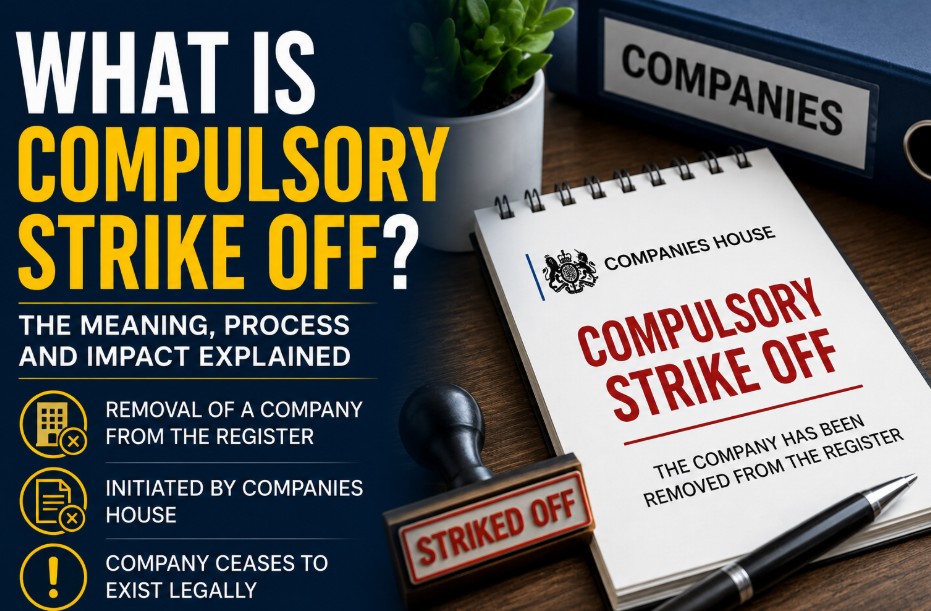
The compulsory strike off meaning refers to the forced removal of a limited company from the official UK register by the Registrar of Companies, effectively dissolving the business entity because of serious statutory non-compliance.
Once struck off, the company legally ceases to exist, making further commercial operations entirely unlawful.
A compulsory strike-off is not a shortcut to closing down a business with debts. Creditors can apply to restore the company to the register at any time, leaving directors personally exposed to investigations and financial liabilities.
What is the Compulsory Strike Off Meaning for a UK Company?
The meaning of a compulsory strike off on a company is that the Registrar of Companies has initiated legal enforcement to dissolve a business because they have reasonable cause to believe it is no longer actively trading or operating.
Under Section 1000 of the Companies Act 2006, the Registrar holds the statutory power to completely remove non-compliant businesses from the index of registered corporate structures.
Once this process concludes, the company ceases to exist as a legal entity. This structural change means the business can no longer lawfully trade, collect outstanding invoices, or utilize its corporate bank accounts.

Who Initiates the Compulsory Strike Off?
A compulsory strike off is initiated solely and exclusively by the Registrar of Companies at Companies House, acting as an automated regulatory enforcement mechanism against structural or filing irregularities.
It is not an action that company directors, shareholders, or standard third-party creditors can directly request or apply for.
When structural or filing irregularities are flagged within the government database, automated systems trigger an enforcement sequence.
While third-party creditors cannot initiate a compulsory closure, they frequently monitor the registry to see if Companies House has begun the process, allowing them to lodge formal objections to protect outstanding debts.
What is the Purpose of a Strike Off?
The primary purpose of a compulsory strike off is to maintain the integrity, precision, and public reliability of the corporate register in the United Kingdom by purging abandoned, defunct, or non-compliant shell businesses.
By removing abandoned, defunct, or persistently non-compliant shell businesses, Companies House ensures that the public database remains reliable for consumers, financial institutions, and government bodies.
In practice, thousands of dormant businesses that individuals originally chose to register a company in the UK for but never actually used are cleared from the system annually via this automated maintenance cycle.
Compulsory Strike Off vs Voluntary Strike Off
The main difference between a compulsory and voluntary strike off is the initiator; a compulsory strike off is forced by the Registrar due to non-compliance, whereas a voluntary strike off is an action chosen by directors using Form DS01 to close a solvent business.
It is essential to distinguish between compulsory and voluntary closures. The direct feature breakdown illustrates the operational differences:
| Feature | Compulsory Strike Off | Voluntary Strike Off |
| Initiator | Registrar of Companies (Companies House) | Company Directors/Shareholders |
| Primary Driver | Statutory non-compliance or suspected abandonment | Strategic business closure or retirement |
| Required Form | None (Automated regulatory enforcement) | Form DS01 (Submitted online or via post) |
| Associated Cost | No immediate fee, but high risk of penalties | Standard digital filing fee (£8) |
| Director Control | None; the timeline is dictated by the state | Full control over filing time and asset distribution |
| Debt Treatment | Cannot be used to legally erase business debts | Only allowed if the company has no debts |
Why Does Companies House Issue a Compulsory Strike Off Action?
Companies House issues a compulsory strike off action when specific statutory compliance failures signal to regulatory authorities that a corporate entity has been abandoned or is operating outside the law.
Main Triggers for a Compulsory Strike Off Notice
The most frequent triggers for a compulsory strike off notice are basic administrative neglect, primarily driven by a company failing to file its annual accounts or annual confirmation statements.
The overwhelming majority of compulsory enforcement actions stem from basic administrative neglect. The primary compliance failures include:
-
Failure to File Annual Accounts: Missing the statutory deadline to submit annual accounts to Companies House.
-
Failure to File Confirmation Statements: Failing to verify company management and structure details at least once every 12 months.
-
Lack of an Active Registered Office Address: If official regulatory correspondence is returned to sender because the physical office address is invalid or fake.
-
Lack of Active Directors: Operating without the legally mandated minimum of at least one natural person appointed as a director.
Secondary Triggers
Secondary triggers for forced dissolution include failing to respond to formal warning letters from the Registrar or failing to provide verified identity documentation for the register of People with Significant Control (PSC).
Beyond standard filing delays, secondary factors can prompt enforcement. If a business fails to respond to formal warning letters sent by the Registrar, the system automatically concludes that the entity is dead.
Furthermore, under modern financial crime prevention initiatives, if a company fails to provide verified identity documentation for its register of People with Significant Control (PSC), it can face rapid administrative termination to prevent the proliferation of unverified corporate vehicles.
What Happens During the Compulsory Strike Off Process?
The compulsory strike-off process moves a non-compliant company from active status to absolute legal extinction across four distinct structural phases: tracking, public notification, operational freezing, and final dissolution.
This strictly regimented legal sequence transitions a company from an active status to total legal extinction across four distinct phases:
- The Tracking Phase: The moment a filing deadline is missed, automated systems flag the account. The Registrar issues private warning letters to the registered office; if ignored, the company is presumed abandoned.
- The Public Notification Phase: Companies House publishes a First Gazette Notice, moving the matter into the public domain to alert creditors and financial institutions.
- The Operational Freeze: Triggered by the Gazette notice, high street banks and payment processors immediately freeze the corporate accounts, effectively paralyzing daily trading, payroll, and billing.
- The Dissolution Phase: If no valid objection or overdue filing is submitted within two months, the Final Gazette Notice is published. The corporate shield dissolves, and the company ceases to exist.
What is the Timeline and Process for a Compulsory Company Strike Off?
The statutory timeline for a compulsory company strike off takes approximately 4 to 5 months from the initial missed filing deadline to full corporate dissolution, operating on rigid legal windows.
The enforcement pathway is highly structured, operating on precise legal windows that leave little room for administrative error. Directors must understand how notices move from a warning to a permanent shutdown.
Notice for Compulsory Strike Off
Before any public declaration is made, Companies House is legally required to send warning communications to the company’s registered office address.
These letters inquire whether the business is still operational and warn that failure to rectify filing gaps will result in a forced dissolution. Ignoring these statutory notices accelerates the process toward public exposure.
First Gazette Compulsory Strike Off
The meaning of a First Gazette compulsory strike off notice is a formal, public declaration in the official journal of record stating that the company will be dissolved and struck off the register within two months unless cause is shown to the contrary.
If the initial warning letters receive no response, the Registrar publishes a formal notice in the Gazette (the official journal of public record in the UK). This notice alerts banks, creditors, and HMRC that the company is on the verge of termination, giving them the chance to step in.
What is the Time Limit for Strike Off?
The timeline from administrative failure to full corporate dissolution follows a rigid statutory progression, outlined in the table below:
| Phase | Procedural Step | Operational Impact |
| Day 1 | Filing Deadline Missed | Late filing penalties begin accruing against the company. |
| Day 14–30 | First and Second Warning Letters | Private statutory warnings sent to the registered office address. |
| Day 60 | Publication of First Gazette Notice | Public warning issued; automatic freezing of corporate bank accounts by lenders. |
| Days 60–120 | Two-Month Legal Objection Window | Period for directors to file documents or creditors to lodge objections. |
| Day 125+ | Publication of Final Gazette Notice | The company is officially dissolved; all remaining assets pass to the Crown. |

Final Gazette Dissolved via Compulsory Strike Off
The publication of the second notice brings the business to an absolute legal end. The final Gazette dissolved via compulsory strike off signifies that the company has been officially struck off the register and no longer exists.
Upon this declaration, the corporate veil changes dynamically, operational capacities cease entirely, and any residual property or capital held by the business is legally frozen.
Can a Limited Company Still Trade After a Compulsory Strike Off?
A limited company cannot lawfully trade after a compulsory strike off has concluded, as doing so constitutes a criminal offense and instantly shifts all business liabilities directly onto the individual directors.
Operating a business during or after a forced closure involves navigating strict legal boundaries, with severe consequences for unauthorized activity.
Can You Still Trade During the Strike Off Process?
Technically, while a first gazette notice for compulsory strike off is active, the company remains on the register and can perform necessary acts to rectify its position.
However, practical trading becomes nearly impossible. Once banks spot a Gazette notice, they typically freeze company bank accounts immediately to mitigate risk.
A common pattern observed across the commercial sector involves businesses being paralyzed mid-transaction, unable to fulfill orders or look up details to find a VAT registration number, because their merchant accounts and payment gateways are suspended overnight due to automated compliance alerts.
Trading After the Final Gazette Notice
Once a company is officially dissolved by compulsory strike off, all forms of business operations must cease immediately. Continuing to trade under the name of a dissolved company is an offence.
Because the corporate entity no longer exists, directors lose their limited liability protection. Any contracts signed, debts incurred, or business conducted post-dissolution are treated as the personal responsibilities of the individuals involved, exposing them to direct civil and criminal litigation.
What Are the Risks of a Compulsory Strike Off for Directors?
Many misinformed business owners assume that an administrative shutdown is a convenient way to walk away from an underperforming company. In reality, the fallout can impact a director’s personal life for years.
Loss of Business Assets to the Crown
When a business is dissolved, any assets remaining in its name, including bank balances, physical stock, vehicles, property, or intellectual property rights, become bona vacantia (ownerless goods).
By law, these items automatically pass to the Crown. Reclaiming frozen cash or property requires an expensive and time-consuming legal restoration process, during which the government holds full title to the assets.
Personal Liability, Debt Overspill, and Piercing the Corporate Veil
A compulsory strike off does not erase corporate liabilities or outstanding debts. Creditors, including HMRC, can apply to the court to have the company restored to the register for the sole purpose of chasing unpaid funds.
If evidence emerges that directors extracted cash or assets while ignoring their statutory responsibilities, liquidators can pierce the corporate veil, converting company debts into personal liabilities for the directors.
Director Disqualification Risks
As of 2026, the regulatory landscape is exceptionally hostile to non-compliant directors.
Under the Rating (Director Disqualification) Act and extended enforcement powers granted via the Economic Crime and Corporate Transparency Act, the Insolvency Service holds the authority to investigate the conduct of directors of dissolved companies.
If bad faith or deliberate neglect is discovered, the Insolvency Service holds the statutory power to disqualify directors from managing any UK company for up to 15 years, alongside imposing substantial fine regimes.
Are There Any Advantages of a Compulsory Strike Off?
From an objective corporate governance perspective, there are no structural advantages to a compulsory strike off for an active business owner. It damages corporate credit profiles, exposes management to personal liability, risks asset forfeiture, and invites regulatory scrutiny.
The only scenario where it occurs without negative impact is when a clean, asset-free, completely dormant company with zero creditors is left to lapse by mutual, passive omission.

How to Stop a Companies House Compulsory Strike Off?
If a business is still viable, immediate action must be taken to stop the automated dissolution process before the two-month window closes.
To save the entity, directors must act immediately upon the publication of the warning notice. The most direct method involves:
-
Filing Outstanding Documents: Electronically submitting all overdue annual accounts and confirmation statements via the Companies House online portal.
-
Paying Outstanding Penalties: Settling any accumulated late filing fees to restore the company to good standing.
-
Lodge a Formal E-Objection: If documents cannot be filed immediately due to extenuating circumstances, an official objection must be submitted online, supported by evidence (e.g., proof of active trading or ongoing restructuring), requesting a temporary stay of execution.
Why Would a Compulsory Strike Off Be Suspended or Discontinued?
When reviewing registry data patterns, you will frequently see notations such as compulsory strike off suspended or compulsory strike off discontinued on a corporate history file.
The process is suspended or discontinued under specific circumstances:
-
Creditor Objection: A bank, supplier, or HMRC formally objects because the company owes them money, preventing dissolution so they can pursue debt recovery.
-
Active Litigation: The business is involved in ongoing legal proceedings or employment tribunals.
-
Director Intervention: Management has shown proof that compliance documentation is being prepared, prompting Companies House to grant a temporary enforcement pause.
Can We Reopen a Struck-Off Company?
If a company has been completely dissolved but directors discover that vital assets or bank balances are trapped inside, the entity must be legally resurrected.
-
Administrative Restoration: This route is available only if the company was forced off the register via compulsory strike off, the directors are applying within six years of dissolution, and the business was actively trading up to the point of closure. All outstanding documents must be filed, penalties paid, and a Crown waiver obtained.
-
Court Restoration: If the company was not trading at the point of dissolution, or if a creditor wants to sue the entity to recover funds, an application must be made through the court system. This process is significantly more expensive, requiring formal legal representation and a judge’s order to re-establish the corporate entity.
Final Summary
Receiving an enforcement notice from Companies House is a critical compliance emergency that requires swift action. A compulsory strike off is not a tool for debt relief; it is an administrative process that can lead to asset forfeiture and personal liability for company directors.
If the company is still active, you must immediately log into Companies House digital services, file all outstanding statutory documents, and submit an electronic objection to halt the dissolution.
If the business is insolvent and burdened with unmanageable debt, you should avoid letting it lapse into a compulsory shutdown; instead, consult a licensed insolvency practitioner to explore proper, legal winding-up routes, such as a Creditors’ Voluntary Liquidation (CVL).
FAQ
Is a first Gazette notice bad?
Yes, it is a serious regulatory red flag. It publicly signals that your company is failing to meet basic legal requirements, which usually leads banks to freeze your accounts and suppliers to cancel credit terms immediately.
Who can apply for strike off?
Only company directors or a majority of shareholders can apply for a voluntary strike off using Form DS01. A compulsory strike off cannot be applied for; it is executed solely by Companies House as an enforcement action.
Is a compulsory strike off the same as company liquidation?
No. A strike off is an administrative removal from the register by Companies House, typically for filing failures. Liquidation is a formal legal process managed by a licensed insolvency practitioner to wind up a company’s financial affairs and distribute assets to creditors.
Can a company bounce back from a compulsory strike off?
Yes, provided you act within the two-month objection window after the First Gazette Notice. Filing all overdue accounts and confirmation statements will prompt Companies House to discontinue the action and restore active status.
What happens to company debt during a compulsory strike off?
The debt does not disappear. Creditors can object to the strike off to keep the company open, or apply to court to restore a dissolved company, allowing them to pursue liquidations and hold directors personally liable for unpaid balances.
How long does the entire compulsory strike off process take?
The entire sequence typically takes between 4 to 5 months from the initial missed filing deadline to final dissolution, with a strict 2-month public notice window occurring between the First and Final Gazette publications.
Why would a compulsory strike off be discontinued?
It is discontinued if the company files its overdue returns, pays its penalties, or if a creditor objects because there are outstanding debts or active lawsuits that must be settled before the company can be legally dissolved.