Do I Qualify for Small Business Rate Relief? (2026/27 Guide for UK Owners)
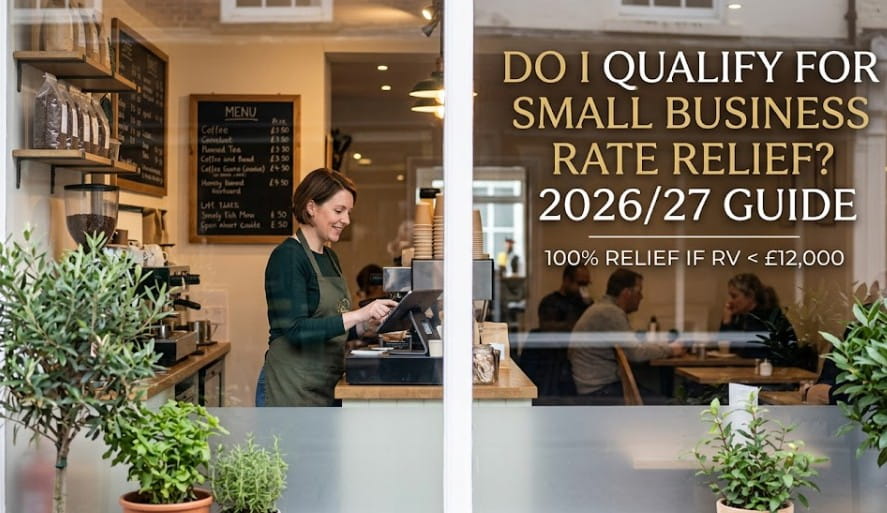
Do I Qualify for Small Business Rate Relief? You qualify for 100% Small Business Rate Relief in England for the 2026/27 tax year if your property’s rateable value is £12,000 or less. For properties valued between £12,001 and £15,000, your relief is tapered (graduated) from 100% down to 0%. To be eligible, the property must be your main place of business and be actively occupied.
What is Small Business Rate Relief?
Small Business Rate Relief (SBRR) is a UK government discount scheme that reduces or eliminates business rates for firms occupying lower-value properties. In England, it provides a 100% tax exemption for properties with a rateable value of £12,000 or less, effectively removing the business rate liability for thousands of small retailers, offices, and workshops.
How does Small Business Rate Relief work in 2026?
The relief works by applying a percentage discount directly to your business rates bill based on your property’s Rateable Value (RV). If your RV is £12,000 or below, you pay nothing.
For values between £12,001 and £15,000, the discount tapers down from 100% to 0%. It is a permanent relief intended to help small enterprises remain competitive by lowering fixed property costs.
Do I qualify for small business rate relief in 2026?
To determine do i qualify for small business rate relief, you must first check if your property’s rateable value is below the £15,000 threshold and ensure it is your primary business location. Current 2026 rules mean you won’t pay a penny in business rates if your rateable value is £12,000 or less.
For shops and offices valued between £12,001 and £15,000, the government applies a sliding scale, meaning your discount gradually decreases until you hit the £15,000 limit.

What are the eligibility criteria for Small Business Rate Relief 2026?
The core requirement for Small Business Rate Relief (SBRR) is the Rateable Value (RV) assigned to your premises by the Valuation Office Agency (VOA).
To qualify in 2026, you must meet these three conditions:
-
Single Property: You generally only use one property (exceptions apply for small secondary units).
-
Value Threshold: Your property’s RV is less than £15,000.
-
Active Occupation: The property must be in use; empty properties do not qualify for SBRR.
The government’s 2026 guidelines state that a property must be in active commercial use to qualify for SBRR. Most home-based businesses, like a small clothing brand or a fashion startup, will typically pay Council Tax rather than business rates.
However, if you have a dedicated space (like a converted garage or a separate studio) that has been specifically valued for business rates, you can often claim 100% SBRR on that portion.
Because the Rateable Value of a home workspace is almost always below the £12,000 threshold, you can effectively run your commercial space tax-free while continuing to pay Council Tax on the residential part of your home.
Can I get rate relief on a second property?
Yes, but only under specific conditions. While the scheme is designed for those using one main property, you can still qualify if you expand into additional units, provided the RV of each secondary property stays below £2,899, and the total combined value remains under £20,000 (£28,000 in Greater London).
What is the grace period for SBRR when expanding?
The 2025 Autumn Budget introduced a significant extension to the Small Business Rate Relief grace period. Previously, if you took on a second property, you only kept the relief on your first property for 12 months.
As of 2026, you can keep the relief on your main property for three full years after moving into a second unit (provided you moved in on or after 27 November 2025). This safety net allows small firms, such as a growing boutique or a local café, to test a new location without an immediate tax hike.

Strategic Expansion for Small Firms
This three-year safety net allows businesses to scale without an immediate tax hike.
Many growing retailers use this 36-month window to test a second location’s viability before the full business-rate liability kicks in.
Take a local bakery with a rateable value of £10,000 that decides to open a second prep kitchen in March 2026. Under the 36-month extension, they can now keep their original tax-free status on the first shop for three full years while they get the new site up and running.
Regional Variations in Small Business Rate Relief
Business rates are devolved, meaning the UK rules vary by nation:
-
Wales: 100% relief applies up to an RV of £6,000, with a taper up to £12,000.
-
Scotland: Known as the Small Business Bonus Scheme, 100% relief is available for properties with a combined RV of £12,000 or less.
-
Northern Ireland: Small Business Rate Relief is tiered based on RV thresholds of £5,000, £10,000, and £15,000.
2026 Business Rates Thresholds & Costs
The biggest sticking point for most owners isn’t just the value of the building, but the occupancy rule.
For example, a boutique shop owner in a high street location will lose their relief if they move out and leave the unit vacant, as empty property relief is a separate, time-limited scheme.
| Property Rateable Value (2026) | Relief Type | Actual Cost Impact |
| Up to £12,000 | 100% Relief | £0 Business Rates |
| £12,001 to £15,000 | Tapered Relief | Sliding scale discount |
| £15,001 to £51,000 | Small Business Multiplier | 43.2p (Non-RHL) / 38.2p (RHL) |
| Over £51,000 | Standard Multiplier | 48.0p / 43.0p |
How much do you actually pay?
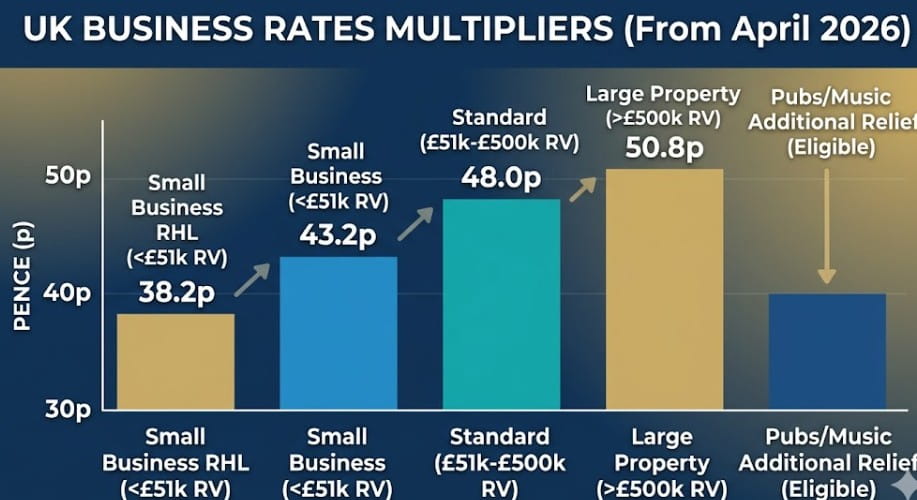
Even if you do not qualify for the 100% relief, you may still benefit from the Small Business Multiplier. From 1 April 2026, your bill is calculated by multiplying your Rateable Value by the Multiplier.
If you run a small office with an RV of £20,000, your bill is calculated using the 43.2p multiplier. However, if you don’t receive Transitional Relief, a 1p supplement usually applies.
£20,000*0.442 (Working Multiplier) = £8,840 per year.
-
Small Business RHL Multiplier: 38.2p (For Retail, Hospitality, and Leisure under £51k RV).
-
Small Business Multiplier: 43.2p (For all other sectors under £51k RV).
-
Standard Multiplier: 48.0p (For properties between £51k and £500k).
-
Large Property Multiplier: 50.8p (For properties over £500k RV).
In 2026, a 1p Transitional Supplement may be added to bills for those businesses not receiving Transitional Relief to fund the wider support scheme. For everyone else, it effectively means the working multiplier is 1p higher than the base rate.
Why the 2026 Revaluation Matters?
The VOA revalues properties every three years to reflect the current rental market. The 2026 revaluation is based on market values from 1 April 2024.
If your property value jumped significantly, the Supporting Small Business (SSB26) scheme ensures your bill increase is capped at the higher of £800 or 5% per year.
How do I apply for small business rate relief?
Once you confirm that you qualify for small business rate relief, you must apply through your local council; it is rarely automatic for new businesses.
- Locate your Bill: Find your non-domestic rates account number.
- Verify RV: Confirm your value is under £15,000 via the VOA website.
- Complete the Form: Fill out the SBRR application on your local council’s website.
- Confirm Multi-Property Status: Declare any other business properties you occupy in the UK.
- Submit Evidence: Some councils may require a lease agreement or proof of occupation.
- Await Updated Bill: The council will issue a revised demand showing zero or the reduced amount.
- Ongoing Compliance: You do not need to reapply every year, but you must notify the council if your property value changes or if you lease additional space.
While waiting for your relief to be processed, you should ensure your storefront is equipped with the latest hardware; checking the top card readers for small businesses can help you manage cash flow during the transition.
Summary of 2026 Relief Measures
The 2026/27 tax year offers a robust safety net for UK small businesses. Between the 100% relief thresholds and the new 38.2p multiplier for high-street shops, the 2026 system is designed to stop smaller firms from facing unmanageable bill hikes.
-
36-Month Grace Period for expanding businesses.
-
SSB26 Caps to prevent bill hikes above £800 or 5%.
-
Special 15% Relief for pubs and music venues meeting public access criteria.
Your next step should be to verify your 2026 valuation on the VOA portal and contact your local council to ensure all eligible discounts are applied to your April statement.
People Also Ask about Do I qualify for small business rate relief
Does small business rate relief apply to empty properties?
No. You must actively occupy the premises to qualify. If the property becomes empty, you may be eligible for a three-month empty property exemption, but the small business discount will cease.
Can I backdate my claim for relief?
Yes. You can generally backdate a claim to the start of the current rating list (1 April 2026). In some circumstances, you can go back further if you can prove eligibility for previous years.
What is the maximum turnover for a small business?
For business rates, turnover is irrelevant. Eligibility is based solely on the Rateable Value of your property and the number of properties you occupy, not your annual revenue or profit.
Do I have to apply for small business rate relief every year?
No. Once granted, the relief usually stays on your account. However, you are legally required to report any change in circumstances, such as taking on a second property or an increase in your property’s value.
Is there a special rule for pubs and music venues?
Yes. From April 2026, eligible pubs and live music venues will receive an additional 15% relief on top of existing support, provided they meet specific public access criteria.
How do I apply for relief in Birmingham?
You should visit the Birmingham City Council business rates page and use their specific SBRR online application form. You will need your 10-digit account reference number.
What if I have two properties?
You can keep your relief if the second property has an RV of less than £2,899 and your total combined RV is under £20,000 (£28,000 in London).