What Is a DUNS Number? A Complete Guide for UK Small Businesses
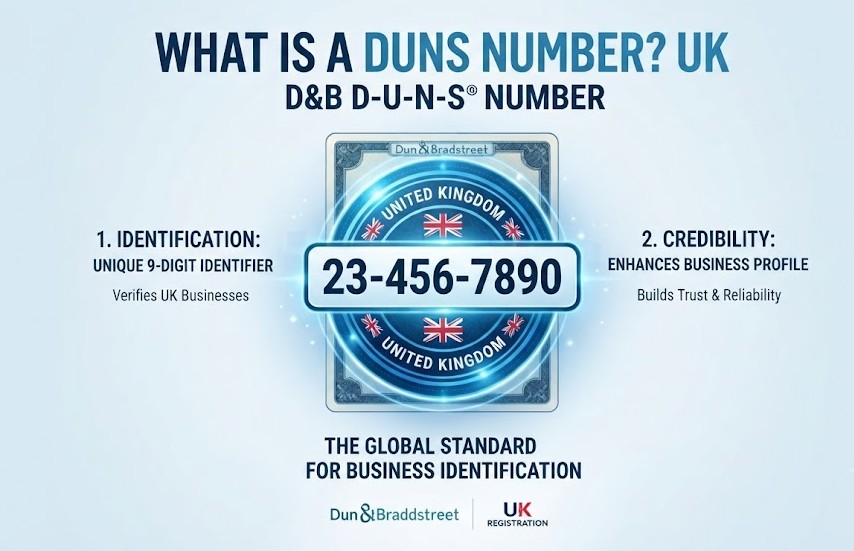
A DUNS number (Data Universal Numbering System number) is a unique nine-digit numeric identifier issued and managed by Dun and Bradstreet that verifies commercial entities globally on a location-specific basis.
It acts as a standardized digital corporate fingerprint, linking individual business premises to a live commercial credit file containing payment histories, legal structures, and corporate family trees.
Key Takeaways
-
A DUNS number is a nine-digit commercial identifier issued by Dun and Bradstreet for global business verification.
-
Standard processing to obtain a new DUNS number is completely free and takes up to thirty business days.
-
Registered UK companies are often assigned a DUNS code automatically through credit bureau data sharing.
-
International software developer platforms and cross-border supply chains frequently require active DUNS verification.
What Is a DUNS Number for a Company?
For a registered corporate entity, a DUNS number functions as an independent commercial identity record that operates alongside official government registries.
While a UK Company Registration Number legally incorporates an enterprise, a DUNS profile captures operational credit health, parent-subsidiary hierarchies, and active trading status within international commercial databases.
When international partners or software platforms evaluate a registered company, they rely on this identifier to confirm that the business is financially stable and actively trading.
Unverified or missing records can stall partnership agreements or trigger automated compliance flags during corporate onboarding procedures.
The Digital Footprint of Modern Trade
Commercial verification requires transparency beyond simple legal incorporation. A Dun and Bradstreet profile translates corporate longevity, payment timeliness, and structural ownership into a universally readable format that lenders, platforms, and procurement officers can evaluate instantly without manual document reviews.
What Is a DUNS Number Used For and Why Is It Important?
UK small business owners require a DUNS number primarily to clear mandatory international vendor onboarding checks, secure software developer accounts, and establish immediate global creditworthiness.
Major global technology ecosystems, such as the Apple Developer Program, require a verified DUNS profile before a small business can publish commercial apps.
Furthermore, international supply chains rely on D&B credit files to evaluate payment reliability and set secure trade credit limits.
| Identifier Type | Issuing Authority | Primary Function | Small Business Relevance |
| DUNS Number | Dun and Bradstreet | Global commercial credit and identity verification | Essential for international developer accounts and cross-border trade. |
| Companies House CRN | UK Government | Legal corporate incorporation in the United Kingdom | Mandatory legal foundation for all limited companies and LLPs. |
| HMRC VAT Number | HM Revenue and Customs | Statutory tax registration and collection | Required for tax-compliant invoicing and VAT returns. |
Maintaining an active DUNS record ensures that corporate credit scores, payment behaviours, and company structure updates remain accurate across global financial networks.
Inaccurate or outdated records within the Dun and Bradstreet database can trigger automated rejections during supplier onboarding or software developer verification, making periodic profile audits an essential administrative safeguard for growing enterprises.
What Is a DUNS Registration Used For?
DUNS registration is utilized by enterprise procurement teams and public sector bodies to authenticate a supplier’s legal legitimacy and financial stability before awarding contracts.
Unlocking cross-border trade agreements often depends on maintaining an active, updated registration profile within the global data cloud, assuring prospective partners that the business is solvent and verified.
In practice, when reviewing vendor applications, enterprise procurement managers inspect the D&B profile to confirm that the trading address matches official registry filings and that no active insolvency flags or severe commercial disputes taint the corporate credit file.
This registration serves as a universal passport for small businesses entering foreign markets where local company registries are difficult to cross-reference independently.
Why Do UK Small Businesses Need a DUNS Number?
A DUNS number is essential for UK small businesses to clear international vendor onboarding checks, unlock global supply chains, and satisfy mandatory corporate verification rules for software developer accounts like the Apple App Store.
For small business owners, operating locally is often just the starting point. When scaling or engaging with the digital economy, a DUNS number becomes a vital operational asset:
-
Global Software & Developer Access: Major platforms, such as the Apple Developer Program or Google enterprise tools, mandate a verified DUNS profile to authenticate corporate identity before approving commercial developer accounts.
-
International Vendor Onboarding: When bidding for overseas contracts or supplying multinational corporations, procurement teams require a D&B credit file to instantly verify that your small business is solvent, legitimate, and actively trading.
-
Establishing Cross-Border Creditworthiness: Because foreign partners cannot easily cross-reference local UK registries, a DUNS profile acts as an internationally recognized trust signal, smoothing out credit checks and trade terms.

What are the Eligibility and registration requirements for UK small business owners?
UK small business owners, including registered limited companies, LLPs, and sole traders, are eligible for a DUNS number by providing baseline identity records, trading addresses, and basic operational metrics like employee headcount.
- Business Structures: Registered limited companies, limited liability partnerships (LLPs), and sole traders or unincorporated partnerships are all eligible to obtain a DUNS number.
- Core Documentation Required: To successfully register or claim a profile, small business owners must supply accurate baseline data, including:
- Official legal business name and any active trading names.
- Registered office address or primary physical trading location.
- Official government identifiers (such as a UK Company Registration Number).
- Operational metrics, including the total number of full-time employees and official business commencement date.
How does a DUNS number differ from a UK Company Registration Number (CRN)?
A UK Company Registration Number (CRN) legally incorporates an enterprise via Companies House, whereas a DUNS number is a private commercial credit identifier issued by Dun and Bradstreet for global risk and identity tracking.
| Feature | DUNS Number | UK Company Registration Number (CRN) |
| Issuing Body | Dun and Bradstreet (a private commercial credit bureau) | Companies House (UK Government agency) |
| Core Purpose | Tracks global commercial credit health, payment behaviors, and parent-subsidiary hierarchies | Legally incorporates and establishes an enterprise as a recognized business entity in the UK |
| Primary Small Business Use | Clearing international vendor vetting, software portal enrollments, and global credit checks | Fulfilling mandatory statutory UK corporate existence, filing annual accounts, and tax compliance |
Is a DUNS Number the Same as a VAT Number?
No, A DUNS number is not the same as a VAT number; a DUNS code is a private commercial credit identifier, whereas a VAT number is a statutory tax registration issued by HMRC.
Small business owners must use their VAT number exclusively for tax returns, invoicing, and tax compliance, while the DUNS number is reserved for commercial credit tracking, vendor vetting, and global software platform enrolment.
Conflating these two numbers during administrative setups typically results in application rejections. Tax authorities manage VAT compliance strictly for revenue collection, whereas private credit bureaus manage DUNS profiles to evaluate commercial risk and business legitimacy.
How Do I Find My DUNS Number?
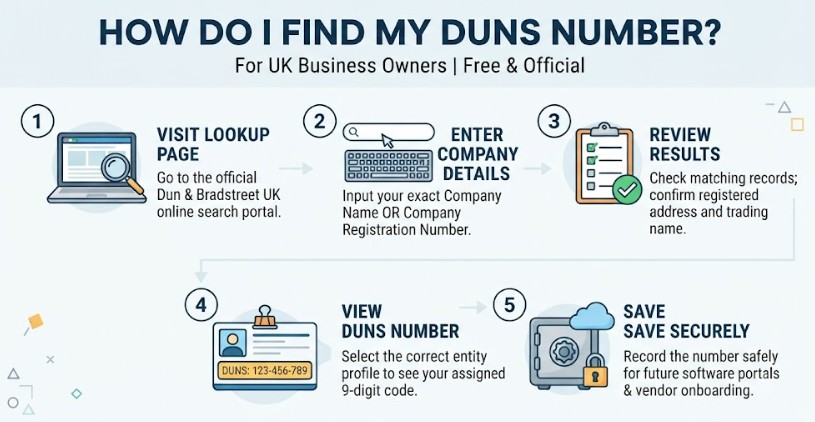
UK business owners can locate an existing DUNS number free of charge by using the official online search portal provided by Dun and Bradstreet.
Because data-sharing agreements link official company registries with credit reference agencies, many established UK enterprises already possess an allocated code without having directly requested one.
-
Navigate to the official Dun and Bradstreet UK lookup page using a standard web browser.
-
Input the official company name or exact Company Registration Number issued by Companies House.
-
Review matching corporate records, ensuring the registered office address and trading name align perfectly.
-
Select the matching corporate entity profile to view the assigned nine-digit code and associated live business identity file.
-
Save the generated code securely for upcoming software portal or vendor onboarding submissions.
How to Register for a DUNS Number?
To register for a DUNS number, small business owners can access the official Dun and Bradstreet portal, submit their company formation metrics and trading address, and choose between free standard processing or expedited paid delivery.
If a quick online lookup reveals that your small business does not yet have an active or visible code, you can request one directly:
-
Access the Portal: Navigate to the official Dun and Bradstreet request portal for your region.
-
Submit Entity Details: Input your exact legal structure, trading address, and contact information.
-
Declare Operating Metrics: Provide employee counts and formation history to help D&B map your corporate file.
-
Choose Processing Speed: Opt for the standard free track (up to thirty business days) or select an expedited paid option if you are under strict timelines for a software release or contract submission.
How much does it cost to have a DUNS number?
Obtaining a standard DUNS number for a UK small business is completely free of charge through Dun and Bradstreet, though optional paid expedited tiers are available for urgent commercial verification timelines.
-
Standard Cost: Obtaining a standard DUNS number for your small business is completely free of charge. For registered companies in the UK and Ireland, a code is frequently generated automatically through data-sharing agreements with official registries.
-
Avoid Phishing Scams: Beware of third-party emails or unsolicited estimates charging renewal fees. DUNS numbers do not expire, and Dun and Bradstreet will never charge a mandatory subscription fee simply to issue or maintain a standard active number.
-
Optional Paid Tiers: While standard electronic processing is free (taking up to thirty business days), small business owners facing tight software launch deadlines can choose an expedited paid service for a faster turnaround.
Is There a Downside to Having a DUNS Number?
While a DUNS number is essential for global trade, maintaining the record requires ongoing administrative vigilance regarding data accuracy and credit profile monitoring.
Outdated address details, unpaid trade credit, or unresolved commercial disputes reported in a D&B file can inadvertently delay supplier onboarding or lower a small business’s perceived credit score with prospective global partners.
Furthermore, because Dun and Bradstreet operates as a private commercial entity, updating company data or correcting erroneous credit file entries occasionally requires navigating administrative customer service channels.
Business owners must routinely audit their commercial credit reports to ensure that closed business accounts or old trading addresses do not trigger automated compliance failures.
How to Manage and Maintain Your DUNS Record?
Small businesses can manage and maintain their DUNS record by conducting periodic credit file audits, keeping corporate addresses aligned with daily operations, and immediately resolving any reported commercial payment disputes.
-
Conduct Periodic Audits: Routinely review your commercial credit file to ensure that active trade lines, correct trading addresses, and director details remain up to date. Outdated data can trigger automated rejections during software partner onboarding.
-
Keep Contact Information Aligned: Ensure that the phone numbers and addresses listed on your D&B profile match your day-to-day operations to prevent communication delays or verification errors.
-
Resolve Disputes Promptly: If incorrect payment defaults or erroneous credit flags appear on your file, utilize D&B customer service channels immediately to correct the record and protect your enterprise’s global credit standing.
Conclusion
Securing and verifying a DUNS number is a foundational administrative step for UK small businesses expanding into international markets or digital platforms.
Business owners should begin by checking existing company records via the free D&B lookup tool before submitting a new application.
Regularly auditing commercial credit profiles ensures seamless vendor onboarding and prevents unnecessary operational bottlenecks as the enterprise scales globally.
Disclaimer: This guide is for informational purposes only and does not constitute formal legal or financial advice; verify all registration requirements directly with official sources.
FAQs
Is a DUNS number free?
Yes, obtaining a standard DUNS number through Dun and Bradstreet is free of charge, though paid expedited processing tiers are available for urgent applications.
Do UK companies have a DUNS number?
Yes, registered UK companies are frequently allocated a DUNS number automatically upon formation, though business owners must look it up or request activation for active commercial use.
How long does it take to get a DUNS number?
Standard electronic processing typically takes up to thirty business days, whereas expedited registration services can reduce the turnaround window to five business days or less.
Is DUNS number the same as Companies House registration?
No, a Companies House registration number legally incorporates your business in the UK, while a DUNS number is an independent global commercial credit and identity metric.
What is a DUNS number used for by developers?
Software developers require a DUNS number to verify corporate identity when setting up commercial developer accounts on major distribution platforms like the Apple App Store.
Can sole traders get a DUNS number?
Yes, sole traders and unincorporated partnerships can obtain a DUNS number by submitting alternative identity and trading verification documents directly to Dun and Bradstreet.
Is a DUNS number required for UK government contracts?
While UK public procurement relies primarily on Crown Commercial Service frameworks and Companies House data, international tenders often mandate an active DUNS profile.