Ping Pong Restaurant Closures UK: Everything You Need to Know in 2026
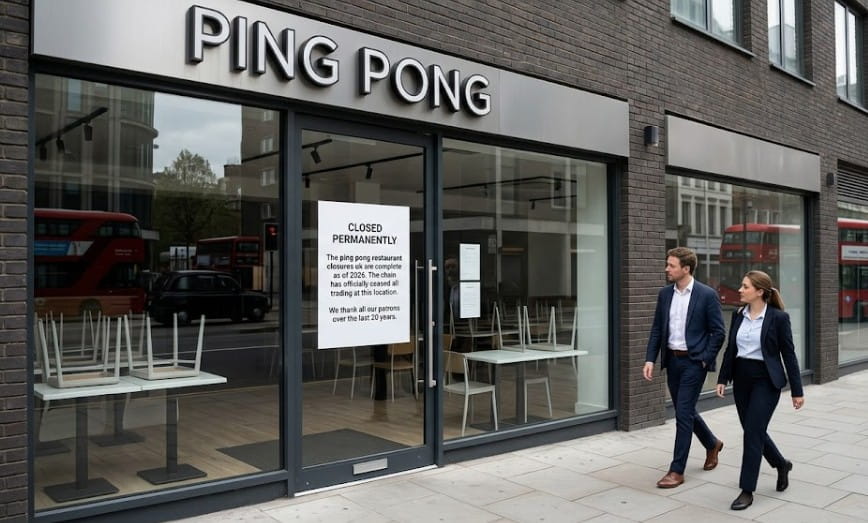
As of 2026, the Ping Pong restaurant closures in the UK are complete, following the brand’s official exit from the hospitality market in July 2025. The final four London locations, Soho, Southbank, Bow Bells House, and St Christopher’s Place, ceased operations after twenty years of trading.
The parent company, AJT Dimsum Ltd, entered administration due to a combination of legacy pandemic debts and legislative shifts regarding service charges.
Are Ping Pong Restaurants Still Open in 2026?
No, the Ping Pong restaurant closures in the UK are now 100% complete. Following the brand’s official exit in July 2025, all physical locations, including Soho, Southbank, Bow Bells House, and St Christopher’s Place, have ceased operations.
As of 2026, the parent company, AJT Dimsum Ltd, has finished the liquidation process, marking the end of the brand’s 20-year run in the UK hospitality market.
Why did the ping pong restaurant closures UK happen?
The primary reason for the Ping Pong restaurant closures was a combination of legacy pandemic debt and the 2024 Employment (Allocation of Tips) Act.
While the chain survived a 2022 pre-pack administration, it could not withstand the 2024 legislative shift that made its 15% Brand Charge model legally untenable.
This model, used to offset administrative and labor costs, was rejected by the public, demanding pricing transparency.
When the brand could no longer retain these fees to subsidize rising operational costs, parent company AJT Dimsum Ltd moved into voluntary liquidation.
The seeds of the 2025 collapse were actually sown during the 2022 administration. While a pre-pack management buyout initially saved nine locations, the new operators struggled to navigate a new normal defined by astronomical central London rents and a growing public demand for pricing transparency.
Former customers often cite the shift from the original affordable luxury feel to an opaque pricing structure as a key reason for the drop in footfall during the final eighteen months.
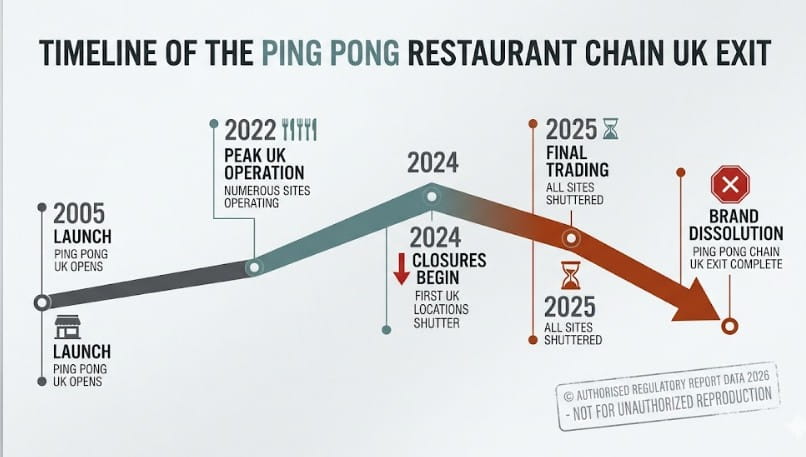
Timeline of the Ping Pong Restaurant Chain UK Exit
The dissolution of Ping Pong wasn’t an overnight failure but a three-stage contraction: from a high-street staple to a restructured survivor, and finally, a casualty of legislative change.
| Year | Milestone | Status of Locations |
| 2005 | Brand Launch | The first site opened in London by Kurt Zdesar. |
| 2022 | Pre-pack Administration | 9 sites saved; sold to AJT Dimsum Ltd for £3.21m. |
| 2024 | 15% Brand Charge Trial | Implemented to replace traditional 12.5% service fees. |
| 2025 | Final Closure | All remaining sites in Soho and Southbank have shuttered. |
| 2026 | Brand Dissolution | Official liquidation and site repurposing are complete. |
Is Ping Pong Available via Delivery in 2026?
No, Ping Pong is not available on Deliveroo, Uber Eats, or Just Eat in 2026. Following the total cessation of trade, the brand’s Dark Kitchen (Ghost Kitchen) network and central production facilities were also shuttered.
While Ping Pong previously experimented with frozen at-home ranges, these retail partnerships have largely dissolved. Former patrons should be wary of third-party sites still listing the menu; these are archival pages and do not represent active delivery services.
Ping Pong vs. Yauatcha and Din Tai Fung
The 2026 market shows a clear survival of the fittest in the dim sum sector. While Ping Pong’s Middle Ground model failed, premium competitors have thrived by leaning into luxury and technical excellence.
-
Yauatcha: Survived by maintaining its Michelin-level Affordable Luxury status, justifying high prices through superior ingredient quality and high-end Soho/City aesthetics.
-
Din Tai Fung: Flourished via global brand recognition and a focus on Show Kitchen transparency. By turning dumpling-making into a performance, they justified the premium price points that Ping Pong’s High-Street Generic model could not.
-
The Verdict: In 2026, the UK hospitality market will be split. Diners now choose either budget-friendly street food or high-end experiential dining (Tattu, Dim Sum Library). Ping Pong, stuck in the middle with rising costs and opaque fees, lost its place in the market.
What Happened to the Former Locations?
For those seeking information on the ping pong restaurant closures UK or searching for a Ping Pong restaurant Near Me, the current landscape has shifted entirely.
While locations in Westfield Stratford and Covent Garden closed earlier in the timeline, the 2025 shutdown marked the total UK exit.
Following the final ping pong restaurant closures UK, the iconic Southbank site has been repurposed into a multi-vendor food hall, reflecting the 2026 trend toward competitive socialising over traditional sit-down dining.
Former Site Status in 2026
-
Soho (Marlborough Street): Now occupied by an independent high-end cocktail and dim sum boutique.
-
Southbank: Integrated into a larger riverside hospitality development.
-
St Christopher’s Place: Repurposed into a retail-led experiential space.
-
Manchester: While Manchester was often cited in expansion plans, the brand remained largely London-centric. No physical locations currently exist outside the capital.
When we look at the ping-pong restaurant footprint today, the Ping Pong City and Ping Pong Cafe concepts have also been retired. The digital presence and Ping Pong Review portals are largely archival, serving as a reminder of the brand’s 20-year run.
Why Are UK Restaurants Closing Right Now?
The collapse of Ping Pong is symptomatic of the Casual Dining Crunch of 2025-2026. The high-street Middle Ground establishments that are neither budget fast-food nor high-end luxury have become financially unsustainable due to three factors:
-
Utility Inflation: Energy costs for commercial kitchens remain 40% higher than 2021 levels.
-
Wage Pressures: Successive increases in the National Living Wage have squeezed margins.
-
The Transparency Deficit: Modern diners are wary of hidden fees, leading many to check small business tax thresholds and pricing models before booking.
In 2024 and 2025, several major UK chains announced significant reductions in their portfolios. For instance, much like the UK toy chain Entertainer closure trends seen in the retail sector, the PAPAS Group and other mid-market operators announced a combined total of over 46 restaurant closures within a single quarter, citing the triple threat of utility inflation, increased minimum wage, and reduced consumer spending power.
With margins tightening, many entrepreneurs are revisiting small business tax thresholds to understand exactly when their liability begins in this volatile climate.
A common pattern is the collapse of the Middle Ground. Establishments that are neither high-end luxury nor budget fast-food struggle to justify their price points to a public squeezed by the cost-of-living crisis.
This is often compared to the 2019 collapse of Jamie Oliver’s Italian empire; both brands relied on high-volume, high-rent locations that offered little margin for error when operational costs spiked.
Why the Financial Model Failed?
To understand why Ping Pong failed, one must look at the standard financial benchmark for the hospitality industry: the 30/30/30 rule.
-
30% Food Costs: The cost of raw ingredients and beverages.
-
30% Labour Costs: Including salaries, pension contributions, and National Insurance.
-
30% Overheads: Rent, utilities, and marketing. To maintain these margins, many owners must also account for complex Business Taxes For Small Business in the UK.
-
10% Profit Margin: The remaining bottom line for the owner.
By early 2026, many mid-market operators found that their combined labour and overhead expenses were climbing toward 40% each. This shift effectively wiped out the thin margins that previously kept high-street dim sum viable.

What the Fall of Ping Pong Teaches the High Street?
The brand’s attempt to pivot to the AJT Dimsum identity and bypass traditional tipping via fees serves as a cautionary tale. Once a brand loses its reputation for honest, all-in pricing, recovering market authority is nearly impossible.
This lack of clear brand direction, coupled with the Brand Charge backlash, serves as a cautionary tale for small business owners regarding transparency.
When a restaurant attempts to bypass traditional tipping via administrative fees, it risks the same fate as Jamie Oliver’s Italian. In both cases, the brands suffered a catastrophic loss of consumer confidence.
Modern diners are increasingly wary of administrative fees, and once a brand loses its reputation for honest pricing, recovering that level of authority in the market is nearly impossible.
Customers in 2026 demand all-in pricing without hidden fees at the bottom of the receipt. For many modern diners, this transparency also extends to how they pay; businesses that survived this period often invested in the Top 10 Card Readers for small businesses to ensure seamless, transparent transactions.
6 Steps to Survive the UK Hospitality Market in 2026
-
Adopt Radical Transparency: Ensure all service charges are clearly explained before the meal.
-
Monitor the 30/30/30 Ratio: Adjust menu prices quarterly to keep food costs under the 30% threshold and labour costs in check.
-
Diversify Revenue: Consider retail-ready products or At Home kits, a move Ping Pong unsuccessfully attempted to subsidise their overheads with.
-
Leverage Tech for Labor: Use automated booking and inventory systems to keep labor costs at a minimum.
-
Focus on Niche Quality: Shift away from High-Street Generic toward specific, authentic regional cuisines.
-
Negotiate Turnover-Based Rents: Protect the business from fixed-rent debt by linking payments to monthly revenue. If a temporary cash flow gap occurs during these negotiations, some owners choose to borrow £500 via short-term loans to cover immediate utilities and maintain trade.
Moving Beyond the High-Street Chain
The finality of the ping pong restaurant closures UK marks the end of an era for affordable luxury dim sum in the capital.
While the ping pong restaurant closures UK serve as a cautionary tale, they also highlight the necessity for absolute pricing transparency in the modern UK hospitality market.
For former patrons, the focus has now shifted to supporting independent parlors in Chinatown or smaller, more transparent groups like Yauatcha. For business owners, the takeaway is clear: prioritize pricing transparency and maintain a strict balance of the 30/30/30 rule to navigate the volatile 2026 economic landscape.
FAQ about Ping Pong Restaurant Closures UK
Does the Ping Pong restaurant still exist?
No. As of 2026, all physical Ping Pong restaurant locations in the UK have permanently closed. The brand officially ceased trading in July 2025 and has since completed its liquidation process.
Who was the Ping Pong restaurant owner?
The brand was founded by Kurt Zdesar in 2005. At the time of its final closure, it was owned and operated by AJT Dimsum Ltd, led by CEO Art Sagiryan.
Why is Ping Pong dim sum closing?
The closure resulted from a lethal combination of rising operational costs, significant pandemic-era debt, and the 2024 Tipping Act, which made their unique service charge model financially unsustainable.
Is there a Ping Pong restaurant near me in 2026?
No, although Ping Pong attempted to diversify into frozen supermarket ranges, these retail partnerships largely dissolved alongside the restaurant closures in 2025.
Why did the Soho location close?
The Soho branch was one of the last four to shut in July 2025. It was closed alongside the rest of the portfolio as part of the company’s total exit from the market.
What is the 30 30 30 rule for restaurants?
It is a financial guideline where 30% of revenue goes to food, 30% to labor, and 30% to overheads, leaving a 10% profit margin for the business.
Can I still use Ping Pong gift cards?
Generally, no. Once a company enters liquidation, gift card holders become unsecured creditors. You should check with the appointed liquidators, though recovery of funds is rare.