
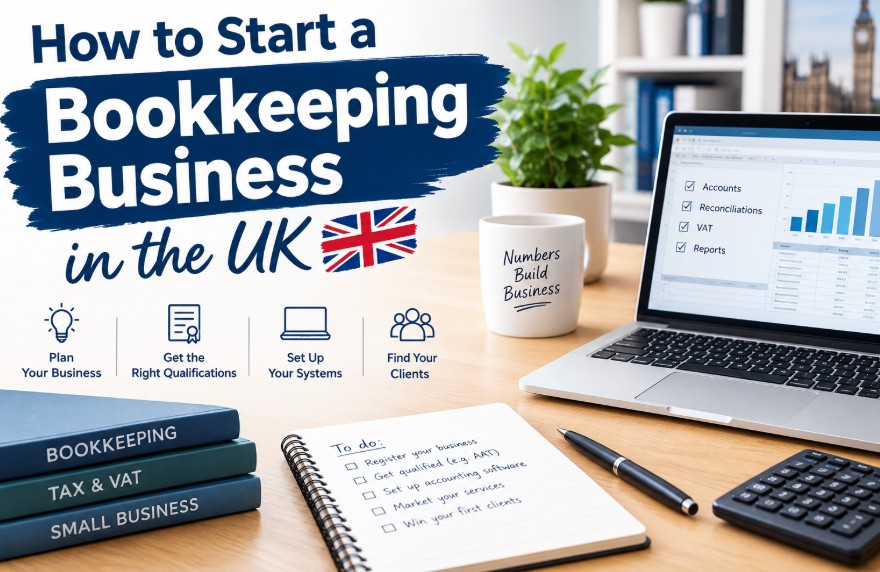
How to Start a Bookkeeping Business in the UK: A Step-by-Step Guide
A bookkeeping business is a UK client-facing financial service that records, reconciles and reports transactions for other companies, distinguished from full accountancy by requiring no formal qualification yet demanding mandatory anti-money laundering registration.
Anyone looking to start a bookkeeping business in the 2026/27 tax year must register for AML supervision before taking on clients.
Key Takeaways
- No formal qualification is legally needed, but AML registration with HMRC costs £300 plus £400 a year.
- Start-up costs for a UK bookkeeping business range from £2,000 to £15,000, covering software, insurance and marketing.
- Self-employed bookkeepers in the UK typically charge £20 to £50 an hour, rising with experience.
How to Start a Bookkeeping Business in the UK?
Starting a bookkeeping business in the UK requires a clear, step-by-step roadmap that balances legal compliance with practical setup. Because no formal licence is needed to operate, the focus shifts entirely to meeting regulatory requirements and setting up efficient client workflows.
-
Secure Legal Compliance: Register for Anti-Money Laundering (AML) supervision with HMRC or a professional body before taking on your first client.
-
Choose Your Structure: Decide whether to operate as a sole trader for simplicity or set up a limited company through Companies House for liability protection.
-
Set Up Protections and Software: Secure professional indemnity insurance, register with the ICO for data protection, and select Making Tax Digital (MTD)-compliant cloud software.
-
Define Pricing and Acquisition: Establish competitive hourly rates or monthly retainers, and leverage your network, local networking, and a Google Business Profile to win your first clients.

Do You Need a Licence to Be a Bookkeeper in the UK?
No licence is required to work as a bookkeeper in the UK, but anti-money laundering registration is mandatory before taking on clients.
Bookkeeping is not a regulated profession under the Financial Conduct Authority (FCA), so no permit or licence application exists for it.
This differs from services the FCA does license, such as consumer credit or investment advice. The real legal gate sits with the Money Laundering Regulations 2017, which classify bookkeepers as accountancy service providers.
Voluntary credentials from the Association of Accounting Technicians (AAT) or the International Association of Bookkeepers (IAB) build client trust and cover skills like VAT returns and bank reconciliation, but no qualifications are legally needed to start.
How to Register for Anti-Money Laundering (AML) Supervision?
You must register for AML supervision with HMRC or a recognised professional body before you take on your first client.
- Decide who supervises you: HMRC directly, or a recognised professional body such as the ICB if you’re already a member.
- Apply and pay the current fees: a £300 one-off application fee plus a £400 annual premises registration fee, as set out under the Money Laundering Regulations 2017.
- Wait for HMRC or your professional body to approve your registration before trading, processing can take several weeks, so apply early.
- Build in ongoing compliance: client identity checks, a written AML policy, and refresher training.
Once registration is underway, the next decision is how to structure the business itself.
Sole Trader or Limited Company: Which Structure Suits a Bookkeeping Business?
Most bookkeepers start as sole traders, but a limited company suits those wanting liability protection or a more corporate client image.
| Factor | Sole Trader | Limited Company |
|---|---|---|
| Setup speed | Same day, online with HMRC | 1–2 days via Companies House |
| Liability | Personal, unlimited | Limited to company assets |
| Annual filing | Self-assessment tax return only | Annual accounts, Corporation Tax return, confirmation statement |
| Perceived professionalism | Adequate for most small clients | Often preferred by larger business clients |
Whichever structure is chosen, registration itself takes only a few minutes online.
How to Register Your Bookkeeping Business with HMRC?
You register as a sole trader directly with HMRC, or complete company formation through Companies House first.
- Register for self-assessment on the gov.uk website if trading as a sole trader, do this as soon as you start working, not after your first invoice.
- Complete company formation through Companies House if setting up a limited company, then register separately for Corporation Tax with HMRC.
- Open a dedicated business bank account so your own bookkeeping stays clean from day one.
- Register for VAT if turnover crosses the current threshold; VAT-registered businesses must already use Making Tax Digital (MTD) software to file returns.

Managing Software Compliance Under Making Tax Digital
Bookkeepers must navigate two separate Making Tax Digital (MTD) frameworks when managing client accounts:
-
MTD for VAT: Mandatory for all VAT-registered businesses (currently set at an £85,000 or £90,000 taxable turnover threshold depending on current rules), requiring automated digital record-keeping and compatible software links.
- MTD for Income Tax Self Assessment (ITSA): Rolling out progressively, affecting sole traders and landlords with qualifying income above £50,000 starting in April 2026, with lower thresholds scheduled for subsequent years.
Ensuring that every client setup utilises HMRC-compatible cloud software from day one protects practice workflows and avoids manual data transfer penalties. Once registration is sorted, insurance provides the next practical safeguard.
What Insurance Does a Bookkeeping Business Need?
Professional indemnity insurance is the one policy every bookkeeping business should carry, even though it isn’t a strict licence requirement.
- Professional indemnity insurance: covers client financial loss caused by an error in the accounts; often required for professional body practice licences.
- Alongside professional indemnity insurance: issuing a formal client engagement letter before starting any work establishes clear scope, protects against scope creep, and sets agreed-upon fee structures.
- Public liability insurance: recommended if clients visit your premises or you visit theirs.
- Cyber liability insurance: worth considering given the volume of sensitive financial data handled daily.
- Employers’ liability insurance: legally required the moment a bookkeeping business takes on any staff.
Insurance premiums are modest, and they sit inside the wider start-up budget covered next.
How Much Does It Cost to Start a Bookkeeping Business?
Start-up costs for a UK bookkeeping business typically range from £2,000 to £15,000, depending on qualifications, software and marketing choices.
AML registration accounts for £300 upfront plus £400 a year if registering directly with HMRC. Data protection registration with the Information Commissioner’s Office (ICO) starts at £52 a year for micro-organisations processing personal data.
Cloud accounting software subscriptions typically run £40 to £200 a month, and a basic professional website costs £500 to £2,000. Professional indemnity insurance for a new bookkeeping business usually adds a few hundred pounds a year on top of these costs.
Starting a bookkeeping business from home in the UK typically costs £2,000 to £15,000 in total, split across AML registration, ICO data protection registration, cloud software subscriptions and a basic website.
Qualifications, if pursued, add several hundred to several thousand pounds depending on the level chosen. Pricing sits alongside start-up costs as the other half of the financial equation.
What Should You Charge as a Self-Employed Bookkeeper?
Self-employed bookkeeper hourly rates in the UK typically run £20 to £50, with rates rising alongside experience and specialism.
New bookkeepers often start at £20–£25 an hour, while experienced specialists charge £40–£50 or more.
Monthly retainers for ongoing clients typically range from £250 to £400. How much a self-employed bookkeeper can earn overall depends on client volume and niche as much as the hourly figure itself.
Choose a fixed monthly retainer for predictable income, or value-based pricing if advisory work sits alongside core bookkeeping, either way, price in software costs, insurance, and unpaid admin time, not just billable hours.
Getting the pricing model right matters most with the clients most likely to test it.
Avoid the Friends-and-Family Pricing Trap When You Start Out
Taking on friends or family as early clients is a common early mistake that creates pricing and boundary problems later.
Practitioner discussion on the accounting forum AccountingWeb repeatedly raises this exact risk: personal clients are harder to invoice on time, harder to raise fees with later, and harder to say no to when scope creeps beyond the original agreement.
The same discussion notes that bookkeeping rarely sells well as a fully standalone service, many practitioners end up bundling it with payroll or wider compliance work, because clients increasingly want one point of contact rather than several separate suppliers.
The same forum discussion also challenges a common assumption: one practitioner reported spending only 30–40% of working hours on data entry, with the rest going to client communication and advisory value rather than pure bookkeeping tasks.
How to Find Your First Bookkeeping Clients?
Most first clients come from an existing network, followed by local networking and a clear, searchable online presence.
-
Leverage Your Existing Network: Former colleagues, local business contacts, and professional acquaintances convert the fastest into early paying clients.
-
Establish a Local Online Presence: Set up a verified Google Business Profile and a clean landing page so local searches for a bookkeeper in your area convert active buyer intent.
-
Engage in Local Networking: Join regional business chambers, BNI chapters, and small business groups to meet directors face-to-face.
-
Target a Specific Industry Niche: Focus on high-demand verticals like construction (CIS scheme) or hospitality, since specialist bookkeepers earn word-of-mouth referrals significantly faster than generalists.
Many bookkeeping businesses start from home before ever needing office space, keeping this whole launch process lower-risk than it first appears.

Conclusion
Starting a bookkeeping business in the UK is achievable without formal qualifications, but AML registration, the right business structure and clear pricing are non-negotiable from day one.
Costs stay modest compared with many professional services, and demand keeps growing as small businesses outsource more of their finances. Get the compliance basics right first, and the commercial side follows.
Disclaimer: This guide is for informational purposes only and does not constitute formal financial, tax, or legal advice. Regulations, fees, and thresholds change over time. Always confirm current requirements directly with HMRC, Companies House, or a qualified professional before starting your business.
FAQs
How much do bookkeepers charge clients in the UK?
UK bookkeepers typically charge £20 to £50 an hour, or £250 to £400 a month on retainer. Rates depend on experience, niche, and whether services are bundled with payroll or VAT work.
Is bookkeeping in demand in the UK?
Yes, demand remains strong. Many people start a bookkeeping business because the UK’s millions of small firms increasingly outsource day-to-day financial admin rather than hire in-house.
Do bookkeepers need to register with the ICO?
Yes, if they process personal data, which almost all bookkeepers do. Registration with the Information Commissioner’s Office starts at £52 a year and is separate from AML supervision.
Is AI replacing bookkeepers?
No, not entirely. AI speeds up data entry and reconciliation, but clients still value a bookkeeper’s judgement, compliance knowledge and direct communication.